
The Matter of Dominance: Active and Passive Submission in Dogs
Content
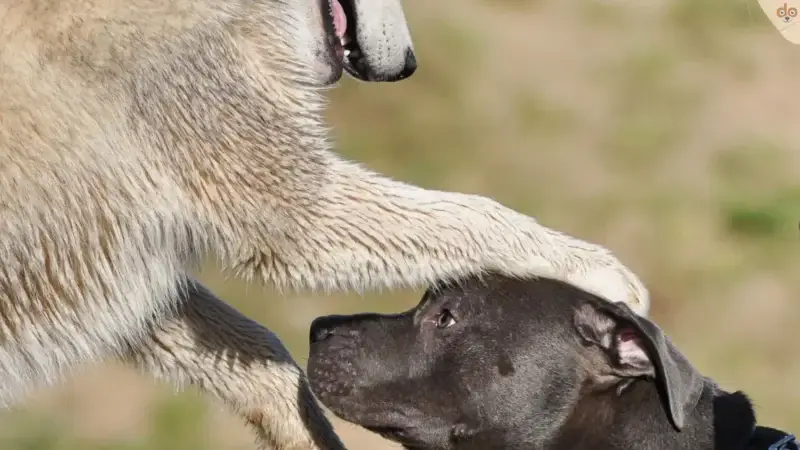
Dogs send signals of submission, also known as appeasement behaviour in technical terms. This behaviour manifests itself in two different forms: active or passive. The difference lies in the body posture, the motivation, and the stress level of the dog.
Active Submission in Dogs
In active submission, the dog is still in an acting posture. The body posture is slightly crouched, with the head usually tilted downwards and ears pinned back. At the same time, however, the dog sends clear signals of contact initiation: it nudges with its snout and wags its tail. Dogs learn this behaviour already as puppies. They nudge their mother on the snout so that she gives them pre-chewed food. Many adult dogs retain these body signals for life.
Passive Submission in Dogs
Passive submission is more clearly visible. The dog assumes an almost motionless posture, often lying on the ground or on its back. In contrast to the active form, it avoids any contact initiation. Many dogs avert their gaze or close their eyes. Typical signals are body rigidity and a tucked tail.
The Psychology Behind Active and Passive Submission
Dogs that submit actively or passively communicate with conspecifics as well as with humans through this. Active submission is usually driven by a friendly disposition. The dog seeks social interaction and signals that it has no harmful intentions. However, this behaviour often also stems from uncertainty: the dog cannot assess its counterpart and tries to defuse the situation. Among dogs, submission also signals position in the hierarchy; the submissive dog shows that it poses no danger. Passive submission, on the other hand, is a sign of great fear. A dog that throws itself onto its back voluntarily and falls into a kind of tonic immobility cannot control the situation. It tries to get through it with as little damage as possible. Some dogs even inadvertently urinate during this.
Understanding Body Language and Providing Security
Some dogs never shed the submissive behaviour from puppyhood, while in others it becomes excessively pronounced. These dogs are particularly insecure when dealing with conspecifics, strangers, or unfamiliar situations. Both active and passive submission mean high stress and a lack of trust at these moments. No direct intervention should take place in cases of excessively submissive behaviour. A shy dog needs security above all. Unwanted contact initiation should never be forced. The owner functions best as a safety factor: as soon as the dog shows signs of submission in stressful situations, distraction helps. The owner remains calm and composed themselves. Often it is sufficient to remove oneself with the dog from the danger zone; on a walk, this simply means continuing to walk. Occasionally one sees dubious practices in which owners force particularly dominant dogs into passive submission. Such behaviour damages the bond between dog and owner. Dogs do not learn trust this way, but rather lose all sense of security.