
Hobby Dogging: Walking with a lead, but without a dog – The idea behind the seemingly pointless trend
Content
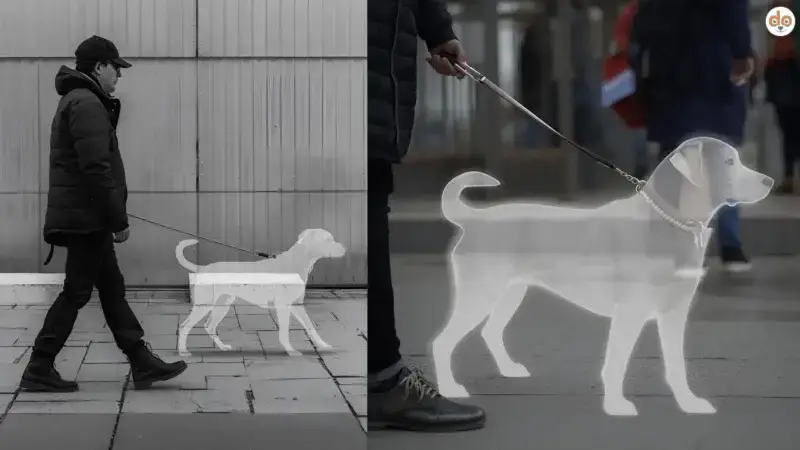
Lead in hand, no dog in sight – and yet someone is strolling through the park relaxed. That is exactly what hobby dogging is. People take a lead on their walk, even though nothing is attached to it. Sounds absurd? Many thought so too. Nevertheless, the phenomenon is currently circulating through the dog world and causing heated discussions – from genuine curiosity to open mockery.
Origin of hobby dogging
The idea comes from a dog trainer. No elaborate concept, no marketing campaign – simply a spontaneous inspiration that suddenly went viral. What was intended as a humorous action apparently struck a nerve in the dog community.
The thought behind it was concrete: Why not experience walking on a lead from a purely human perspective – without a dog, without the pressure of the real animal, without distraction? Many behavioural problems on the lead do not arise in the animal, but on the human side: incorrect body language, unclear signals, unconscious tension in the arm or upper body.
With an empty lead in hand, you suddenly notice things that would otherwise get lost in the hustle of a real walk: How tightly am I gripping? How do I walk when no one is pulling? What tone do I actually use when I speak? Those who work through this first without a dog can lead more confidently afterwards – that is the thesis.
Mockery and criticism online
Barely any dog trend has triggered so many reactions in recent weeks as this one. Comments are piling up on social media – and the majority of them are not friendly. Under the corresponding videos, you can find classics such as: “Now it’s finally happened, the world is going mad!” or “Some people really have too much free time.”
Laughing emojis, ironic memes, head-shaking on repeat. Particularly in dog groups, amusement mixes with genuine incomprehension. The fact that someone voluntarily goes for a walk without having a dog along seems simply grotesque to many.
However, this reaction also reveals something about us: New ideas are often laughed off before anyone has even briefly considered what they are actually about. Especially in the area of dog training, where convictions are often deeply rooted and emotions flare up quickly, unconventional approaches almost reflexively meet with resistance.
Nevertheless, a second look is worthwhile – a genuine one, not a benevolent-reconciling one.
The idea behind Hobby Dogging: When the human is trained
There is more to Hobby Dogging than just a quirky social media idea. The trainer who started the trend follows a clear line of thought: Most lead problems do not arise from the dog, but from the human end of the lead.
If a dog pulls, stops, or becomes nervous, it is often due to our own body language – unconscious tension, unclear signals. Anyone who has ever been out with an excited dog knows this from personal experience: your own mood transfers to the animal, sometimes faster than you can react.
This is where the concept comes in. Without a dog on the lead, you can focus entirely on yourself – posture, breathing, rhythm when walking, vocal pitch. How does the lead feel in your hand when you consciously keep it loose? How do I react when “my imaginary dog” suddenly stops?
This type of dry run helps to recognise automatisms before they become a problem in real training. Sometimes a changed posture, a slightly more relaxed step is enough – and the dog walks noticeably more calmly beside you on the next walk.
The goal is therefore not to walk an invisible dog. It is about training your own behaviour – at a distance, without time pressure, without the dog as an unwilling mirror.
Dry runs in dog training are established
Even though Hobby Dogging may make you smile at first glance – the idea behind it is by no means new in dog training. Experienced trainers have relied on dry runs for a long time, long before the dog even comes into play.
In seminars and one-to-one coaching, people practise correct lead handling, timing in clicker training or their body language in certain situations – initially without any animal partner. The reason is simple: When the dog is present, many are automatically tense or react to the animal rather than to themselves. Without a dog, movement sequences and signals can be perceived and corrected much more consciously.
Hobby Dogging taps into exactly this effect – just with a portion of humour and a low barrier to entry. It invites you to observe yourself and take responsibility for your own behaviour. Because anyone who becomes aware of their impact on the dog can also lead them more clearly.
The trend is therefore less a joke and more a playful training idea with a solid background.
Gag or learning effect?
Whether you laugh about it or become curious – Hobby Dogging shows how close fun and concrete benefit can sometimes be. What began as a quirky internet trend turns out, on closer inspection, to be a food for thought with a genuine training effect. Anyone who takes the lead in hand once without a dog will surprisingly quickly notice how much depends on their own behaviour – and how rarely they even notice this in everyday life.
Naturally, a walk with an empty lead does not replace real training. But it can break routines and sharpen the focus on your own communication.
Whether you participate or not – that is ultimately irrelevant. What remains is the question: How much of what hangs on the dog actually hangs on me?