
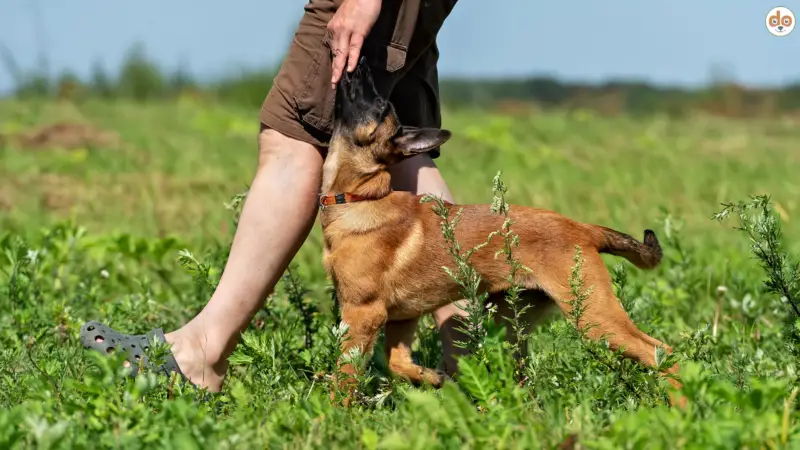
The development of puppies: What happens biologically?
A puppy is not yet emotionally mature at handover in week 8. Its brain develops rapidly until week 16 (rule of thumb: brain development is largely complete by around 20 weeks). The puppy learns who it is, whom it can trust, and how the world works. Early experiences shape it for life. A puppy that you frighten in week 10 carries this fear with it, even if you become friendly later.
The two fear periods
First fear phase: 8–10 weeks
The new puppy comes home and sometimes shows fear of everyday things: vacuum cleaner, car, loud voice. This is normal and biologically sensible. It is away from its mother and testing what is safe. The fear itself is not the problem; your reaction to it can become one. Whoever comforts the puppy excessively («Oh, poor creature») conveys that the fear is justified. Better: remain calm and wait until the puppy realises on its own that the noise is harmless. After seconds or minutes, it calms down, then react in a friendly manner.
Second fear phase: 6–14 months
A second, often milder fear phase occurs sometime between month 6 and 14. The puppy was previously brave, now suddenly fearful again. This is adolescent fear: the brain continues to mature, and previously familiar stimuli are reassessed. Here too, patience is the answer, no building up of pressure, no punishment.
The socialisation window: week 8 to 12 is critical
The socialisation phase lasts from week 8 to approximately week 12–14. The puppy learns that people, other dogs, cats, noise, cars and different environments are normal. Puppies with little contact in this phase develop fear of everyday things; this cannot be easily corrected later. Important: socialisation does not mean «meeting all dogs», but rather calm, positive contacts with various stimuli. A chaotic dog park with 20 dogs is not socialisation. That is overwhelming.
What your puppy should learn in weeks 8–16
Social skills (not obedience)
The puppy should get to know other dogs in a calm environment, meet people of different age groups, be relaxed around children and understand that human contact is neither wild nor painful. Rough play with humans, biting the ear, pulling on clothes, is gently stopped, not through punishment but by ignoring or ending the game.
Environmental habituation
The puppy should get to know different floors (tiles, wood, grass, gravel), hear different noises (traffic, construction site, music from a distance, fireworks from far away), walk up and down stairs and experience different crowds of people (street market, market, busy street). All this in small doses, increasing slowly, never too intense.
First signals, not obedience
Training in the classical sense, repeated commands, is not yet sensible. The puppy should learn that «Here» means: «Come to me, this is pleasant.» You achieve this through positive associations, not through commands. «Sit» can be trained mechanically (gently push bottom down, treat, praise), but not as a strict command. The focus is on relationship and trust, not on control.
Common mistakes and how you avoid them
Mistake 1: Training too hard too early
Puppies that are punished in the first weeks, by shouting, clapping hands, yelling «No!», develop fear of the owner. Later they become insecure or fear-aggressive, not because they are «malicious», but because their emotional basis has been damaged. Reward-based training is not «too soft»; it is neurobiologically correct.
Mistake 2: Too little socialisation
A puppy that stays in the house for the first 14 weeks because «the vaccination protection is not yet complete» later develops fear of the world. Cautious outings with known, healthy dogs are correct. The infection risk is lower than the risk of lifelong fear.
Mistake 3: Unclear boundaries
The puppy must learn what is allowed and what is not, through consistency, not through punishment. If the puppy bites your hand, the game ends calmly (no reaction that excites it). This teaches it: biting = game ends. Consistency is more important than punishment.
Frequently asked questions about puppy training
When should my puppy attend a puppy class?
From week 8–9, when the puppy is with you. A good course focuses on play and socialisation, not on obedience drill. The courses should work with puppies under 20 weeks, in small groups (maximum 5–6 puppies) of similar developmental stage. The trainer must be certified and use positive reinforcement.
Can I hit my puppy if it does something wrong?
No. Aversive methods, hitting, shouting, leash jerks, create fear and stress in puppies that burns itself permanently into the brain. According to current research findings, dogs raised with punishment show more stress signals and less reliable behaviour than reward-based trained dogs. The animal welfare perspective is clear: punishment-based training for puppies is irresponsible.
How long should a training session last?
Maximum 5–10 minutes per session, several times a day. The puppy has a short concentration span. A long, exhausting session frustrates it. Short, positive sessions are more effective and make the puppy enjoy it even more.
When can I start structured training?
At 4–6 months, when the puppy is emotionally more stable and can concentrate for longer. At 16 weeks, you lay the foundation: relationship, trust, enjoyment of learning. Structured obedience training with multi-week sequences follows later. Do not try to train a 12-week-old puppy like an adult dog; this is neurobiologically impossible.