
Child-Friendly Dog Training: Commands and Exercises for Children
Child-friendly dog training must be adapted to the age. Children aged 3–6 train a maximum of two commands; schoolchildren can safely take on five basic commands.
Content
Your four-year-old son finally wants to give commands himself. Your ten-year-old daughter dreams of teaching tricks to the family dog. Both wishes are justified, but the approach must be completely different.
In child-friendly dog training, it is not just about cute moments. It is about safety, age-appropriate responsibility and building a stable relationship between child and dog. The correct procedure depends heavily on the child’s age.
Which commands can children aged 3–6 safely train?
Small children should master a maximum of two simple commands: “Sit” and “Shake”. These two are completely sufficient and do not overwhelm either child or dog.
The sit command works best with small children using a clear hand movement from bottom to top. The child says “Sit” and raises the hand with the treat above the dog’s head. The dog follows the treat with its gaze and automatically sits down.
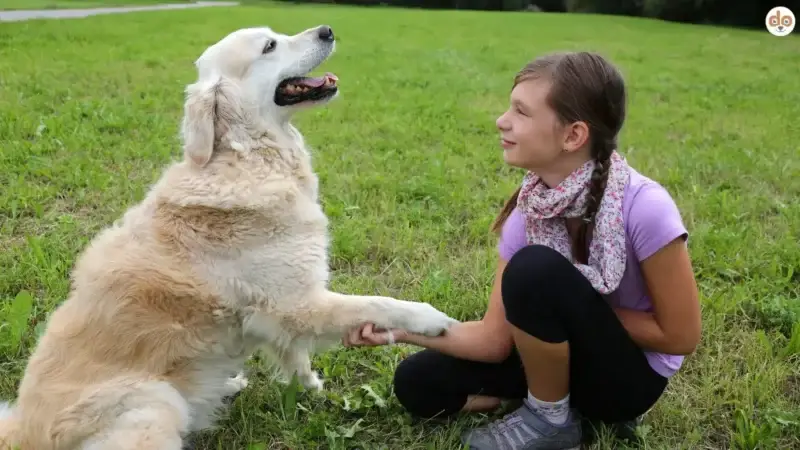
Three-year-old children train “Shake” most safely while sitting on the floor. This way they are at eye level with the dog and cannot be knocked over. The child extends their flat hand and says “Paw”; nothing more is needed.
Other commands such as “Down” or “Come” are unsuitable for this age group. Small children cannot yet read the dog’s body language and would not react correctly in case of problems.
What can children aged 7–12 take on during dog training?
Schoolchildren can take on significantly more responsibility. They already understand when a dog is stressed or needs a break. This age group can safely train five basic commands.
In addition to “Sit” and “Shake”, “Down”, “Stay” and “Come” are added. You practise the Down command best by slowly leading the treat from the dog’s head towards the ground. The dog follows the movement and lies down.
An adult must be present during “Come” training. The child only calls the dog from a short distance, a maximum of five metres. At greater distances, there is a risk that the dog will not react and the child loses control.
Trick commands like “Spin” or “Speak” are pure playthings. They are fun, but have no training value. Children of this age group can train them, but should understand: these are extras, not basics.
Which games strengthen the bond between child and dog?
Playing hide-and-seek works excellently from school age onwards. The child hides in the house, an adult holds the dog and lets it search on command. Important rule: The dog may only find the child by sniffing, not by jumping up.
Treat hide-and-seek is suitable even for toddlers. They hide three to four treats in the living room while the dog waits outside. Then they lead it on a leash through the room and let it search. The child learns to lead the dog calmly.
An obstacle course made of cushions and blankets excites both age groups. But: The child always leads the dog on a leash through the course. Free running is too dangerous because the dog could knock over the child.
Quiet phases are just as valuable as active games. Children can learn to simply sit next to the dog and stroke it calmly. These moments build trust and show the child: a dog does not need to be kept busy permanently.
How do I recognise when training becomes too dangerous?
Certain warning signs mean: stop training immediately. If the dog opens its mouth and pants, even though it is not warm, it is stressed. If it turns away or lays its ears back, it needs a break.
Growling is a clear stop signal, even if it is only quiet. Many children find growling funny and continue. That is a mistake. Growling means: the dog is warning. Anyone who ignores this warning risks a snap.
There are also limits on the child’s side. A tired or whining child should not train. It becomes impatient, makes mistakes and overloads the dog. Better: short training sessions of a maximum of ten minutes.
The one-adult rule always applies: as soon as a child trains with the dog, an adult must be in the same room. Not in the next room, not in the garden, in the same room, with a view of the child and the dog.
Treats must never be fed directly from the child’s hand if the dog is excited. The child places the treat on the ground or gives it to the adult. Excited dogs snap faster and can accidentally bite children’s fingers.