
Understanding pack hierarchy in dogs – and why clarity is not achieved through dominance
Content
Many people believe that dogs need a clearly defined «boss» over them – and this boss must be unambiguously number one. The image of the pack leader runs deep. Too deep, if one is honest. Meanwhile, research has long abandoned this model. What really lies behind the pack hierarchy myth, why dominance attempts often have the opposite effect – and how you can give your dog genuine orientation without resorting to harshness.
Myth vs science: The history of the pack leader theory
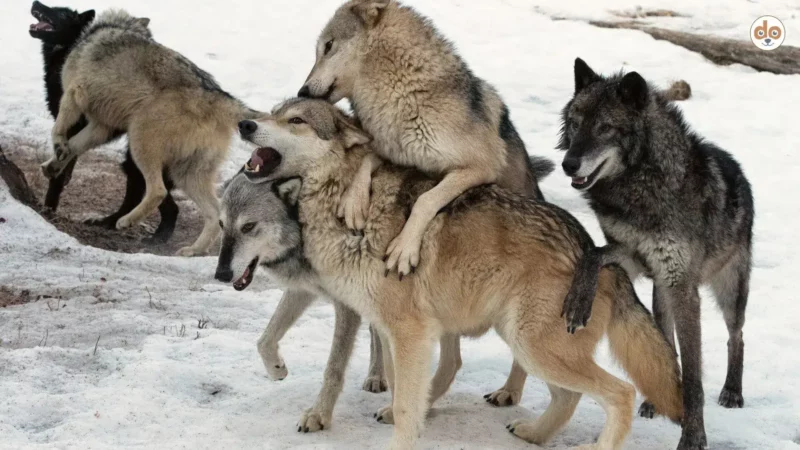
The so-called pack leader theory goes back to studies on wolf packs from the 1940s to the 1970s. The researchers at the time observed wolves in captivity – and interpreted their behaviour as a rigid hierarchy with an «alpha wolf» in command at the top.
This idea quickly migrated to domestic dogs. Accordingly, dogs were thought to need a pack hierarchy system – and humans had to consistently play the alpha role. It sounded logical. But it was not.
Later field studies on wild wolf packs paint a completely different picture: wolves function more like family units. Parents lead their offspring, rigid power struggles among adult animals are the exception, not the rule. The alpha concept simply arose because stressed, randomly assembled animals were observed in captivity.
For dogs, this means: fixed hierarchies are not their thing. Their social behaviour adapts to the situation – and to the other party.
How dogs really interact: A modern look at social behaviour
Dogs communicate through body language, facial expressions, scent and tone of voice – simultaneously, in real time, constantly. No rigid dominance hierarchy controls this. It is dynamic. Social structures depend on the individual relationship, the specific situation and the personalities involved – sometimes from moment to moment.
What dogs really seek is not submission. They seek security and clear orientation. They want to know what is expected of them. Routines give them stability – not because they have to “obey”, but because predictability is relaxing.
In everyday life, this becomes clearly apparent: A dog follows a person who acts calmly, consistently and understandably – much more willingly than someone who “marks the boss” with strictness or intimidation. Dogs follow voluntarily. Out of trust, not out of fear.
Clarity arises through communication – not through dominance.
The risks of hierarchy and dominance theory
Anyone who tries to “make clear” the hierarchy to a dog through harshness risks quite a bit. Many dogs react to such methods with stress, withdrawal – or aggression. Not out of malice. But because they feel threatened.
Harsh punishments, physical dominance, intimidation – this can have a lasting negative impact on a dog’s behaviour. Some animals become quiet and insecure, showing defensive aggression. Others escalate. Both are dangerous, both are avoidable.
For the human-dog relationship, the damage is often harder to repair than one might think: trust breaks silently. And a dog that has lost trust is harder to handle than one that was never put in this situation. In addition: dominance methods are difficult to apply correctly – even experienced people inadvertently trigger new problems with them.
There are better ways. Ways based on understanding, respect and clear communication.
How to give your dog clarity – without “playing the strong one”
Leadership does not mean dominating. It means being reliable. Your dog should be able to orient themselves by you – and this works best when they do so voluntarily. No intimidation needed. No power play.
Consistency has nothing to do with harshness
Consistency means: You behave reliably and transparently. Like this today, exactly the same tomorrow. If you tell your dog “Off the sofa!” but then let them back on in the evening, that confuses you from their perspective – not them. They simply learn that the rule is negotiable.
Dogs feel safe when they understand what applies. This only works if rules are consistent. And: The rules must be fair, fit into everyday life and be handled equally by all key people. A rule that only you enforce is not a rule – it is a quirk of yours.
More on this: Being consistent in dog training – what it really means
Communication: using body language consciously
Dogs read us. Constantly. Our posture, our pace, our tension – all of this reaches them before we have even said a word. That is why your body signals should match what you want at the moment.
Should your dog wait? Stand upright, show a calm palm, remain still yourself. A clear signal. Nervous movements or an excited tone of voice send contradictory messages – and your dog will choose the image over the word in case of doubt.
Voice also counts: Calm, firm commands have an effect. Loud scolding or hectic repetition hardly does. Communication for dogs is always the complete package.
Positive reinforcement instead of punishment
Praise is more powerful than punishment – if it comes at the right moment. Dogs learn fastest when desired behaviour is rewarded directly. This can be a treat, a word of praise, a short game or a stroke – depending on what really motivates your dog.
The immediacy is decisive: The reward must follow the behaviour directly so that your dog makes the connection. This way you build up desired behaviour – without pressure, without intimidation.
And if something doesn’t work out? Instead of scolding, a brief interruption, redirection or simply ignoring often helps – these are effective methods that work without violence. Sometimes the best reaction is no big reaction at all.
Routines and structure create security
Dogs like rituals. Not because they are boring, but because predictability is relaxing. Fixed feeding times, regular walks, clear rest phases – all this gives your dog a framework within which they can find their way.
Even small sequences within activities help: Sit before the leash comes on. Wait before going through the door. Such mini-routines have a calming effect – and they strengthen trust in your leadership, because your dog notices: This person is predictable.
Setting boundaries without harshness
Setting boundaries does not mean acting authoritatively. It means showing your dog clearly: Up to here – and no further. This can be done friendly and firm at the same time.
Does your dog jump on you or guests? Turn away, remain calm, allow contact again only when all four paws are on the ground. No shoving, no scolding – a clear reaction is enough. Or: If your dog crowds you during feeding, simply let them wait until you give the signal. They learn self-control – through consistency, not through punishment.
Leadership takes time: patience and understanding
No dog is “finished” overnight. That is not the goal either. It is not about perfection, but about your dog feeling understood, safe and secure.
Leadership means giving it time. Time to understand new rules. Time to build trust. This requires patience – but it pays off. A dog that feels taken seriously cooperates voluntarily, rather than constantly resorting to confrontation.
Mistakes are part of the process – on both sides. What matters is not being error-free, but how you handle them: with love, calmness, and without drama. Your dog learns every day. So do you.