
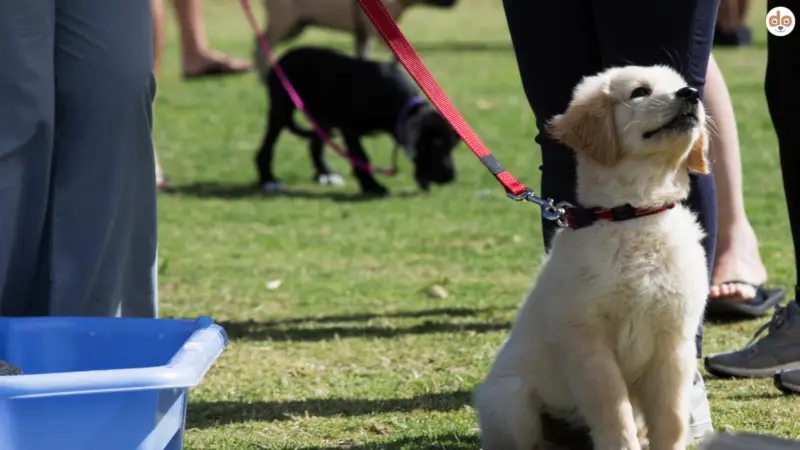
Why a puppy course is important – and what it actually achieves
A puppy course does not turn your puppy into an obedient robot. That is not the point. It is about socialisation with puppies of the same age, basic training without pressure – and about you as the owner learning how your dog works. What it is telling you right now. Which mistakes you can still easily correct now, which will be much harder to resolve later. Puppies from good courses are more confident, less prone to anxiety and easier to train later on. Not because they have “learned” so much, but because the emotional basis is right.
What makes a good puppy school?
Small groups with similar ages
The ideal group size is 4–6 puppies, not 15. And all should be approximately the same age – a maximum difference of two weeks. A 16-week-old puppy in a group with 8-week-old dogs will quickly become overwhelmed, react too wildly or withdraw fearfully. Small groups allow the trainer to keep an eye on each individual puppy – and to recognise in time if someone is showing signs of fear.
Focus on play and socialisation, not obedience
You do not recognise a good puppy school by the little ones sitting nicely or coming when called. Good schools let puppies play: wild, chaotic, loud – just as it should be. They show you as the owner how to gently guide this wild activity without suppressing it. Obedience drill is simply not effective in this phase. This must be stated clearly.
Positive reinforcement and tolerance of errors
Good training works with treats, praise and toys. No leash jerking, no shouting, no punishments. Mistakes are learning opportunities, not reasons for corrections. A trainer who “corrects” aggressive or overly reserved puppies with pressure harms their emotional development – regardless of how they justify it.
Instruction for the owners – not just for the puppies
One of the most common mistakes: The school trains the puppy, but not you. The best puppy school teaches you how to train yourself. Time is needed for questions, for explanations. Why does this puppy not sit? Because as the owner you were a fraction too late with the treat. A good trainer shows you that – calmly, concretely, without reproach.
Age-appropriate requirements (maximum under 20 weeks)
Puppy courses are for dogs under 20 weeks. After this limit, the intensive socialisation phase ends. A course with dogs over 20 weeks is no longer a puppy course, but an adolescent dog course – with different requirements and significantly higher physical and mental resilience.
Trainer certifications: VDH, ÖKV, SKG
VDH (Germany)
The VDH (Verband für das Deutsche Hundewesen) certifies dog trainers with specific requirements and checks them regularly. A VDH recognition is not a guarantee of quality, but it is a serious indicator. You can look up the trainer’s name on vdh.de or the website of the local association.
ÖKV (Austria)
The ÖKV (Österreichischer Kynologenverband) has comparable standards. The ÖKV trainer training includes theory and practice. An ÖKV-certified trainer has committed to animal welfare-compliant training – aggressive methods are explicitly not permitted there.
SKG (Switzerland)
The SKG (Schweizerische Kynologische Gesellschaft) has its own training standards for puppy and adolescent dog courses. SKG-recommended trainers have undergone certification. The SKG explicitly recommends puppy courses as an integral part of early socialisation.
Without association certificate?
No certificate does not automatically mean poor quality. But a formal review of the methods is then missing. So ask: What training has the trainer received? Do they regularly attend further education? A good trainer can answer these questions without hesitation.
Play vs. Drill – the decisive difference
Good play in a puppy course
Good play looks chaotic. Puppies frolic, wrestle, chase each other, fall down, play with objects. The trainer observes – and intervenes if it gets too wild or a puppy shows fear. Then they are separated, the fearful puppy is calmed down. That is exactly what socialisation is: learning to interact with others. A 10-minute play block is normal training time, not a waste.
Poor drill in a puppy course
“All puppies sit in a row, we are now training ‘sit’ for 20 minutes, no play.” That is not age-appropriate. It destroys the desire to learn and is mentally exhausting rather than beneficial for a puppy. A trainer who mainly does obedience drills with young puppies simply has not understood what really helps this age group.
How to find the right school
Step 1: Search for association-affiliated trainers
Google “puppy course [Your City]” or search directly on the websites of VDH, ÖKV or SKG. Filter by certification status. Make a short list of 2–3 schools near you.
Step 2: Attend a free training session
Good schools offer observation hours. Use that. Go there, look at how the puppies react. Do they seem relaxed and playful – or rather tense? Does the trainer work with praise and treats or with loud shouting and leash jerks? How do they deal with mistakes?
Step 3: Talk to the trainer
A few direct questions help: “What certification do you have?” “How often do we meet, how long do the sessions last?” “How big is the group, are all puppies the same age?” “How much play, how much training?” A good trainer answers patiently and clearly – without making you feel like you are disturbing.
Step 4: Clarify the training philosophy
Ask directly: “Do you use aggressive methods – leash jerks, shock collars?” The answer must be a clear no. Full stop. A good trainer does not need any of these methods to work with puppies.
Step 5: Start with a trial session
Many schools offer a trial training. Bring your puppy and observe them. Are they curious, relaxed, playful? If they seem fearful or react aggressively, that is not a failure – that is information. A good trainer will notice this and respond specifically.
Typical warning signs: These schools are better avoided
The trainer shouts or uses aggressive corrections
That is not acceptable. A good trainer gives calm, clear instructions. If you hear someone shouting aggressive commands or “correcting” a puppy, look for another school.
Large groups with mixed ages
Twenty puppies between 8 and 24 weeks in one group – that is not socialisation, that is chaos. No trainer can keep an eye on everyone.
No play, only drill
A full hour of “sit, down, come” is not age-appropriate. There needs to be a real balance between free play and gentle training.
Trainer is hard to reach or remains vague about their goals
A good trainer takes time for questions – and explains why they do certain exercises. If they seem impatient or evade, that is a clear sign: better keep looking.