
ABC of Emotions in Dogs: Olfactory & Tactile Regulation – and Stabilising the “C” (Reappraisal)
Content
- A – Understanding Triggers and Consciously Shaping Them
- B – Regulate bioreaction & behaviour
- C – Stabilise re-evaluation (the memory moment)
- FAQ – The 10 most frequently asked questions about the ABC of emotions in dogs
- Why do dogs react so strongly to smells?
- Can my dog really smell my stress?
- Do lavender or chamomile really help with calming?
- What do pheromones like Adaptil offer?
- Why does stroking calm dogs so strongly?
- Are pressure vests useful?
- What happens in my dog’s body during stress?
- What does “re-evaluation” (C) mean?
- Why is sleep after training so important?
- What concrete steps can I take in everyday life to stabilise my dog’s emotions?
- Important safety notes
In short: Emotions in dogs can be understood and influenced through three steps: A — the trigger, B — the physical reaction and behaviour, C — how the experience is stored. Those who understand all three can direct reactions purposefully.
The Most Important Things in Brief
- A — consciously shape triggers, also through touch and pressure (tactile).
- B — recognise the bioreaction in the body and regulate it with short protocols.
- C — stabilise the reappraisal so that the experience is stored positively.
- All three steps interlock — viewed individually, the picture remains incomplete.
Dogs feel before we have even noticed that anything has happened. This is not a metaphor; it is neurobiology. That is exactly why it is worth understanding three things: A – what starts a reaction (trigger), B – what then happens in the body and how to direct it, C – how the experience is stored. All three interlock. If you only adjust one, you lose the other two.
A – Understanding Triggers and Consciously Shaping Them
Dogs live in a world of smells – this is no exaggeration, it is simply their primary level of perception. And this also includes what we emit when we are nervous. Studies show that dogs react to human stress and fear odours and adjust their behaviour accordingly. Smells can fuel tension – or create genuine security. This is a huge lever that is mostly completely ignored in everyday life.
Eigengeruch als Anker: Ein getragenes T-Shirt, eine vertraute Decke der Bezugsperson – solche Dinge klingen banal, können aber in fremden oder aufwühlenden Situationen stabilisierend wirken. „Safe Cues” nennt man das. Sie kosten nichts und helfen manchmal verblüffend viel.
Duft-Enrichment: In Tierheimstudien führten Lavendel- und Kamillenduft zu messbarer Ruhe – weniger Aktivität, weniger Lautäusserungen. Das klingt nach Wellness-Magazin, ist aber beobachtete Realität. Trotzdem gilt: immer sparsam dosieren, niemals direkt auf den Hund, Räume regelmässig lüften. Und vor allem: Duft ersetzt kein Training. Er ergänzt es höchstens.
Pheromone: Synthetische Pheromone wie Adaptil kursieren seit Jahren in der Ratgeberliteratur. Die Studienlage ist ehrlich gesagt durchwachsen. Manche Hunde profitieren, bei anderen passiert wenig. Als einzige Massnahme taugen sie nichts – als Teil eines grösseren Plans können sie einen Versuch wert sein.
Tactile – the power of touch and pressure
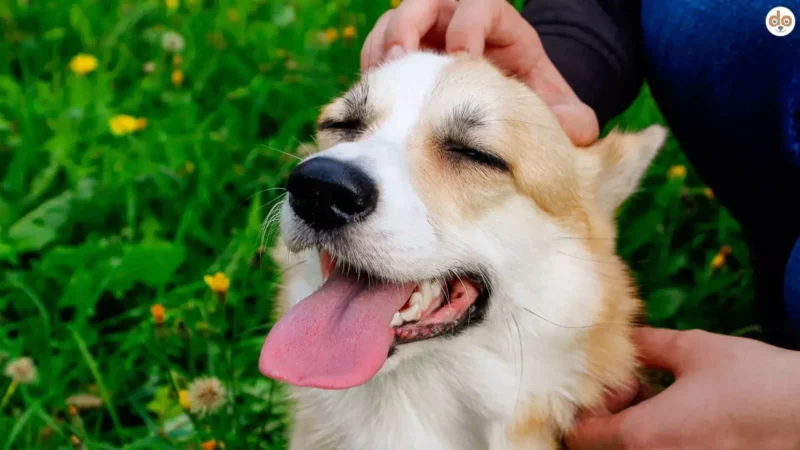
Touch acts directly into the emotional system. Calm stroking combined with eye contact promotes the release of oxytocin and demonstrably lowers stress markers – in dogs and, incidentally, also in humans. What matters here: rhythm and predictability. If you tap hectically or press uncontrollably, you make it worse. It is best to combine this touch with a fixed location – a mat, for example – and a clear signal, so that it becomes a real ritual that conveys security.
Druckwesten: Manche Hunde empfinden sanften Körperdruck als wohltuend. Die wissenschaftliche Datenlage dazu ist allerdings dünn und widersprüchlich. Falls Du eine Druckweste ausprobierst: auf gute Passform achten, den Hund langsam gewöhnen und sie niemals als Ersatz für Training einsetzen, sondern nur als Ergänzung.
A into practice – 5 steps
First, you keep a trigger diary: For 1–2 weeks, note when and why your dog reacts – smells, touches, specific situations. Then you define a safety scent – preferably your own smell, consistently linked with calm moments. Next, you establish a tactile pattern: even, slow stroking strokes, about 30–60 per minute over the chest or shoulder. In parallel, you design the context: non-slip mat, distance from stimuli, a clear retreat area. And finally, you consistently avoid flooding – the stimulus dose must remain so low that your dog is still responsive and can actually learn something.
B – Regulate bioreaction & behaviour
What happens in the body
As soon as a trigger appears, the dog’s body switches to alarm: the sympathetic nervous system and the HPA axis go into action immediately. This manifests as muscle tension, panting, avoidance behaviour or reactive outbursts. The goal in this phase is expressly not to remove the emotion. Emotions cannot be switched off. The goal is to deliberately regulate them – i.e.: the dog remains responsive, arousal remains controllable, alternative behaviours become possible. Calm stroking, gentle eye contact or a familiar ritual can demonstrably influence stress physiology favourably in this process.
Tools for B
Distance & orientation: Give your dog space first – make a wide arc, stand still. As soon as he turns back to you, reward exactly this orienting behaviour. Ritualised calm means: a fixed combination of mat, calm stroking and chewing activity. Only practice in a relaxed environment, then transfer to easier triggers. For noise and environmental fears, think multi-track from the start: desensitisation and counter-conditioning as the basis, adapted management around it – and in acute phases, for example with noise phobia, veterinary support if necessary. Pressure vests can be tested additionally; the scientific evidence is weak, but some dogs benefit. Document effects, keep expectations realistic.
B into practice – micro-protocol (3–5 minutes)
You start with braking: 2–3 steps to the side or at a distance, until your dog seeks eye contact again. Then you anchor: lay out the mat, offer a familiar safety signal – your blanket, a specific scent. Now you regulate: three slow stroking strokes, two deep breaths from you, then a chewing element for the dog. Finally, there is brief practice: 20–60 seconds of nose work, for example a few pieces of food in a snuffle mat. This way, the situation ends calmly – and the dog has worked this out for itself.
C – Stabilise re-evaluation (the memory moment)
Whether your dog files a situation as threatening or as “ended harmlessly” – this is decided in the re-evaluation. If it experiences security, the brain can lay down a new track that dampens fear and stress. Research findings suggest that exactly this process can be actively supported – through consistent “good endings” and the right conditions for memory, i.e. calm and sleep.
The scientific pillars – briefly explained
Inhibitory learning: When encounters with triggers end such that security prevails at the end, a new “safety track” is laid over the old fear track. Variety, small surprises and consistently good endings strengthen this effect – this lowers the risk of relapse and stabilises in the long term.
Retrieval extinction/reconsolidation: Shortly after a memory has been retrieved, it is malleable. If security is deliberately trained in this time window, the memory can be virtually “rewritten”. The results are mixed – but the practical consequence is clear: use mild triggers to offer security experiences directly afterwards.
Sleep & rest: Studies confirm that dogs – just like humans – consolidate learning experiences during sleep. Non-REM sleep with sleep spindles plays a particular role here. Rest after a positive ending is not a luxury, it is a necessary part of learning.
C into practice – the “good ending” protocol (10–20 minutes)
Regarding timing, the rule is: as soon as the trigger has passed or the intensity subsides, immediately initiate the familiar safety ritual. You activate the safety signal: familiar scent, mat, stroking pattern – calm voice, as few commands as possible. A closing cue helps enormously with this: always the same signal, for example a short phrase or sound, followed by a chewing activity or sniffing task. This is followed by the quiet window: 20–60 minutes of pause, no new stimuli, no activities. Only in this silence can the brain actually process what has been experienced. And finally, you vary & generalise: practice the protocol in different contexts – living room, garden, car stationary. Variety makes the safety trace more durable.
Checklist for “stabilising C”
- Did I set a positive end directly after the situation?
- Was the stimulus dose chosen so that my dog remained responsive?
- Was there genuine rest or sleep afterwards?
- Do I also practice the ritual on calm days, so that it works automatically in an emergency?
FAQ – The 10 most frequently asked questions about the ABC of emotions in dogs
Why do dogs react so strongly to smells?
A dog’s sense of smell exceeds ours by many times – this is no exaggeration. Dogs can even sniff out the emotional states of humans, literally smelling fear or joy. Scents therefore act as strong emotional triggers, in both directions.
Can my dog really smell my stress?
Yes. Studies show that dogs react to stress hormones and sweat odours and adjust their behaviour accordingly. This explains why they often become restless when we ourselves are tense – they simply smell it.
Do lavender or chamomile really help with calming?
In animal shelter studies, scent enrichment with lavender or chamomile led to more calmness and less barking. The effect varies individually; it should be used sparingly and never applied directly to the dog.
What do pheromones like Adaptil offer?
Pheromone preparations can help some dogs in certain situations – thunderstorms, New Year’s Eve, vet visits. The scientific evidence is mixed. Useful as a supplementary component, unsuitable as a sole solution.
Why does stroking calm dogs so strongly?
Calm, even stroking releases oxytocin – this promotes bonding and trust while simultaneously lowering stress hormone levels. Crucial is a predictable, gentle rhythm, best embedded in a fixed ritual.
Are pressure vests useful?
Some dogs find them helpful, others don’t care about the vest or find it uncomfortable. Overall, the scientific evidence is weak. Those who use them should gently accustom the dog, carefully check the fit, and always combine the vest with training.
What happens in my dog’s body during stress?
A trigger activates the stress system: heart rate and blood pressure rise, cortisol is released. This becomes visible as panting, muscle tension, avoidance behaviour or reactivity.
What does “re-evaluation” (C) mean?
The re-evaluation determines how a situation is stored – as dangerous or as safe. Through positive rituals at the end, i.e. “good endings”, you can help your dog process experiences in a stable and fear-free manner.
Why is sleep after training so important?
During sleep, the brain consolidates new learning experiences. Studies show that dogs can recall learned material significantly better after non-REM sleep. Rest after positive training is therefore not a bonus, but part of the learning process.
What concrete steps can I take in everyday life to stabilise my dog’s emotions?
Keep a trigger diary, build up a safety signal (scent or touch ritual), always end excitement with a good ending (e.g. chewing activity), plan quiet times – and regularly practice the ritual even on relaxed days, so that it is ingrained when it is really needed.
Important safety notes
Scent substances only subtly, never directly on the dog; ventilate rooms regularly and thoroughly. In case of respiratory problems, cats in the household, puppies or pregnant animals, consult a vet beforehand. Anxiety disorders often require a multimodal approach – training, management and, if necessary, medication, always in consultation with the vet.
Note: This guide does not replace individual veterinary behavioural advice. In case of pronounced fear, stress or health questions, please involve a vet with additional qualifications in behaviour.
- Wilson E. et al. (2022): Dogs can discriminate between human baseline and psychological stress condition odours. PLOS ONE 17(9): e0274143.
- PMC (2025): Not just avoidance: dogs show subtle individual differences in reacting to human fear chemosignals. PMC12477697.
- Wells D.L. (2006): The influence of olfactory stimulation on the behaviour of dogs housed in a rescue shelter. Applied Animal Behaviour Science 91(1–2):1–14.
- Handlin L. et al. (2011): Short-Term Interaction between Dogs and Their Owners: Effects on Oxytocin, Cortisol, Insulin and Heart Rate. Anthrozoos 24(3):301–315.
- Gambino M. et al. (2020): Effects of Stroking on Salivary Oxytocin and Cortisol in Guide Dogs: Preliminary Results. Animals 10(4):708.
- Systematic Review (2024): A Systematic Review of the Efficacy of Compression Wraps as an Anxiolytic in Domesticated Dogs. PMC11639916.
- Pilla R. & Doherr M. (2016): Are Pressure Vests Beneficial at Reducing Stress in Anxious and Fearful Dogs? Veterinary Evidence 1(3).
- Kis A. et al. (2017): The interrelated effect of sleep and learning in dogs (Canis familiaris). Scientific Reports 7:41873.
- Bódizs R. et al. (2005): Sleep in the dog: experience-dependent changes following an emotionally loaded waking episode. Journal of Sleep Research 14(3):285–290.
- Craske M.G. et al. (2014): Maximizing exposure therapy: An inhibitory learning approach. Behaviour Research and Therapy 58:10–23.
- Beerda B. et al. (1998): Behavioural, saliva cortisol and heart rate responses to different types of stimuli in dogs. Applied Animal Behaviour Science 58(3–4):365–381.