
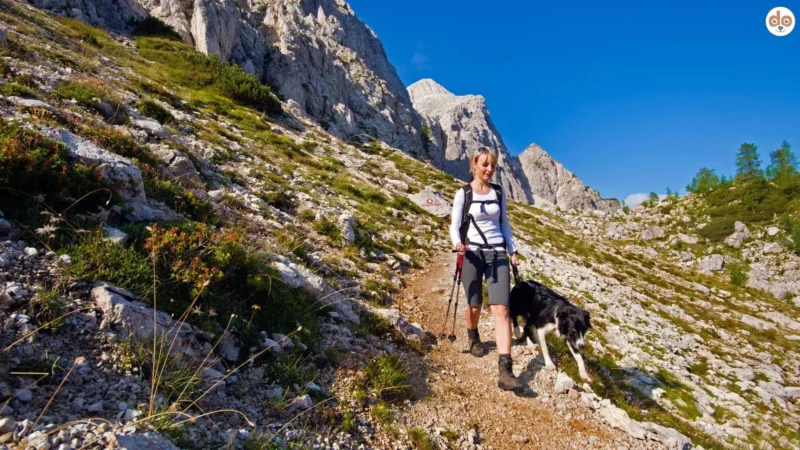
How far can my dog hike? Realistic guidelines
An untrained dog can manage a maximum of 10–15 km in one go, after which it is done. A dog that goes for regular walks with an average level of training can manage 30–50 km, provided the route is not too demanding. A proper hiking dog (Border Collie, pointing dog, Beagle) can run 50–100 km, but only if it has trained for it.
The difference between these figures is not the breed alone, but the level of training. A trained Dachshund runs more reliably than an untrained Golden Retriever. Size plays a role (large dogs tire faster over the same distance because they move more body weight), but less than one might think. More important is that your dog receives regular endurance training.
Conditioning training: How to train endurance
Start by having your dog run a 30-minute route without problems. This is your baseline. Then extend the training by 5–10 minutes per week. After 8 weeks, your dog must be able to run for 90 minutes uninterrupted. From there, increase more slowly, perhaps by 15 minutes every 2 weeks. This way you avoid overtraining and injuries.
Important: Keep the tempo relaxed. Your dog should run, not sprint. A loose trot is ideal: your dog breathes normally, sniffs regularly and looks around. If your dog pants, drools or slows down, take a break. These are signs of overload. A dog that is truly well trained runs at the same pace as you and shows no signs of stress.
Equipment and provisions for long hikes
What the dog needs
- Drinking water: At least 1 litre for every 20 km of hiking. Take short breaks and offer water regularly (not too much at once)
- Leash: 1.5–2 metres in length, no retractable leash on hiking trails (tripping hazard)
- Collar or harness: A harness fits the dog better and is more comfortable for long distances
- Dog boots: For stony, snowy or very hot ground; train beforehand so that the dog tolerates them
- High-visibility vest: Useful for forest hikes (hunting season, other hikers)
- First aid: Bandage, disinfectant spray, tweezers (for ticks), saline solution for eyes
What you should take in your rucksack
- Water bladder or bottle for the dog (portable fabric bowl)
- Small treats (for motivation and energy boost)
- A light blanket or windbreaker (in case your dog shivers after rain/cooling down)
- Poop bags and a small bag (leave forest paths clean)
- Map or GPS app (also for emergencies: look up vet addresses on the go)
- Your mobile phone with a full battery
Safety when hiking: Knowing the dangers
Awns and barbs, underestimated dangers
In summer and early autumn, awns and barbs are a major danger. These sharp-edged plant seeds bore into the paws, between the toes and into the ears. Some even migrate into the eye or nostril. After every hike through grass and grain: check paws thoroughly, look between the toes, check ears. Remove barbs immediately with tweezers; do not simply pull them out, but carefully work them out.
Leash requirement in the forest, knowing the law
In most federal states, Austria and Switzerland, there is a temporary or local leash requirement in forests and nature reserves. This is not a nuisance, but wildlife protection. A free-running dog causes considerable stress to deer, hares and birds, especially during the breeding and fawning season (March to June). Find out beforehand where the leash requirement applies. Some regions have off-leash zones, but these are the exception.
Animal encounters and correct behaviour
If your dog encounters other animals (horses, cows, sheep), your control is crucial. A short leash, calm behaviour and no dog-to-animal contact without the permission of the farmer or animal owner are the rule. Horses can become panicked, cows may kick, sheep get stressed. Keep your distance and let your dog walk on a short leash beside you. If it gets tight: move to the side of the path, sit the dog down, hold the leash.
Paw care after the hike
After every longer hike, you must check the paws thoroughly. Look between the toes for grass remnants, dirt or small stones. If the paws are dirty, rinse them with lukewarm water. Some dogs get sore pads after many hikes. This is a sign that you have built up the pace too quickly or that the route is too demanding. Keep dry and, in doubt, ask the vet.
FAQ: Hiking with dog
How far can my dog hike?
That depends on the level of training. An untrained dog 10–15 km, a normally trained one 30–50 km, a very well-trained one 50–100 km. The first step is always for your dog to run a 30-minute route easily.
What do I take on a long hike?
At least 1 litre of water, leash, first-aid kit, poop bags and your mobile phone. For summer: dog boots or a cooling vest. For autumn: drying towel and possibly a high-visibility vest.
May my dog run off-leash in the forest?
That depends on the region and season. During breeding and nesting seasons (March–June), many areas have a leash requirement. Find out beforehand. The leash requirement is not meant to be restrictive but serves to protect wildlife.
What should I do if my dog has problems during the hike?
Stop immediately, find a shady spot, and offer water. If the dog continues panting, drooling, or limping, you should turn back. Do not push through just because there are still 5 km left. The dog is more important than your hiking destination.
How do I get my dog fit as quickly as possible?
With regular, gradually increased training, not with occasional long marches. Running a relaxed route 3–4 times a week is more effective than a mountain marathon every Sunday. Avoid overtraining, which leads to injuries.