
Dog Scooter in Canicross – How to find the perfect model
Content
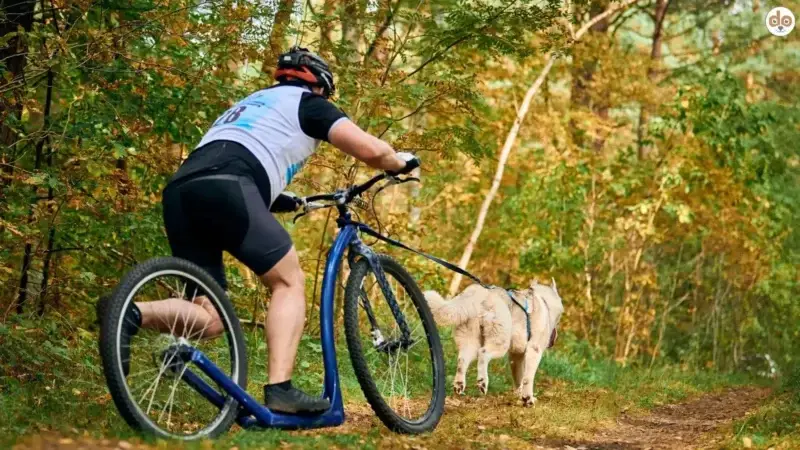
Dog scootering is really fun – but only if the equipment is right. Anyone who goes out on a scooter with a dog (or several) quickly notices: A normal kick scooter is not enough. Here is what you really need to pay attention to when buying.
Important selection criteria for the dog scooter
Stability and Safety
- Robust frame and wide deck: As soon as a dog pulls, the terrain becomes secondary – the scooter must be able to take it. For multi-dog teams, this is not a nice-to-have, but a basic requirement.
- Disk or hydraulic brakes: Dogs react faster than you can brake. Important to know: Over 70–80% of the braking force acts on the front wheel – this influences how you brake in curves or downhill.
Terrain Suitability
- Air-filled tyres (20–26 inches): On soft or uneven paths, this makes itself immediately noticeable. Some cross models allow the ground clearance to be increased – practical if you are often out in the forest.
Accessories and Integration
- Antenna/leash adapter: Getting the leash under the front wheel is a classic beginner’s nightmare. An antenna system (e.g. KLICK-Fix) solves this reliably.
- Shock-absorbing leash (Bungee): Jerky starts are uncomfortable for both dog and owner – a spring leash takes away the majority of this impulse.
Material and Comfort
- Anti-slip platform: Sounds trivial, but it is not – anyone who has already slipped off at speed will only buy scooters with a proper surface afterwards.
- Mudguards and safety clips: Open wheels and dog leashes are a bad combination. Good scooters solve this by design.
Top Brands at a Glance
- Gravity (Gravity Mushing Pro): Stable cross and downhill scooters, popular with teams with multiple dogs.
- Kostka (e.g. Fairbanks Cross, Mushing Max): Robust dog scooters for demanding terrain.
- Crussis: Solid all-rounders, good for versatile use.
- Pawtrekker: Modular design with Sidewalker system – anyone riding with more than one dog appreciates the additional space on the scooter.
- Zero DC, Weltmeisters Dogsports, ManMat: Available at specialist shops such as Leithund.
Tips for Selection for Different Areas of Use
| Scenario | Recommendation |
|---|---|
| One dog, forest and field paths | Robust cross scooter with good suspension and air-filled tyres. |
| Two or more dogs | Model with disc brake, extra braking power, stable platform (Gravity, Kostka). |
| City and asphalt/light trails | Lighter scooter with functional focus, e.g. with antenna and spring leash. |
| Training and everyday use | Beginner-compatible equipment is sufficient for the start; high-quality accessories can be retrofitted if required. |
Training and Safety Basics
- Build up gradually: Short distances on flat terrain, increase slowly. No competition with yourself in the first few weeks.
- Protective equipment: Helmet and gloves are essential – protectors also for fast dogs.
- Communication with the dog: Clear commands such as “Go”, “Easy” and “Whoa” are not optional, but mandatory.
FAQ – Dog Scooter for Dog Sledding Sports
When can my dog pull on the dog scooter?
Only when it is physically fully grown. For most breeds, this is the case from around 12–18 months – smaller breeds earlier, larger breeds rather later. Have the health status checked by a vet beforehand and then start slowly.
What prerequisites does a dog need for dog sledding sports?
Good health, genuine enjoyment of movement and willingness to cooperate. Athletic dogs of medium to large stature are particularly suitable. One thing is non-negotiable here: The dog must enjoy pulling. Coercion has no place here.
What distinguishes a dog scooter from a normal kick scooter?
Quite a lot. A dog scooter is specifically built for dog sledding sports: more stable frame, larger air tyres, powerful brakes (usually disc brakes), a wide deck and a holder for antenna or bungee leash. Normal kick scooters are simply unsuitable for dog scootering – and can become dangerous.
How many dogs can I use at the same time?
Most dog scooters are designed for 1–2 dogs. High-performance models such as the Gravity Mushing Pro also allow 3 dogs – but this is really only something for experienced drivers with appropriate training.
Does my dog need a special harness?
Yes, absolutely. For dog sledding sports you need a well-fitting pulling harness – such as an X-Back or a Short Harness. These distribute the pulling force optimally and allow enough freedom of movement. Collars and everyday harnesses are not suitable for this and can seriously harm the dog.
What do I need to get started?
In essence: a dog scooter with leash holder (antenna), a shock-absorbing pulling leash (bungee), a suitable pulling harness and protective equipment for you (helmet, gloves, protectors if required). For the dog, a calm familiarisation phase is at least as important as the equipment.
Can I also do dog scootering on asphalt?
In principle yes – but the gentler surface for the joints remains forest floor, meadows or forest paths. Asphalt only during the cooler hours of the day, never in heat. Overheating and paw injuries happen faster than you think.
Which brands are particularly recommended?
Gravity, Kostka, Crussis and Pawtrekker have proven themselves. All four offer robust models for different areas of use – from cross to tour to beginner and multi-dog team configurations.
How long may my dog pull?
This depends on fitness, training level, weather and terrain. Beginners do well with 2–4 km, trained dogs can manage 8–10 km. But: no kilometre plan replaces close observation. Watch your dog’s body language, take regular breaks and always offer water.
Where am I allowed to ride the Dog Scooter?
This is regulated differently depending on the region. Dogs as draft animals in public traffic areas are not permitted everywhere – ask your municipality, forestry authority or a dog sport association. In many areas, dog scootering is permitted on forest and woodland paths, provided no wildlife protection periods are violated.
What matters when buying
A good Dog Scooter must safety, stability, comfort and the right accessories under one hat. Brands like Gravity and Kostka have proven themselves over the years. For getting started, a functional, stable scooter is perfectly sufficient. Protective equipment and a slow training build-up are not optional – they are part of it.