
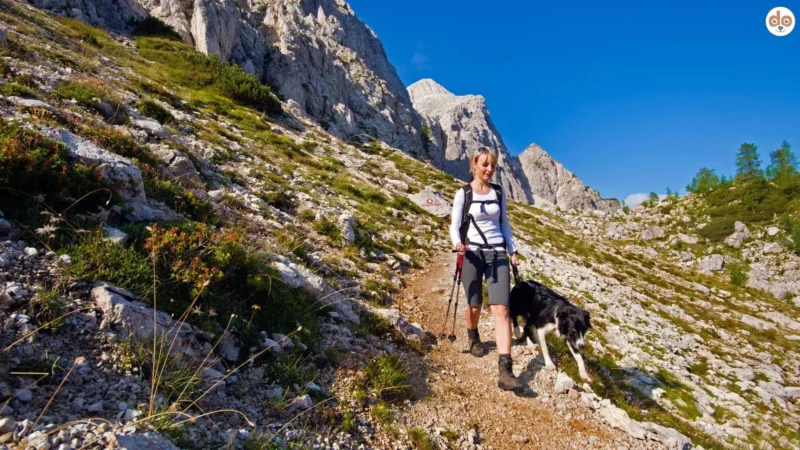
What do you need to know for hiking with a dog? Almost every healthy dog can hike; the question is how far and with how many breaks. Suitable routes, the right equipment, and the leash rules in the DACH area are important.
The most important points in brief
- Adjust distance and breaks to the age and fitness of your dog.
- Do not overload young dogs; their joints are still growing.
- Essential equipment: water, first aid, and depending on the route, tick protection and paw protection.
- Observe leash requirements and wildlife protection, especially during breeding and rearing seasons.
- If problems arise on the trail: cool down, take breaks, and go to the vet in an emergency.
Which dogs are suitable for hiking?
In principle, almost every healthy dog can hike. The real question is: how far, how long, and with how many breaks? A young Border Collie will easily manage a 6-hour tour. A Pug needs shade, short stages, and frequent rest breaks. Puppies under one year of age should generally not be put under strain on long distances – the growth plates are not yet closed, and every jump from stone to stone puts stress on the joints.
Seniors aged 8–10 years often still enjoy going along – but for shorter distances, more slowly, with more breaks and fewer vertical metres. If your dog has arthritis, a history of slipped disc or heart problems, clarify suitability for hiking with the vet beforehand. Brachycephalic breeds such as Pugs, French Bulldogs or Pekingese are particularly at risk of overheating: their shortened snout simply makes effective heat dissipation difficult.
Choosing routes – what matters?
You can recognise a truly dog-friendly route by a few concrete characteristics:
- Water sources: stream, lake or at least regular wells – indispensable in summer
- Shade: at least on sections, through forest or gorges
- Suitable ground: long scree or sharp-edged karst injures paws; you often only notice this hours later
- Clear leash situation: wildlife crossings or grazing animals nearby mean a leash requirement – otherwise there will be trouble with farmers or wildlife
- Good accessibility: getting there with the dog (public transport or car) and a return route that still works even if the dog is simply finished after three hours
On hot days: avoid asphalt. At an air temperature of 25 °C, the ground temperature can reach 50 °C and more – this burns paws. And alpine via ferratas with steel cables or ladders are generally not an option for dogs.
Equipment for dog and owner
What really needs to go in the rucksack – without any frills:
- Harness (distributes pulling force better than a collar, especially on longer tours)
- Leash – a short one for narrow places, a long one for open terrain where it is permitted
- Foldable water bowl and a separate water bottle for the dog
- Snacks or dry food – dogs need intermediate meals during prolonged exertion
- Mini first aid kit: tick remover, paw bandage, tweezers, emergency phone numbers
- Poop bags – yes, even in the forest
- Reflector or light-up collar for dusk
- In heat: cooling bandana or a light jacket, and paw protection for sensitive paws
Leash requirement and regulations in the DACH area
The rules differ depending on the country, region and season – and they change. On rundum.dog we document the current regulations for each region (see Excursion destinations by location). Here are the rough orientation points:
- Switzerland: In most nature conservation areas, a leash requirement applies from April to July (breeding and rearing season). The details vary greatly – sometimes even from municipality to municipality.
- Germany: The breeding and rearing season runs from 1 March to 30 June. In many federal states, a leash requirement applies year-round in forests or protected areas. North Rhine-Westphalia and Lower Saxony have stricter regulations than Bavaria or Baden-Württemberg.
- Austria: Each federal state regulates this itself. In Vienna, a leash requirement applies in almost all parks; in Tyrol, many alpine pasture areas require dogs to be leashed.
On alpine pastures, the rule is: always keep your dog on a leash around grazing animals. Conflicts with mother cows are extremely dangerous – for the dog and for you. In southern Germany and Tyrol, there have been several incidents resulting in injuries in recent years.
Hiking regions in the DACH area
Based on the experiences of owners who regularly go on tours with us, these regions have proven to be particularly dog-friendly:
- Switzerland: Bernese Oberland, Engadin, Ticino valleys, Schaffhausen with its proximity to the Black Forest – our day-trip destination database shows what is suitable for dogs in each canton
- Germany: Black Forest, Bavarian Forest, Eifel, Saxon Switzerland, Harz – many routes there are explicitly marked as dog-friendly
- Austria: Salzkammergut, Carinthia (Nockberge), Lower Tyrol, Styria
What to do if your dog has a problem while out and about?
Three scenarios you should be prepared for:
- Paw injury: Stop immediately and check the paw thoroughly. Bandage any wounds if necessary and return calmly to the car. For deep cuts, go straight to the vet.
- Overheating: The dog is panting excessively, staggering, and its tongue turns dark red – this is an emergency. Immediately move into the shade, cool the belly and paws with cool (not ice-cold!) water, and call emergency services right away.
- Tick found: Remove it with a tick remover, disinfect the area. Watch for redness or changes over the next 14 days – Lyme disease and TBE are real risks in the DACH region.
You can find all important emergency information about your dog on its emergency ID card, which you can create and print in the My Dog section on rundum.dog.
FAQ
How far can my dog hike per day?
As a rule of thumb: a healthy, adult dog of medium size can manage 4–6 hours of hiking with breaks. More is possible – but only if it is physically prepared for it and the conditions are right (temperature, terrain, gradient). Puppies and seniors should be out for significantly shorter periods.
My dog has never done longer hikes before – how do I start?
Increase gradually over 4–6 weeks: start with 30–60 minutes, then 1.5–2 hours, then longer distances. A good sign that you have increased the intensity too quickly is if the dog gets up stiffly the next morning or hardly wants to move.
What insurance do I need when hiking?
A dog owner’s liability insurance should definitely also be valid abroad and cover conflicts with wildlife – i.e., the case where your dog chases wild animals and causes damage. A pet health insurance policy can be useful; at the very least, it is worth knowing emergency tariffs for vet visits while on the move.
Can my dog come with me to the mountain summit?
On normal, unsecured hiking trails: yes, if it is fit. On via ferratas with steel cables, ladders, or exposed sections: definitely not. Some cable cars do not allow dogs – checking this in advance saves frustration.
How much does a hiking week with a dog cost?
In dog-friendly hotels in the DACH region, expect an extra dog fee of 5–15 CHF/EUR per night. On top of that come travel, food and possibly a dog crate for the car. A five-day hiking week for two in a mid-range hotel quickly adds up to 800–1,200 CHF/EUR – and the lion’s share of that goes on the humans, not the dog.