
01Summary
In a paragraph
If you only have 30 seconds.
The dachshund is a fully-fledged hunting dog in a small format, bred for work underground, not for the role of an uncomplicated companion. Its pronounced prey drive, its stubbornness and its increased risk of slipped disc are not footnotes, but the core profile of the breed. Anyone who understands this and deals with it in a structured way obtains a loyal, intelligent dog with an extraordinary personality.
02Introduction
What makes the Dachshund special
The dachshund (Dachshund) is a German hunting dog, FCI Group 4, with a breed-typically increased risk of slipped disc, withers height 20–27 cm.
03Profile
Key facts and suitability
- Origin
- Deutschland
- Original purpose
- Earth hunting on badger and fox, tracking dog
- FCI
- No. 148 · Group 4
- height at the withers
- 20–27 cm
- Weight
- 7–14 kg
- Life expectancy
- 12–16 Years
- Coat type
- Short-haired
- Minimum exercise
- 45 min/day
- Puppy price
- 1'000–2'000 CHF
- Waiting period
- 9 months
- Sports
- Hunting · Scent work · Earthwork
04Temperament
How the Dachshund shows up in everyday life
The dachshund profile becomes clear during the morning walk: The nose goes straight to the ground, the animal pulls towards the bushes, and a recall in the middle of a scent trail is consistently ignored. This is not defiance; it is genetics. The dachshund was selected over centuries to work independently and with endurance, without waiting for human instructions.
Internally, what the dog needs: The need for social contact is medium to high. The dachshund forms an intense bond with its primary caregiver and tolerates long periods alone poorly if these have not been built up gradually. Mental work is not a bonus but a requirement: scent work, search games, and structured training sessions are part of the daily routine. Without mental stimulation, the dachshund will develop its own occupations, which are rarely in the owner's interest.
Externally, how the dog reacts: Towards strangers, the dachshund behaves watchfully to reservedly. It barks, observes, and decides for itself whether to make contact. This reaction is not a sign of aggression but of mistrust, a hunting dog instinct that takes territory boundaries seriously. Anyone who expects the dachshund to greet every visitor joyfully will be disappointed. Whoever accepts this reserve as part of the character and works on socialisation early on will obtain a dog with clear judgement.
With other dogs, the dachshund appears confident; it does not relativise its small body size. This can become problematic in encounters with larger dogs if socialisation is patchy. It accepts children when treated respectfully but tolerates no overbearing behaviour.
05Needs
What this breed needs daily
The dachshund needs 60 to 90 minutes of active exercise daily, divided into several sessions, not as a single marathon walk. More important than the pure distance walked is the type of movement: scent work, controlled search tasks, and mantrailing correspond to its genetic profile and tire it more effectively than pure running distances.
Mental stimulation is equal in importance to physical exercise. A dachshund that runs for 90 minutes daily but receives no mental work is not sufficiently stimulated. Snuffle mats, food search games, and structured nose training are low-threshold ways to channel the scent drive meaningfully.
Being left alone must be built up gradually. The maximum time alone is around four hours, with well-established training. Anyone who is regularly away from home for longer than four hours needs a reliable care solution.
Stairs and jumps from furniture or out of the car should be consistently reduced. Ramps or steps are not luxury accessories, but a preventive measure against disc damage. The weight must be kept permanently within the normal range; every additional kilogram puts disproportionate strain on the spine.
Training requires patience, consistency and humour. The dachshund questions instructions, tests boundaries and reacts sensitively to uncertainty or inconsistency. It rejects monotonous repetitions. Short, varied training sessions with a clear structure and positive reinforcement yield the best results. Recall is one of the most demanding exercises and requires particularly consistent, long-term management, especially in areas with wildlife crossings.
Exercise
Medium
mental work
A lot
Social needs
Medium
training
Demanding
06Sport & Mental and Physical Stimulation
What sports the Dachshund is suited for
Realistic in terms of physiology and genetics – not every breed suits every sport.
Structurally and physiologically suitable: no jumping sports (risk of slipped disc) · Suitable for mantrailing, dummy work and tracking.
07Quick Check
08Suitability
Who this breed is suitable for – and who it isn't
✓Matches
The dachshund suits owners who have experience with independent dogs or are prepared to engage intensively with the breed. Specifically: people with at least 60 to 90 minutes of active exercise time daily, an interest in nose work or mantrailing and a willingness to train recall and impulse control consistently over the long term.
Households with a garden benefit, provided it is secure, as a dachshund digs and flees when a scent trail tempts it. Keeping one in an apartment works with sufficient stimulation and consistent disc management (ramps, no jumping).
Families with children from around eight years of age, who treat the dog respectfully and are not overbearing, get along well with the dachshund. Toddlers and the dachshund always require supervision.
Owners who enjoy an intense human-dog relationship and appreciate the dachshund's independence as a character trait, rather than viewing it as a problem, will find in it a loyal, intelligent companion. Anyone prepared to support the dachshund's reserved reaction towards strangers through early and broad socialisation obtains a dog with clear judgement instead of blind obedience.
×Doesn't match
The dachshund does not suit owners who are looking for an uncomplicated first-time dog and have little experience with independent breeds. Anyone who expects that a small dog is automatically easier to handle will regularly hit limits with the dachshund.
Households where the dog is alone for longer than four hours daily and no care solution exists are unsuitable for the dachshund; its need for social contact and separation sensitivity should not be underestimated.
Anyone who regards prey drive as a negligible trait and relies on free exercise in unsecured terrain risks losing the dog. The dachshund follows a scent trail consistently, regardless of calls.
Owners who misinterpret the dachshund's reserved reaction towards strangers as "friendliness to everyone" and forgo early socialisation reinforce unwanted reaction patterns. Anyone who also lacks the willingness to implement disc prevention consistently (weight control, ramps, no jumping) significantly increases the risk of costly and burdensome illnesses. Multi-storey buildings with noise-sensitive neighbours are also a risk factor without consistent barking management.
10Line reality
Show line, working line, breeder market
The dachshund exists today in two fundamentally different lines: hunting lines and companion dog lines. This difference is significant for the decision on how to keep the dog.
Hunting dachshunds are still selected by the German Teckel Club for scent drive, endurance, courage, and independence. Hunting utility tests are a breeding prerequisite in these lines. A dachshund from an active hunting line comes with a significantly more intense drive; the prey drive is more pronounced, and independent decision-making under pressure is more deeply ingrained. These dogs require a living environment that can channel this drive.
Companion dog lines, which have been bred over decades without hunting selection, often show a somewhat more balanced drive profile, but there is no guarantee. Dachshunds with a strong prey drive can also emerge from pure companion dog lines, as the genetic basis is the same.
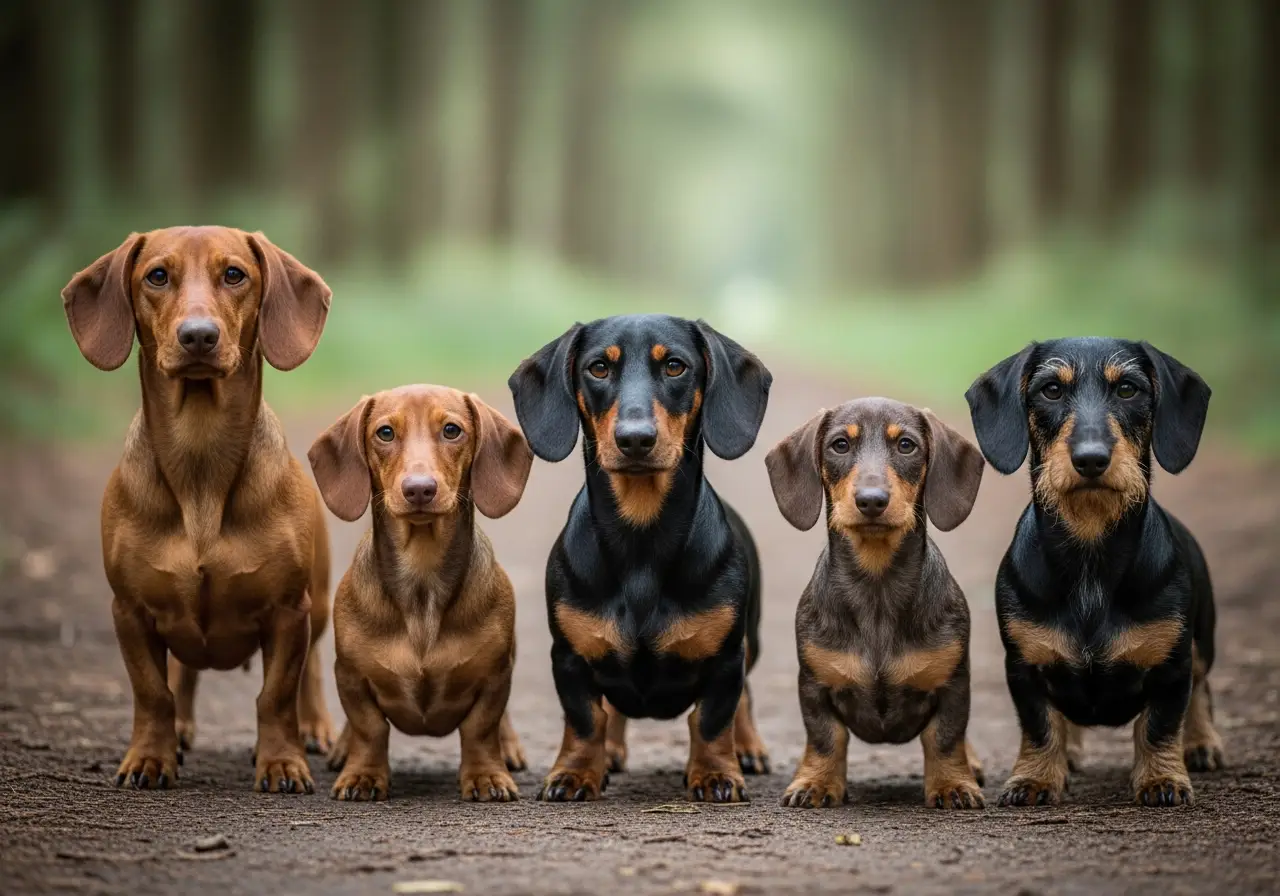
Additionally, the breed differentiates by coat type: The wire-haired dachshund is considered particularly robust, independent, and sometimes stubborn due to terrier crossbreeding. The long-haired dachshund is often described as somewhat softer in handling. The smooth-haired dachshund is regarded as the "classic" type without additional crossbreeding influences. These differences are tendencies, not guarantees; individual variation remains significant.
11Health · Reality
What you need to plan for medically with your Dachshund
The life expectancy of the dachshund is 12 to 16 years, making it one of the longer-lived dog breeds. However, this range presupposes active health management.
The dominant health risk is Intervertebral Disc Disease (IVDD), in German slipped disc. Studies show that up to 25% of all dachshunds develop clinically relevant IVDD during their lives (Priester, 1976; confirmed by more recent population studies, e.g. Bergknut et al., 2012, Veterinary Journal). The chondrodystrophic body shape (long back, short limbs) is the anatomical basis for this risk. Symptoms range from back pain and gait disturbances to paralysis. At the first signs of neurological symptoms, immediate veterinary assessment is mandatory.
Preventive measures: maintain weight permanently within the normal range, avoid jumps from heights of more than 40 cm, use ramps instead of stairs, no overexertion through running on hard surfaces.
Further breed-typical diseases: patellar luxation (kneecap dislocation), progressive retinal atrophy (PRA, particularly in long-haired dachshunds), dental problems due to narrow jaw proportions.
Preventive examinations: eye examination for breeding dogs (PRA screening), IVDD screening via X-ray recommended, regular weight checks at the vet. Overweight is a significant risk factor in dachshunds; already 500 grams above ideal weight measurably increases spinal load. Annual dental check-ups are sensible due to dental issues.
12Structured data
Health by the numbers
Prone to diseases
Intervertebral disc disease (IVDD, frequently breed-typical), eye problems, heart problems
Recommended health tests
DNA test IVDD (PDK4 gene), eye examination
13Myths ↔ Reality
What is often said incorrectly about this breed
Five myths, five realities, five sources.
'The dachshund is a low-maintenance lap dog for seniors and beginners.'
The dachshund is genetically programmed for independent work underground. Its prey drive, stubbornness and barking behaviour regularly overwhelm owners who expect a calm companion dog. The Deutsche Teckelklub explicitly points out that the breed requires consistent handling and mental and physical stimulation. Dachshunds are among the breeds most frequently surrendered to animal shelters, often due to their character being underestimated.
"Small dogs need little exercise; for the dachshund, a short walk is enough."
The dachshund needs 60 to 90 minutes of active exercise daily, plus additional mental and physical stimulation through nose work or search games. Under-stimulation manifests as barking fits, destructive behaviour or increased stubbornness. Body size says nothing about activity requirements; the dachshund is an endurance hunter, not a lap dog.
"Disc problems in dachshunds are rare and only affect old dogs."
Intervertebral disc disease (IVDD) is breed-typical in dachshunds and can occur already in young adulthood. Studies show that up to 25% of all dachshunds develop a clinically relevant disc disorder during their lifetime. The chondrodystrophic body shape (long back, short limbs) is the anatomical cause. Early weight control and avoiding jumps from great heights reduce the risk.
"All dachshunds are the same; coat and size variants are just cosmetic."
The three size variants (standard, miniature, rabbit) differ not only in weight but also in their original hunting function. The wire-haired dachshund is considered particularly independent and robust due to its terrier crossbreeding. Long-haired dachshunds are often described as somewhat more balanced. These differences are no guarantee, but they are relevant when deciding on care.
"The dachshund is easy to keep in an apartment because of its size."
Keeping a dachshund in an apartment is possible, but requires consistent stimulation. Stairs and jumping from furniture put considerable strain on the spine. Without ramps or consistent management, the risk of disc problems increases. Furthermore, the dachshund tends to bark loudly, which can lead to conflicts in multi-unit buildings.
14animal welfare
The animal welfare perspective
Breeder market, designer versions, animal shelter reality — what no one writes in the puppy ad.
The dachshund is among the breeds overrepresented in German and Austrian animal shelters. The reasons for surrender are documented and recurring: underestimated prey drive, barking behaviour in multi-storey buildings, disc diseases with high treatment costs, and being overwhelmed by an independent character that does not match the expected "lap dog" image.
The backyard breeder market exploits the breed's enduring popularity. Dachshunds from dubious breeding are sold without IVDD screening, without socialisation in a household environment, and without health certificates, often via classifieds platforms at prices that appear attractive at first glance. The risk: higher veterinary costs, unknown drive profile, lack of imprinting. A puppy from reputable breeding with DTK membership and health examinations costs more, but protects against foreseeable problems.
Designer variants of the dachshund, such as "mini-dachshunds" with extreme miniaturisation or crosses with other short-legged breeds, further increase IVDD risk without this being communicated transparently. Anyone looking for a particularly small or extreme dachshund should inform themselves about the anatomical consequences before making a decision.
Adopting an adult dachshund from an animal shelter or rescue organisation is an equivalent alternative to buying a puppy. An adult dog comes with a known character profile; prey drive, social behaviour, and ability to be left alone are observable, not speculative. Many rehomed dachshunds are between two and five years old and still have ten or more years of life ahead. Settling in requires structure and patience, which applies to every dog, regardless of age.
15Costs · Transparency
What this breed realistically costs
A puppy from reputable DTK breeding with pedigree and health examinations costs between 1,200 and 2,000 euros. Offers significantly below this often originate from backyard breeding without health screening. A dachshund from rehoming is generally more cost-effective; rehoming fees usually lie between 200 and 500 euros.
Annual living costs consist of: food (high-quality, weight-adjusted) approx. 400 to 700 euros, basic grooming approx. 100 to 300 euros depending on coat type (wire-haired requires regular trimming), basic veterinary care (vaccinations, deworming, annual check-up) approx. 200 to 400 euros.
The greatest financial risk is IVDD treatment: conservative therapy costs 500 to 1,500 euros, neurosurgical operation 3,000 to 6,000 euros or more. Pet insurance covering surgery costs is particularly recommended for dachshund owners; annual premiums lie between 400 and 900 euros depending on provider and coverage scope. Taking out the policy before the first illness is crucial, as pre-existing conditions are generally excluded. Total lifetime costs for a dachshund realistically lie between 15,000 and 30,000 euros.
16Puppy search
What you need to consider when choosing a breeder
- A reputable breeder is a member of the German Dachshund Club 1888 e.V.
- (DTK) and is subject to its breeding regulations.
- Concrete features of reputable breeding: both parent animals are examined for disc health before mating (IVDD screening), the puppies grow up in a household environment, the breeder asks questions about the living situation and releases the puppies no earlier than eight weeks of age.
- A reputable breeder openly provides the litter book, pedigree and health certificates.
- Warning signs: several litters available simultaneously, no personal conversation, handover at a neutral location, no interest in the living situation, prices significantly below 800 euros without a comprehensible reason.
- Adoption via animal shelters and rescue organisations is an equally valid option.
- Dachshunds are surrendered disproportionately often, frequently due to underestimated prey drive or health problems.
- An adult dachshund from adoption comes with a known character profile and requires structured settling-in management.
- Organisations such as DACHSHUND RESCUE or regional animal shelters regularly place dachshunds of all age groups.
- No named recommendations for individual breeders are made on rundum.dog; the DTK maintains an official breeder list at dtk1888.de.
FAQ
Frequently asked questions about the Dachshund
Is Dachshund suitable for beginners?
Dachshund is considered suitable for first-time dog owners.
Is Dachshund a family dog?
Dachshund is considered suitable for families with good socialisation and species-appropriate care.
How much exercise does Dachshund need?
At least around 45 minutes of exercise per day.
Does Dachshund suit an apartment?
With enough exercise and enrichment, Dachshund can also be kept in an apartment.
What is the size and weight of Dachshund?
Fully grown, Dachshund reaches about 20–27 cm at the withers and weighs around 7–14 kg.
What is the life expectancy of Dachshund?
The life expectancy of Dachshund is approximately 12–16 years.
Which diseases are common in Dachshund?
Intervertebral disc disease (IVDD, frequently breed-typical), eye problems, heart problems
17Breed clubs
Official breed clubs in DACH
19Related
Similar breeds – and their differences
You might also be interested in
Participate
Do you have a good photo of your Dachshund?
We are looking for expressive images for our breed profiles. Submit yours; the editorial team reviews every submission before publication.
Does this breed suit you?
One of the most popular German dogs. Spinal health is the central issue. No stairs, no jumping, no overweight.