
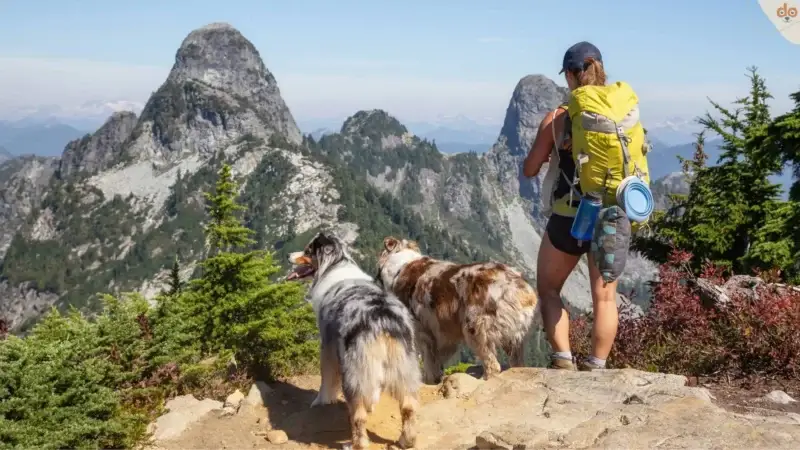
Preparation: How to prepare your dog for alpine tours
Step 1: Build up flatland endurance
Before your dog sees a mountain, it must be able to walk 60–90 minutes of flat terrain easily – without excessive panting or fatigue. Then you start with gentle inclines: small hills, gentle ascents. After 4–8 weeks of systematic training, most dogs master moderate mountain tours.
Step 2: Gradual increase in altitude
Start with tours up to 800 metres of altitude difference. Keep the pace slow – your dog must be able to breathe calmly and sniff regularly. After a successful tour at this altitude, wait 2 weeks before tackling the next more difficult tour. The dog’s body needs time to adapt.
Step 3: Terrain exercises
Alpine paths have loose stones, gravel and tight curves. Train your dog on such ground. You also learn its limits here: Which incline is too steep? How does it react to loose rock? Does your dog trust you enough to follow you in difficult terrain? These are important pieces of information for later.
Step 4: Mountain railway training
Many alpine tours start with a mountain railway. Your dog must be familiar with it. Go up and down once beforehand without a hiking goal – some dogs react with ear pressure or fear in the cabin. You are better off knowing this before the tour rather than only finding out at the top.
Altitude sickness in dogs: Truth vs over-anxiety
Altitude sickness occurs in dogs only from about 3500 metres – so in really high mountain regions such as the Alps above 3500 m or in high alpine regions such as the Himalayas. Most European family hiking tours are below 2500 metres, where altitude sickness is not a real risk.
Still observe your dog: Excessive panting, reluctance to move, or balance problems can also be signs of overexertion at lower altitudes. However, this is more likely a training or pace issue rather than an altitude problem. If your dog is fit and the hike proceeds at an adjusted pace, you won’t have any issues well below 3500 m.
Via Ferrata with a Dog: Only Under Certain Conditions
Via ferratas are difficult to navigate with a dog. Dog paws are not designed for metal rungs and wire rope safety systems. A trained, absolutely reliable dog can manage easy via ferrata sections – but only with special equipment. For this, you need a dog safety harness (Double Back Harness), a sturdy safety rope, and genuine experience in handling both.
Important: The dog must be absolutely obedient and fearless. An insecure or nervous dog has no place on a via ferrata. If your dog already gets nervous during normal hikes, a via ferrata is not an option for you. For most dogs and owners, via ferratas are simply unsuitable.
Alpine Huts: What Is Allowed, What Is Not?
Each alpine hut has its own rules for dogs. Some allow dogs without issue, others ban them completely, while others only permit them in the stable or an outdoor room. There is no uniform rule. The only reliable way to find out if the dog is allowed in the hut is by phone – and not on the way up, but beforehand.
Hut overnight stays with a dog must be booked in advance. The host needs to know that a dog is coming. Some huts have special dog boxes or runs, while others only offer for the dog to stay in a separate room. Do not be surprised if the dog is not allowed to sleep in the room – this is completely normal and also sensible (allergies of other guests, germs, noise).
Specialised Equipment for Mountain Hiking
Dog Boots – Useful or Superfluous?
On easy mountain tours, your dog usually does not need boots. On very stony paths, over snowfields, or sharp-edged scree fields, however, dog boots are useful. Train your dog beforehand to tolerate them – this takes time. Many dogs do not like boots at first. If your dog accepts them after a short period of getting used to them, good mountain boots are worth considering.
Protective Vest and Backpack
A dog-friendly backpack – in which the dog carries its own water and provisions – is practical for long mountain tours. Not for you, but to distribute the load: The dog carries its own reserves. A protective vest is worthwhile in hunting regions where there is a risk of confusion with wild animals – especially in autumn and winter.
First Aid for Mountains
Take an extended first aid kit with you: bandage material, antihistamines (for insect stings), painkillers (only on the vet’s instructions), electrolyte tablets against dehydration. Also know the nearest vet addresses on the route and in the valley. You should get a list of mountain vets before departure.
Risks in the Alpine Environment
Falling Rocks and Rockfalls
Your dog is small and vulnerable to stones falling from above. Stay on marked paths and avoid areas directly below rock faces – especially after rain or if people are still climbing above. Falling rocks are unpredictable. The best protection is not to be in the risk zone at all.
Glacier Crevasses
Your dog has no place on glaciers. Glacier crevasses are life-threatening, and a small dog can easily fit into them. In addition, the ground is uncomfortable for dog paws – ice, sharp ice edges. Avoid glacier tours with a dog or book a mountain guide who will secure you properly.
Birds of Prey
In very high alpine regions, eagles can theoretically attack small dogs. This is extremely rare, but not impossible. A dog under 5 kg near known eagle nests must stay very close to you and be able to find cover quickly in open terrain.
Checklist for Mountain Hikes with a Dog
- Before the tour: Call huts and ask about dog rules
- Equipment: Dog boots (if necessary), harness instead of collar, short sturdy leash
- Provisions: Extra water (mountains evaporate faster), light snacks with extra calories
- Safety: Keep dog close to you, do not let it run free, prefer known paths
- Emergency: Mountain rescue number in phone, vet addresses in the valley researched
- Pace: Slower than without a dog – accept and enjoy it
- Time: Start early so you do not descend in the dark
- Weather: Check well – mountain weather can change quickly and is more strenuous for dogs