
What requirements do livestock guardian dogs have?
Livestock guardian dogs such as the Kangal, the Pyrenean Mountain Dog and the Maremmano are not working dogs in the classical sense. They are round-the-clock watchers that live with the herd. Their goal is deterrence through presence, not active hunting. This means: they work with little stress and can sit calmly next to the herd for hours. Their bond with the herd is enormously strong, the bond with people significantly weaker.
This is intentional and has been reinforced through breeding. That is why they are sometimes difficult in classic families (they are not ‘obedient’ in the classical sense), but on a farm with a genuine task, they fit perfectly.
- Kangal: Turkish breed, 50–65 kg, extremely powerful, needs clear boundaries from the start. In some German federal states (Berlin, Hessen, Hamburg) the Kangal is classified as a restricted breed with varying requirements.
- Pyrénées Mountain Dog: French origin, 55–90 kg, slightly less aggressive than the Kangal, more compatible with family life. Both breeds require expert knowledge and should not be taken on by beginners without support.
Herding dogs vs. livestock guardian dogs: The difference
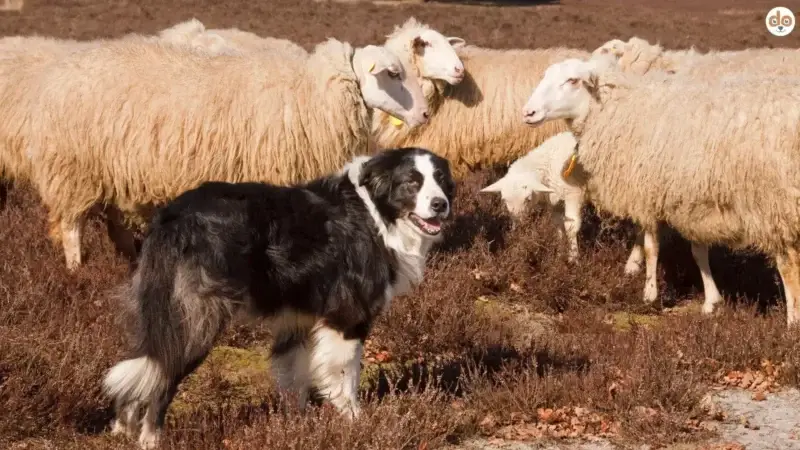
A herding dog (Border Collie, Australian Shepherd) is highly trainable and actively controls the flock through movement and eye contact. The dog wants to work, wants to be guided. A livestock guardian dog sits beside the flock and deters predators through presence and noise. Less human controllability, but greater independence.
This has implications: A herding dog needs clear daily tasks and guidance. A livestock guardian dog needs a stable living environment with the flock and regular (but less intensive) contact with humans.
Animal welfare legal requirements for farm dogs kept outdoors
A dog that lives permanently outdoors is subject to the same animal welfare laws as a house dog. This means in Germany, Austria and Switzerland the following minimum requirements apply:
- Doghouse with an insulated floor, protected from moisture and extreme temperatures; minimum size 1.5 times the dog’s body length.
- Water available around the clock, especially in hot weather.
- Daily checks for injuries, parasites, illness.
- Regular interaction with humans (no psychological neglect).
- Sufficient exercise. For farm dogs this often means: working with the flock counts. A dog that sits on the same chain all summer long without contact with the flock is questionable from an animal welfare perspective.
Understanding this is necessary before bringing a farm dog home.
Interaction with livestock: Training and safety
A dog that lives with sheep or cattle must grow up with them early (ideally as a puppy). Livestock guardian dogs have less prey drive than other breeds, which helps. But: A dog not imprinted on livestock may suddenly react if an animal runs off or panics.
Training must be gentle. The puppy lives with the flock, is positively reinforced for calm behaviour beside them, and is never forced to control them (unless it develops this on its own). If the dog starts snapping or chasing, immediate intervention is required. Not through punishment, but through redirection and re-imprinting.
How to keep a dog on a farm in a species-appropriate and animal welfare-compliant manner
Breed selection & preparations
If you have a genuine herding or guarding task: Choose a breed bred for this, with support from trainers or experienced breeders. Do not buy blindly. The puppy must grow up with the flock or at least come to the farm early.
Accommodation & space
Build a spacious, insulated doghouse (no cramped wooden enclosure). A sturdy dog often needs fewer artificial structures but can also use barns. Ensure the dog has access to the doghouse at night too. Provide a large open area; a dog that is always chained up is not happy, no matter how big the farm is.
Daily integration & contact
A farm dog needs regular human contact, at least 15–30 minutes daily. This can include: feeding, checking, a short play session. This bonds the dog and creates responsibility for the owner. A dog that only works without an emotional relationship may feel isolated.
Health & regulation
Vaccinations, parasite prophylaxis, annual veterinary checks also apply to farm dogs. If your breed has a restricted breed classification (like Kangals in some federal states): Inform yourself about local requirements (registration, insurance, possibly an owner permit). The legal situation is complex and varies; it is better to clarify this in advance.