
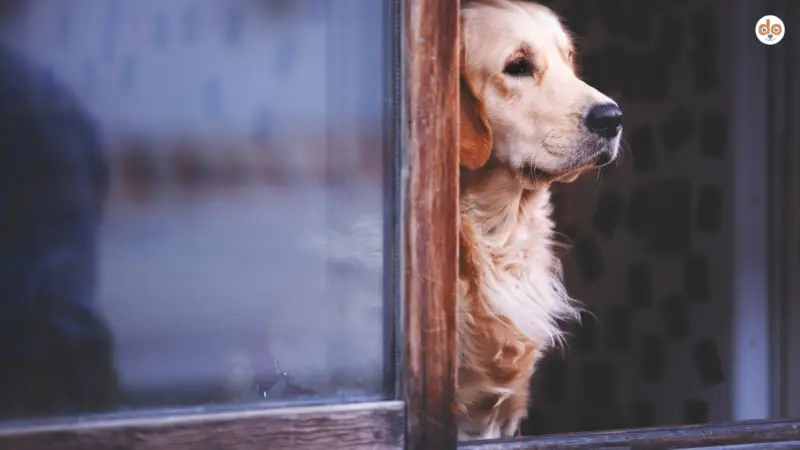
How long can a dog be left alone?
There are biological limits, and they cannot be trained away. A healthy adult dog can cope with a maximum of 4 to 6 hours alone. Not as a permanent state, but as an absolute limit for exceptional days.
Puppies need entirely different standards: Up to the third month, two hours is the maximum, after that it increases gradually, but only around the first birthday is a limit of four hours realistic.
Seniors are a story in themselves. Bladder weakness and age-related anxiety disorders make more frequent companionship simply necessary.
A dog that sits alone for nine hours five days a week lives under chronic stress. The nicest dog bed does not change that.
Genuine separation anxiety vs. frustration: The difference
This may sound like an academic subtlety, but it is crucial. Frustration behaviour is goal-oriented: The dog barks because it wants you to come back, and stops as soon as the trigger has disappeared. It can calm itself down. Separation anxiety is the opposite of that. It is panicky, compulsive and does not stop. Affected dogs literally scratch themselves bloody on doors and window frames, drool excessively, urinate or defecate without any control, howl for hours. The parasympathetic nervous system has simply stopped functioning.
While frustration behaviour can be trained with fewer freedoms and more rest periods, genuine separation anxiety requires behavioural medicine work: systematic desensitisation, counter-conditioning, and sometimes also medication support.
A trainer who advises an owner with a separation-anxious dog to simply “let it ride it out” causes damage.
Recognising stress signals: What your dog shows you even before the door
Many dogs send signals long before things become dramatic. If your dog freezes as soon as you pick up the keys, if it breathes faster, its hackles rise, it yawns repeatedly or licks its snout and quietly moves away from you, these are early, low-threshold warning signs that are easily overlooked in everyday life.
It becomes more intense if it already urinates uncontrollably on the way to the door or outright refuses treats. These signs are important because they tell you where your dog really is at the moment.
During training, this means: if it shows stress, the absence was too long or the build-up too fast. Do not push further, but go back to the last stable step.
How you train being left alone from scratch
Phase 1: Relaxation association (Week 1–2)
First, your dog needs a place that really feels safe, a basket, a crate or a partitioned room. You do not build this up with commands, but with calmness. Sit or lie down calmly next to it yourself. Say your ritual word, ‘Calm’ or ‘Basket’, every time the dog is lying relaxed. After about two weeks, the word alone triggers relaxing reactions. This sounds unremarkable, but it is the foundation of everything that follows.
Phase 2: Short absences (Week 3–4)
Now comes the first real test. Give the dog something to occupy itself with, a snuffle mat, a chew bone, a treat puzzle, call the ritual word and leave the room for five seconds. Come back, no big greeting, no drama. Repeat this daily, extending the absence by about five seconds per day. As soon as stress appears: pause. Do not go further.
Phase 3: Training closing the door (Week 5–6)
A closed door is psychologically a whole different calibre for many dogs than an open room. That is why this step is trained separately. Dog lies calmly in its resting place, you go out, door shut, for ten seconds. That’s it for now. Then 30 seconds, then one minute, then two.
Anyone who jumps forward too quickly here usually ends up having to start again from scratch. This is the most common mistake in training being left alone.
Phase 4: Adding external stimuli (Week 7–8)
Now it goes into the world. With the door closed: go to the car, open it briefly, but do not get in, come back. Then a round the block. Then 15 minutes during which you are away, but still visible, in the garden, on the balcony. Always keep an eye on the dog, either directly or via camera.
Phase 5: Longer absences (Week 9 and beyond)
Only when the foundation is really solid: 30 minutes, then one hour, then two. Some dogs need six weeks to get here, others twelve or more.
Pressure does not lead faster to the goal, but to setbacks. Dogs with genuine separation anxiety symptoms often cannot proceed at this point without professional support, and that is not a defeat, but realism.
Animal welfare: When does being alone become a problem?
Studies show that dogs kept alone permanently exhibit significantly higher stress hormones than socially integrated animals. Over time, behavioural disorders develop: stereotypies such as pacing for hours, self-injury, depressive states, and sometimes also aggression.
Eight hours alone every day? From a biological and animal welfare law perspective, that is simply questionable.
Anyone in a life situation that requires this should seriously consider alternatives: dog sitters, a reliable neighbour, doggy daycare, or (if possible) more flexible working hours.