
01Summary
In a paragraph
If you only have 30 seconds.
The Pyrenean Mountain Dog is not a family dog in the classic sense. It is a genetically programmed livestock guardian that makes independent decisions, watches at night, and requires a secured territory. Anyone who confuses gentleness with obedience will be surprised. This breed demands experience, space, and a leader with calm, consistent authority—not pressure, but clarity.
02Introduction
What makes the Pyrenean Mountain Dog (Chien de Montagne des Pyrénées) special
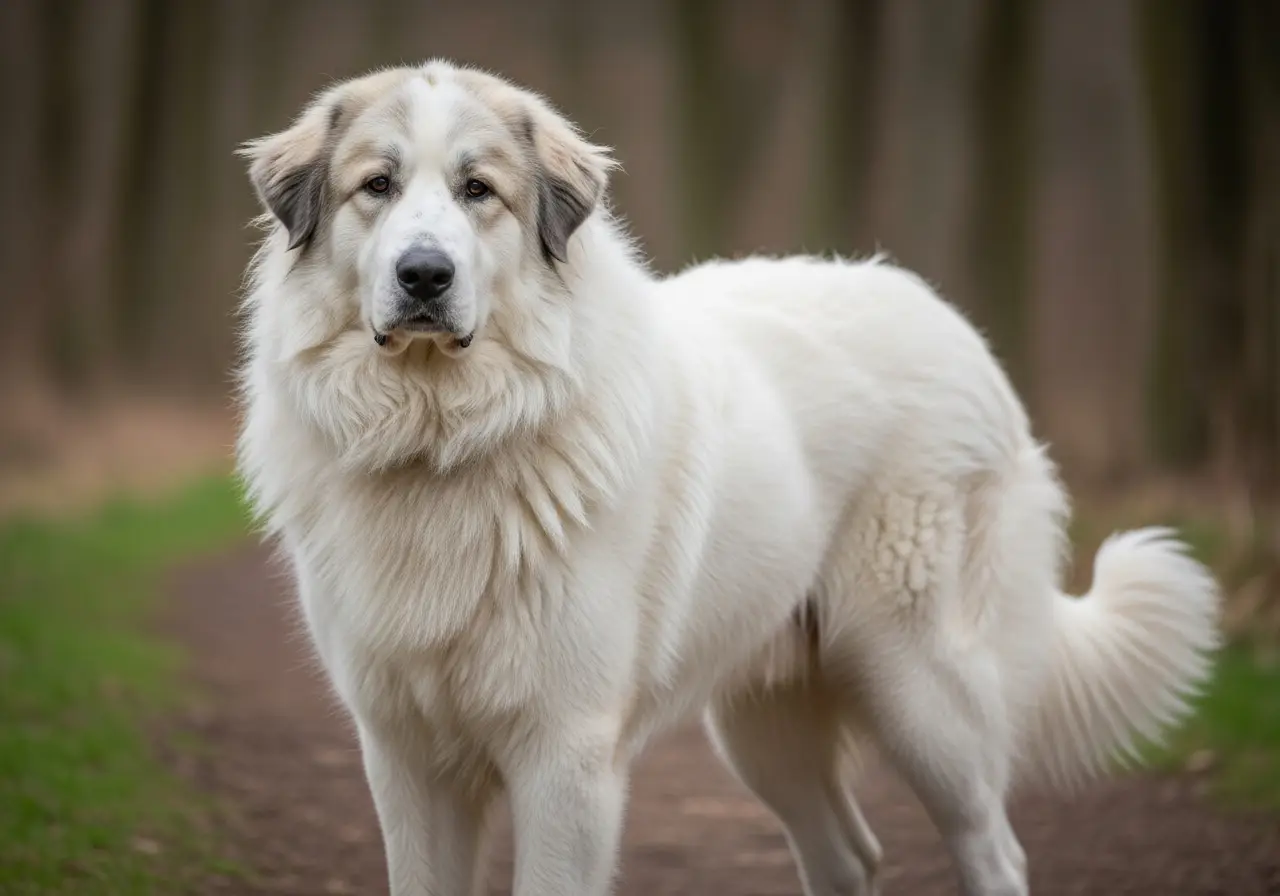
Pyrenean Mountain Dog: imposing white livestock guardian dog from the Alpine region, calm, independent and nocturnal
03Profile
Key facts and suitability
- Origin
- Frankreich Spanien
- Original purpose
- Livestock guarding
- FCI
- No. 137 · Group 2 · Sektion 2.2: Molossoide, Berghunde
- height at the withers
- 65–82 cm
- Weight
- 50–100 kg
- Life expectancy
- 10–12 Years
- Coat type
- Doppel
- Minimum exercise
- 120 min/day
- Puppy price
- 1'500–2'500 CHF
- Waiting period
- 5 months
- Sports
- Hiking Schutzhund work
04Temperament
How the Pyrenean Mountain Dog (Chien de Montagne des Pyrénées) shows up in everyday life
When returning home, the Pyrenean Mountain Dog greets its primary caregivers calmly and dignifiedly, no exuberant jumping, no hectic barking. It registers the arrival, assesses the situation and then returns to its task: keeping an overview of its territory.
Internal axis (what the dog needs): The need for social contact is in the middle range. The dog seeks closeness to the family, but does not require permanent attention. Mental work in the classical sense (fetching, search games) interests it little. Its mental need is met by control tasks: monitoring the territory, assessing the situation, reacting independently. The need for exercise is 60 to 90 minutes daily, calm and structured, not sporty-intense.
External axis (how the dog reacts): It shows clear reserve towards strangers. A visitor it does not know is observed and assessed, not immediately accepted. This reaction is not a mistake, but breed standard. Children it has grown up with, it treats calmly and patiently. Unknown children who move unpredictably trigger vigilance.
Important: High need for social contact towards one’s own family does not mean openness towards strangers. Anyone who confuses these two axes and uses the dog as a “sociable family dog” in social situations with many strangers creates stress for the animal.
At night, the Pyrenean Mountain Dog is active. This is not bad training; it is genetically anchored alertness. In a household without a garden or with neighbours in immediate proximity, this regularly leads to conflicts.
05Needs
What this breed needs daily
The Pyrenean Mountain Dog needs 60 to 90 minutes of structured exercise daily. Intensive sports sessions are neither necessary nor typical for the breed; calm walks on familiar terrain correspond better to its nature than endurance sports.
More important than the quantity of exercise is a secured territory. A large, securely fenced property with a fence of at least 1.80 metres in height is not an option, but a basic prerequisite. The dog needs the opportunity to control its territory; this significantly reduces stress and undesirable behaviour.
Mental stimulation for this breed does not arise from classical dog sports. Territorial tasks, calm observation posts and a clear daily structure meet the need for mental work. Anyone who expects to stimulate the dog with fetching exercises or agility will fail.
The dog needs social structure in the form of a stable, calm-consistent primary caregiver. Emotional instability or changing rules lead to independent decisions by the dog, and these do not always turn out in the owner’s favour.
The breed tolerates being left alone in a stable environment for up to about six hours. The prerequisite is that the dog knows its territory and no unknown stimuli occur. In an unfamiliar environment or with frequently changing situations, this tolerance drops significantly.
Early and broad socialisation (with various people, noises, and situations) is crucial in the first few months of life. Omissions during this phase are difficult to correct later on.
Exercise
Medium
mental work
Medium
Social needs
Medium
training
Experts
07Quick Check
08Suitability
Who this breed is suitable for – and who it isn't
✓Matches
The Pyrenean Mountain Dog suits owners with proven experience in handling independent-thinking, large dogs, ideally livestock guardian dogs or similar breeds.
A property of at least 1,000 m² and a secure fence of at least 1.80 metres in height are essential prerequisites. Rural or suburban locations with tolerant neighbours are suitable; barking at night is typical for the breed and cannot be completely stopped.
Families with children from around ten years of age who are calm and predictable in their interaction with the dog may be suitable, provided the parents clearly take on the leadership role and the children are instructed in the rules.
Owners who are professionally flexible or work from home benefit from the fact that the dog does not demand permanent enrichment but requires consistency in the daily routine.
People who already have contact with breed clubs or experienced breeders and are willing to use a supporting dog training school with experience in livestock guardian dogs are clearly at an advantage. The breed does not require intensive sporting activity, but rather a clear, calm leadership personality with patience and consistency over years.
×Doesn't match
The Pyrenean Mountain Dog is unsuitable for first-time dog owners or people without experience with large, independent-thinking breeds. Anyone expecting to receive an obedient companion dog that reacts on command will be permanently overwhelmed by this breed.
City dwellers without access to a secured property should not consider this breed. Keeping it in an apartment, even with daily walks, does not meet its territorial needs.
Households with very small children under six years of age carry an increased risk: the dog’s size alone poses a physical danger if the animal becomes alert.
Anyone who views reserve towards strangers as a problem and expects to transform the dog into an open, sociable one through training misunderstands the genetic basis of this breed. Anyone who equates gentleness towards the family with general approachability underestimates the protective behaviour in unfamiliar situations.
Owners who regularly have long working hours away from home and cannot present a reliable dog care plan, as well as people living in rented flats without a garden or with neighbours within earshot, should choose a different breed.
10Line reality
Show line, working line, breeder market
The Pyrenean Mountain Dog exists today in two recognisable lines, which differ in their characteristics and keeping requirements.
Working lines are still used in active livestock guarding, mainly in the Pyrenees, but also in other European mountain regions where wolves are present again. These dogs show a more pronounced guarding instinct, higher alertness and more pronounced territorial behaviour. They are conditioned to make independent decisions under minimal human supervision. For keeping as a family dog, they are generally unsuitable.
Show lines have been bred more strongly for appearance and suitability for exhibitions. The guarding instinct is generally less intensely pronounced, but remains genetically present. These dogs are more socially compatible, but still require experience, space and clear leadership.
Anyone buying a puppy should actively ask the breeder about the line affiliation and have the parent dogs shown to them. A dog from a working line kept as a family dog will be overtaxed in most households. The differences are not marginal; they fundamentally affect everyday life.
11Health · Reality
What you need to plan for medically with your Pyrenean Mountain Dog (Chien de Montagne des Pyrénées)
The Pyrenean Mountain Dog has an average life expectancy of 10 to 12 years. As a large breed, it carries an increased risk of hip dysplasia (HD) and elbow dysplasia (ED). Evaluations of the VDH health register show that HD prevalences of 20 to 35 % are not uncommon among Molossoids and mountain dogs; cross-breed data from the Bernese Mountain Dog Association Germany document comparable values for related large breeds (as of 2023).
X-ray examinations of both parent dogs for HD and ED before breeding are the minimum standard for reputable breeders. A puppy without existing parent dog test results represents a calculable health risk.
Gastric torsion (gastric dilatation-volvulus, GDV) is a life-threatening emergency in deep-chested large breeds. Symptoms include a distended abdomen, restlessness, unproductive retching, and sudden weakness. In case of suspicion, every minute counts; immediate veterinary emergency admission is necessary. As a preventive measure, vets recommend avoiding large meals before intense exercise and switching to two or three smaller daily portions.
Overweight poses a significant risk for this breed: the dense coat masks weight gain until it is already advanced. Regular weight checks at the vet, at least twice a year, are advisable.
Preventive examinations: HD/ED screening of parent dogs, annual eye examination, heart auscultation from the fifth year of life. Vaccination and deworming plan according to current WSAVA guidelines.
12Structured data
Health by the numbers
Prone to diseases
Hip dysplasia Bone osteochondrosis
Recommended health tests
Hip X-ray Elbow X-ray
13Myths ↔ Reality
What is often said incorrectly about this breed
Five myths, five realities, five sources.
"The Pyrenean Mountain Dog is a good dog for beginners due to its gentleness.
Gentleness towards its own family is a trait that was selectively bred for herd work; it does not mean obedience. The FCI standard explicitly describes a tendency towards independence and initiative, which requires a certain authority from the owner. Without experience with independently thinking dogs, a situation quickly arises in which the dog makes its own decisions that the owner can no longer control.
"A large property is sufficient for stimulation; the dog occupies itself.
A secured territory is a necessary prerequisite, but it does not replace active leadership. A Pyrenean Mountain Dog left to its own devices develops independent guarding strategies: barking at night, territorial marking, controlling the area. These are not behavioural problems, but breed-typical reactions to a lack of structure. Owners regularly report complaints from neighbours about night-time barking.
“Pyrenean Mountain Dogs are dangerous and aggressive because of their size.
The FCI standard describes gentleness and attachment to the flock as central breeding goals. Towards its own family and known people, the breed generally shows calm, dignified behaviour. Reserve towards strangers is typical of the breed and not a sign of aggression. Problematic behaviour arises almost exclusively from lack of socialisation, incorrect living conditions or overtaxing the owner.
“The breed is easy to care for because it is so calm.
The dense, white double coat requires regular, intensive care, especially during the moulting period. Matting occurs quickly if care is neglected. Furthermore: a calm temperament does not mean a lower need for space. A dog of this size and with this territorial behaviour requires a large, securely fenced property as a basic prerequisite.
“Anyone who trains a Pyrenean Mountain Dog consistently can use it like a working dog.
The breed was not bred for obedience, but for independent decision-making. Classical obedience exercises hit genetic limits. Pressure and harshness lead to resistance or withdrawal, not to better cooperation. The dog cooperates when it has built up trust in its primary caregiver, not because it executes commands.
14animal welfare
The animal welfare perspective
Breeder market, designer versions, animal shelter reality — what no one writes in the puppy ad.
The Pyrenean Mountain Dog is one of the breeds that land in animal welfare organisations with above-average frequency. The reasons are almost always the same: underestimated space requirements, barking at night that overwhelms neighbours and owners, and protective behaviour that was not manageable in everyday life. These are not isolated cases; it is a structural pattern linked to the breed's appearance.
The white, fluffy large dog raises expectations of a gentle family companion. This expectation is not wrong; it is incomplete. Gentleness towards one's own family and independent territorial behaviour coexist in this dog. Whoever sees only one side experiences the other as a problem.
Backyard breeders and unscrupulous suppliers exploit precisely this image. Puppies are sold without health documentation, without socialisation, and without prior assessment of living conditions. The buyer receives a dog that does not function in their situation and gives it up. The dog pays the price.
Designer variants of the Pyrenean Mountain Dog (crossbreeds intended to combine the appearance with supposedly "easier" keeping) exist on the market. They do not solve the fundamental problem: livestock guarding instinct is genetically anchored, not eliminable through crossbreeding.
Rehoming an adult Pyrenean Mountain Dog from animal welfare is a serious option. Adult dogs bring an assessable temperament structure with them. Breed-knowledgeable animal welfare organisations know the typical reasons for surrender and can realistically assess suitability. Anyone interested in this breed should actively search for rehoming dogs, not because breeders are to be rejected across the board, but because the need for experienced owners for surrendered dogs of this breed is real and large.
15Costs · Transparency
What this breed realistically costs
A puppy from a reputable breeder with pedigree, health documentation of the parent animals, and club membership costs between 1,500 and 2,500 euros in the DACH region. Offers significantly below this without verifiable justification indicate missing health examinations or backyard breeding.
Ongoing costs per year: food for a dog of this size amounts to 800 to 1,400 euros annually, depending on food quality and body weight. Grooming, with regular self-grooming supplemented by professional trimming twice a year, amounts to 200 to 400 euros. Basic veterinary costs (vaccinations, deworming, annual check-up) amount to 300 to 600 euros annually.
Unforeseen veterinary costs for HD treatment, gastric torsion surgery, or orthopaedic interventions can reach 3,000 to 8,000 euros. Pet insurance with surgical cover costs 80 to 150 CHF monthly for this breed and size class in Switzerland, and 60 to 120 euros monthly in Germany, depending on provider and excess.
Total costs over a lifespan of ten to twelve years: realistically 25,000 to 45,000 euros including getting a dog, excluding extraordinary treatments.
16Puppy search
What you need to consider when choosing a breeder
- A reputable breeder of Pyrenean Mountain Dogs is a member of a recognised breed club, in Switzerland for example the Club Suisse du Chien de Montagne et Mâtin des Pyrénées (CMP).
- They have parent dogs tested for HD, ED, and eye health and present the results transparently.
- Puppies leave the litter no earlier than at eight weeks, are vaccinated, dewormed, and microchipped.
- A reputable breeder asks questions in return: about the living situation, experience, and daily routine.
- Anyone who does not ask questions is merely selling and protects neither the dog nor the buyer.
- Warning signs: puppies without pedigree, multiple litters available simultaneously, no visit to the breeder possible, handover at a neutral location, price significantly below 1,500 euros without a comprehensible justification.
- Adoption through animal welfare organisations is an equally valid option.
- Pyrenean Mountain Dogs are surrendered disproportionately often, usually due to underestimated space requirements and nocturnal guarding activity.
- An adult dog from adoption often already comes with an assessment of its temperament, which facilitates the match.
- Organisations such as rescue dog associations or breed-knowledgeable animal welfare societies facilitate adoptions with prior experience.
- No platform on this website recommends individual breeders by name; breed club websites maintain current breeder lists.
FAQ
Frequently asked questions about the Pyrenean Mountain Dog (Chien de Montagne des Pyrénées)
Is Pyrenean Mountain Dog (Chien de Montagne des Pyrénées) a family dog?
Pyrenean Mountain Dog (Chien de Montagne des Pyrénées) is considered suitable for families with good socialisation and species-appropriate care.
How much exercise does Pyrenean Mountain Dog (Chien de Montagne des Pyrénées) need?
At least around 120 minutes of exercise per day.
What is the size and weight of Pyrenean Mountain Dog (Chien de Montagne des Pyrénées)?
Fully grown, Pyrenean Mountain Dog (Chien de Montagne des Pyrénées) reaches about 65–82 cm at the withers and weighs around 50–100 kg.
What is the life expectancy of Pyrenean Mountain Dog (Chien de Montagne des Pyrénées)?
The life expectancy of Pyrenean Mountain Dog (Chien de Montagne des Pyrénées) is approximately 10–12 years.
Which diseases are common in Pyrenean Mountain Dog (Chien de Montagne des Pyrénées)?
Hip dysplasia Bone osteochondrosis
17Breed clubs
Official breed clubs in DACH
19Related
Similar breeds – and their differences
You might also be interested in
Participate
Do you have a good photo of your Pyrenean Mountain Dog (Chien de Montagne des Pyrénées)?
We are looking for expressive images for our breed profiles. Submit yours; the editorial team reviews every submission before publication.
Does this breed suit you?
Calm guard dog with a willful nature – needs clear guidance and plenty of space outdoors