
01Summary
In a paragraph
If you only have 30 seconds.
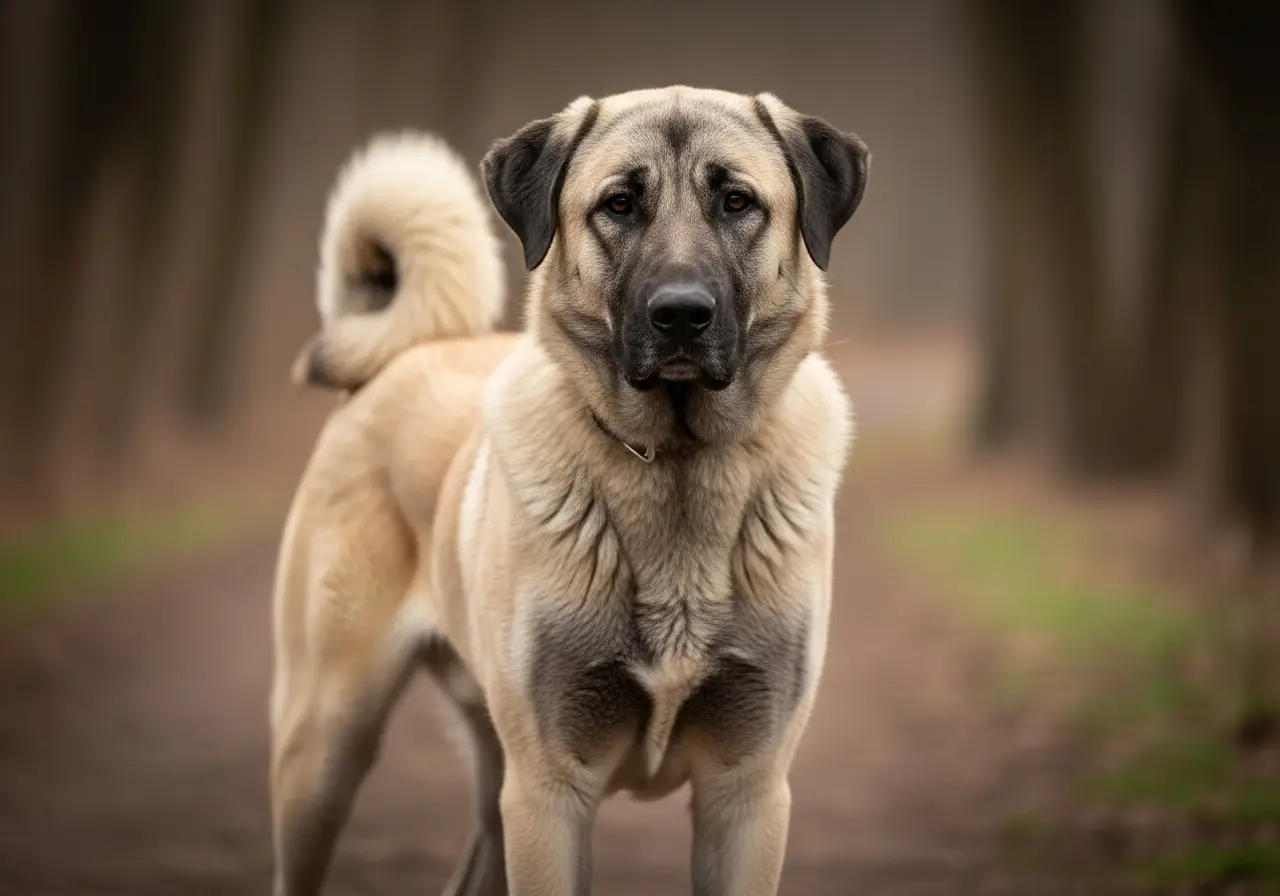
The Kangal is not a companion dog with a large body; it is a herd guardian from the Turkish province of Sivas, genetically programmed for independent protective decisions. Anyone who keeps one takes responsibility for a dog that defends territory, distrusts strangers and questions authority. This is not a character flaw but the breeding goal over centuries.
02Introduction
What makes the Kangal special
The Kangal is the Turkish national watchdog, FCI Group 2, with the strongest bite of all dog breeds, bred for wolf hunting, shoulder height 72–86 cm.
03Profile
Key facts and suitability
- Origin
- Türkei
- Original purpose
- Livestock protection against wolf, bear and leopard
- FCI
- No. 331 · Group 2 · Sektion 2.2: Molossoide, Berghunde, ohne Arbeitsprüfung
- height at the withers
- 65–78 cm
- Weight
- 41–66 kg
- Life expectancy
- 12–15 Years
- Coat type
- Short-haired
- Minimum exercise
- 60 min/day
- Puppy price
- 1'000–2'500 CHF
- Waiting period
- 12 months
- Sports
- Schutzhund
04Temperament
How the Kangal shows up in everyday life
When a stranger enters the property, the Kangal does not react with barking out of uncertainty; it positions itself. It observes, assesses and decides independently whether a situation requires a reaction. This is not an impulse, but the result of centuries of selection for independent judgement.
In everyday family life, another side shows itself: towards its primary caregivers, the Kangal is loyal and affectionate. During dinner on the terrace, it lies quietly nearby, watches the garden and sleeps half-asleep. When an unknown car drives past slowly, it lifts its head. When a neighbour appears at the fence, it stands up.
Here lies the decisive separation of the two behavioural axes: The internal need for social contact of the Kangal is moderate; it does not require constant interaction, no playing, no enrichment in the classic sense. It wants closeness to its group, not activity with it. The external reaction to strangers, however, is clearly reserved to mistrustful. A high need for social contact in this breed does not mean openness towards every person.
Anyone who does not understand this difference makes a consequential mistake: A Kangal that is closely bonded to its family will therefore not be friendly towards visitors. On the contrary, its bond with the group strengthens its guarding motivation.
It behaves dominantly towards conspecifics, particularly those of the same sex. In a multi-dog household, it requires clear structures and sufficient retreat space. It accepts puppies of other breeds more readily than adult dogs it does not know.
The Kangal is not a dog that adapts to changing situations. It requires a stable territory, reliable routines and a primary caregiver who frames its decisions without breaking it.
05Needs
What this breed needs daily
The Kangal requires 60 to 90 minutes of controlled exercise daily. The decisive factor here is not sporting intensity, but the quality of the walk: structured walks with clear leadership, no uncontrolled off-leash running in public areas. A secured property on which it can move freely does not replace a guided walk; it complements it.
The territory is not a comfort for the Kangal, but a psychological prerequisite. An enclosed area of at least 500 m², preferably more, gives it the opportunity to exercise its guarding function without being under constant stress. The fence must be stable, high and dig-proof: at least 180 cm, ideally with an anti-climb protection.
Mental stimulation in the Kangal does not arise from fetching or agility, but from perceiving its guarding role. A Kangal that has a clearly defined territory and knows who belongs to it is more balanced than a Kangal that has to process new stimuli without context daily.
It tolerates being left alone within its territory for up to six hours, provided the territory is secured and familiar. Outside its own property, such as in an apartment or a strange house, the stress level rises considerably.
Socialisation from the early puppy phase is not optional, but mandatory. The Kangal requires structured encounters with people, children, other dogs and urban stimuli, not to make it an open dog, but to stabilise its threshold of irritation and prevent overreactions. An accompanying dog training school with experience in livestock guardian dogs is significantly more helpful than general obedience courses.
Exercise
Medium
mental work
Medium
Social needs
Medium
training
Experts
06Sport & Mental and Physical Stimulation
What sports the Kangal is suited for
Realistic in terms of physiology and genetics – not every breed suits every sport.
Structurally and physiologically suitable: CaniCross / bikejoring possible.
07Quick Check
08Suitability
Who this breed is suitable for – and who it isn't
✓Matches
The Kangal suits owners who demonstrably have experience with independently working dogs or livestock guardian dogs. Anyone who has already handled a dog of this category and understands that obedience works differently here than in retriever breeds brings the right starting basis.
A household with a large, securely fenced property is suitable, at least 500 m², stable fence, dig-proof. Rural or suburban locations are significantly more suitable than urban environments with high stranger frequency.
Families with children from about ten years of age come into question if the adults fully take on leadership responsibility and children are consistently guided in handling the dog. Younger children increase the risk of uncontrolled situations.
Owners who are prepared to ensure 60 to 90 minutes of structured exercise daily, schedule regular vet visits, and actively manage the dog's socialisation meet the basic time requirement. Anyone who regularly receives visitors needs a well-thought-out management concept for these situations; a separate, secure area for the dog is not an exception but standard practice.
×Doesn't match
The Kangal is unsuitable for owners without prior experience with livestock guardian dogs or independently working breeds. Those who have previously handled companion dogs or classic family dogs tend to significantly underestimate the independence and guarding instinct of this breed.
Keeping the dog in an apartment is out of the question, regardless of the apartment's size. The Kangal requires a defined territory outdoors. Anyone living in a rented flat, a terraced house without a secure plot of land, or in a densely populated urban area cannot meet the basic requirements.
Owners who are regularly away from home for more than six hours and cannot organise reliable dog care structurally overwhelm the dog. Anyone expecting the Kangal to react openly and friendly towards strangers because it is warm-hearted towards its family confuses the internal bond axis with the external reaction axis, a misunderstanding with serious consequences. Households with frequently changing visitors, children under ten years old without consistent supervision, or other dogs without a clear introduction structure are also unsuitable.
10Line reality
Show line, working line, breeder market
The Kangal does not have a classic working line-show line division in the sense of retriever or German Shepherd breeding. The breed was historically selected exclusively for performance; beauty was a consequence of function, not an independent breeding goal.
Regional differences exist in Turkey: dogs from the province of Sivas are considered the original type with the greatest uniformity in colour and physique. Dogs from other Anatolian regions sometimes differ in size, coat structure and temperament, but they are not always clearly managed as separate lines.
In DACH countries, the breeding base is narrow. Most breeders work with imports from Turkey or from other European countries where the breed is more established, such as Great Britain or the Netherlands. A pronounced show line in the European sense does not exist; show success plays a subordinate role compared to type consistency and health.
Anyone buying a Kangal should ask about the lineage of the parent dogs and check whether the dogs were bred for livestock guarding traits or for show type. The latter is rare, but not excluded. A dog with a strong show focus may be milder in temperament; this is not a quality feature if the owner is looking for a reliable guardian, but it is a relevant difference for everyday keeping.
11Health · Reality
What you need to plan for medically with your Kangal
According to breeder associations and veterinary literature, the life expectancy of the Kangal is 10 to 13 years, a solid value for a breed of this size. However, as a large-framed molossoid, it carries specific health risks that must be known before purchase.
Hip dysplasia (HD) is widespread in large dog breeds. Reliable figures specifically for the Kangal are limited in scientific literature, as the breed is comparatively rarely kept in DACH countries. The Orthopedic Foundation for Animals (OFA) records HD rates of 15 to 25 % for related molossoids (OFA database, status 2023). Reputable breeders X-ray parent animals and provide HD findings; this is a minimum standard, not a bonus.
Gastric dilatation-volvulus (bloat) is a serious risk in deep-chested large dogs. Symptoms such as a distended abdomen, retching without vomiting and restlessness require immediate veterinary emergency care; every hour counts. As a preventive measure, vets recommend avoiding large meals after intense exercise and switching to two or three smaller meals daily.
Regular check-ups include: annual weight checks (overweight places disproportionate stress on joints), dental status, eye examinations and joint screening from the fifth year of life. Vaccinations and parasite prevention follow the usual large dog schedule.
Overweight is an underestimated risk in this breed: A Kangal that receives too little exercise and too much food places permanent stress on hips and elbows. The ideal weight lies between 50 and 65 kg, depending on sex and frame size.
12Structured data
Health by the numbers
Prone to diseases
Hip dysplasia, heart problems, thyroid problems
Recommended health tests
Hip X-ray, cardiac examination
13Myths ↔ Reality
What is often said incorrectly about this breed
Five myths, five realities, five sources.
"The Kangal is aggressive and dangerous by nature.
The FCI standard explicitly describes the Kangal as non-aggressive, but as a good watchdog. Its guarding instinct is directed against perceived threats to the territory or the flock, not against people in general. Misbehaviour almost always arises from inadequate socialisation, incorrect keeping conditions or inexperienced handling, not from genetically ingrained aggressiveness.
"A large property is sufficient as a prerequisite for keeping.
Space is necessary, but not sufficient. The Kangal additionally requires an experienced primary caregiver with an understanding of livestock guardian dog behaviour, a consistent leadership structure and early, broad socialisation. A large property without these prerequisites produces an uncontrollable dog, not a reliable watchdog.
"The Kangal has the strongest bite of all dog breeds, which makes it unmanageable.
Measurements of bite force vary greatly depending on methodology and are scientifically difficult to compare. The decisive factor is not the bite force alone, but the overall profile: A well-socialised Kangal, handled by an experienced person, uses its guarding instinct in a situation-appropriate manner. The bite force is an argument for experience and responsibility, not for unmanageability.
"The Kangal is identical to the Anatolian Shepherd Dog.
Since the standard of 15 June 2018, the FCI lists the Kangal Shepherd Dog as an independent breed under FCI Standard No. 331. The Anatolian Shepherd Dog (Karabash) is a separate classification that has been used historically in some countries, particularly in the Anglo-American sphere. In the FCI system, the two are not identical.
"Kangals can be shaped like other Molossers through consistent obedience training.
The Kangal was not selected for obedience towards humans, but for independent decision-making ability in livestock protection. It questions authority and often reacts to classic working dog methods with refusal. Training must be based on trust, consistency and an understanding of livestock guardian dog psychology, not on drill.
"A Kangal from an animal shelter is unreliable and no longer trainable.
Many Kangals are surrendered because owners have underestimated the breed, not because the dogs are behaviourally disturbed. With an experienced primary caregiver, a structured daily routine and sufficient space, even rehomed Kangals can lead a stable life. A reputable animal welfare organisation with breed knowledge can assess the suitability of the dog for a new household.
14animal welfare
The animal welfare perspective
Breeder market, designer versions, animal shelter reality — what no one writes in the puppy ad.
The Kangal belongs to the breeds that end up in animal shelters and rehoming centres disproportionately often in DACH countries. The reason is almost always the same: owners have underestimated the breed. Territorial behaviour, barking intensity in residential areas and pronounced independence overwhelm people who expected a large, calm family dog.
There are considerable quality differences on the breeder market. Reputable breeders in breed associations work with health screenings, socialisation and buyer checks. Alongside this exists a grey market, particularly from Eastern European and Turkish imports, where puppies are sold without socialisation, without health certificates and without support. These dogs statistically end up being given up more often.
Designer versions or crosses with the Kangal are occasionally marketed under terms such as "Anatolian Mix" or "Kangal Shepherd". These dogs often carry the guarding and territorial behaviour of the Kangal without buyers being informed about this. The result is dogs in households that are structurally unsuitable.
Problems arising from housing conditions are primarily caused by insufficient space, lack of socialisation and the attempt to handle the Kangal like a working dog. A Kangal kept permanently in a territory that is too small or whose guarding instinct finds no structured task develops behavioural issues, not out of malice, but due to under-stimulation and stress.
Adoption is an equally valid option. Many of the surrendered Kangals are healthy, stable dogs that can lead a good life in a suitable household. Specialised animal welfare organisations and breed protection clubs know the dogs and can assess suitability realistically. Anyone who truly understands the breed often finds a dog there that is already basic-socialised, an advantage over a puppy without a background of experience.
15Costs · Transparency
What this breed realistically costs
A Kangal puppy from a reputable association breeder costs between 1,200 and 2,000 euros in DACH countries. Offers significantly below this often originate from dubious sources without health screenings or sufficient socialisation. Rehomed dogs from animal welfare organisations cost a rehoming fee of 200 to 500 euros.
The annual food costs for a Kangal range from 800 to 1,500 euros depending on the form of nutrition. Raw feeding (BARF) is at the higher end, high-quality dry food in the mid-range. In addition come care costs for the dense coat: regular brushing is done by the owner, professional grooming occurs less frequently but costs 80 to 150 euros per session.
Average vet costs: basic care (vaccinations, parasite protection, annual check-up) amounts to 300 to 500 euros annually. Orthopaedic assessments, emergency treatments or operations can quickly reach 1,500 to 5,000 euros. Dog liability insurance is not an option but mandatory for this breed, particularly in federal states with restricted breed status. Costs: 150 to 400 euros annually depending on the coverage sum and provider. A health insurance policy for the dog costs an additional 600 to 1,200 euros per year.
16Puppy search
What you need to consider when choosing a breeder
- A reputable breeder registers their dogs with an association, provides health certificates (hip X-rays, eye examinations) and allows interested parties to inspect the rearing conditions on site.
- The puppy grows up with human contact and structured stimuli, not isolated on a farm without socialisation.
- Reputable breeders ask counter-questions: Who are you, what have you kept before, what does your property look like?
- Those who do not wish or need to buy a puppy can regularly find Kangals available for rehoming through specialised animal welfare organisations and breed protection clubs.
- Many of these dogs were given up because owners underestimated the breed, not because the dogs are problematic.
- A reputable rehoming centre with breed knowledge assesses the dog's suitability for the new household and supports the settling-in period.
- Warning signs with breeders: no viewing appointment, puppies without the mother, sale under eight weeks of age, no vaccination and deworming documentation, prices significantly below 800 euros without justification.
- Platforms such as eBay Kleinanzeigen are not a suitable way to acquire a breed with this profile of requirements.
FAQ
Frequently asked questions about the Kangal
Is Kangal a family dog?
Kangal is considered suitable for families with good socialisation and species-appropriate care.
How much exercise does Kangal need?
At least around 60 minutes of exercise per day.
What is the size and weight of Kangal?
Fully grown, Kangal reaches about 65–78 cm at the withers and weighs around 41–66 kg.
What is the life expectancy of Kangal?
The life expectancy of Kangal is approximately 12–15 years.
Which diseases are common in Kangal?
Hip dysplasia, heart problems, thyroid problems
17Breed clubs
Official breed clubs in DACH
19Related
Similar breeds – and their differences
You might also be interested in
Participate
Do you have a good photo of your Kangal?
We are looking for expressive images for our breed profiles. Submit yours; the editorial team reviews every submission before publication.
Does this breed suit you?
Turkish national breed. One of the strongest bites of all dog breeds. Species-appropriate keeping only as a working dog. Nocturnal watchdog.