
Common ear disease: haematoma auris in dogs
A haematoma auris in a dog is usually caused by vigorous head shaking during ear infections. Treatment costs between 50 and 400 euros and heals within 1–2 weeks if punctured in time.
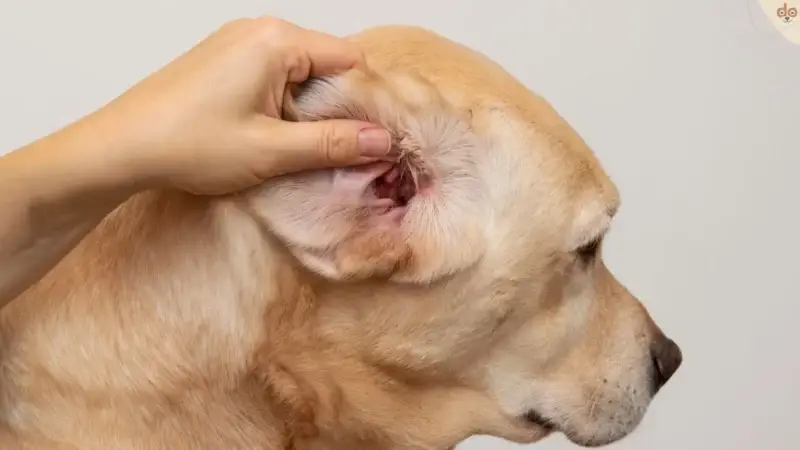
Content
Is your dog suddenly scratching its ear continuously and shaking its head? Is the ear swollen and feels warm? You may be looking at a haematoma auris, a haematoma where blood collects between the ear cartilage and the skin.
How does a haematoma auris develop in dogs?
A haematoma auris develops through injuries to the fine blood vessels in the pinna. This usually happens due to vigorous head shaking during ear infections, scratching with claws or bites from other animals.
Dogs with floppy ears such as Labradors or Cocker Spaniels are particularly susceptible; their ears have less air circulation and are prone to inflammation. These inflammations itch. The dog scratches and shakes its head. The blood vessels tear.
Sometimes a foreign body in the ear also triggers vigorous shaking. Or an allergy makes the ears so itchy that the dog scratches itself until it bleeds.
How do I recognise a haematoma auris?
You can recognise a haematoma auris by a tense, warm swelling of the pinna. The swelling feels like a balloon filled with fluid.
Your dog shows these signs:
- Frequent scratching at the affected ear
- Head shaking or head tilting
- The ear hangs differently than usual
- Tenderness to touch on the ear
In dogs with light skin, you will see a reddish discolouration due to the accumulated blood. In dogs with dark skin, the swelling is the most obvious feature.
What does treatment cost?
A simple puncture costs between 50 and 80 euros. In cases of recurrent haematomas or more complicated cases, costs can rise to 200–400 euros, including anaesthesia, surgery and aftercare.
The vet usually punctures the haematoma on an outpatient basis. They insert a cannula and let the blood drain. Afterwards, your dog often receives a cortisone injection to prevent the haematoma from reforming immediately.
In case of relapses, the vet sometimes sutures the pinna together at several points. This prevents blood from accumulating again.
How long does healing take?
After a successful puncture, the ear swells noticeably less within 3–5 days. Full healing takes 1–2 weeks.
Without treatment, the haematoma auris can persist for weeks. The ear cartilage then becomes permanently deformed, resulting in so-called “cauliflower ear”.
The underlying disease that led to the head shaking must be treated in parallel. Otherwise, the haematoma will keep forming anew.
When do I need to go to the vet immediately?
Go to the vet on the same day if you notice a tense swelling on the ear. The earlier the treatment, the better the prognosis.
It becomes particularly urgent if your dog no longer allows its ear to be touched or shows clear signs of pain. An untreated haematoma auris can become inflamed.
Also have seemingly harmless ear infections treated. They are the most common trigger for haematomas auris.
Can a haematoma auris heal on its own?
A small haematoma can theoretically disappear on its own. However, this takes weeks and usually leaves a deformation of the ear. Professional treatment is significantly gentler.
Does a haematoma auris keep recurring?
This depends on the cause. If the underlying disease (usually an ear infection) is not treated, the haematoma will return. After successful treatment of the underlying disease, a relapse is unlikely.
Is a haematoma auris contagious?
No, the haematoma itself is not contagious. However, if a bacterial ear infection was the cause, this can be transmitted to other animals through direct contact or shared items.
Can both ears be affected at the same time?
Yes, in systemic diseases or bilateral ear infections, both ears can develop a haematoma. However, this is rarer than a unilateral haematoma auris.
Does cooling help with a fresh haematoma auris?
Cooling can limit swelling in the first few hours. Wrap a cold pack in a towel and hold it against the ear for a maximum of 10 minutes. However: a visit to the vet is still necessary.