Dog choking on an object? The Heimlich manoeuvre by dog size
If your dog cannot get air, seconds count. How to recognise a true blockage and act correctly depending on your dog's size.
Content
- How can I tell that my dog is really choking?
- What are the typical causes?
- How do I protect myself before I step in?
- How do I open the mouth and remove a visible foreign object?
- What do I do with a small dog?
- How do I perform the Heimlich manoeuvre on a large dog?
- What if my dog loses consciousness and is not breathing?
- Do I still need to see a vet after successful first aid?
- How can I prevent it?
- Frequently asked questions
Updated October 21, 2026Responsible editor: Roger Klein
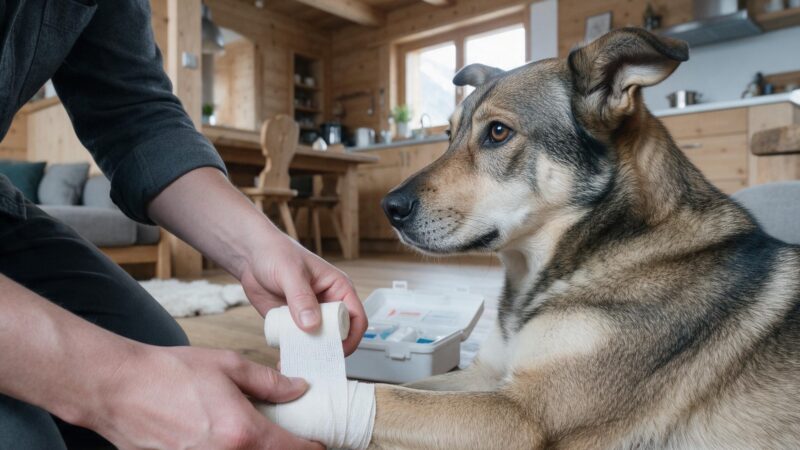
Featured image: AI-generated illustrative image (Seedream 5 Pro).
When a dog chokes, it is rarely quiet. It opens its mouth wide, paws at its muzzle, retches without bringing anything up and paces restlessly in circles. You then have a few seconds to decide whether to step in. Stepping in while the dog can still get air is a mistake too.
Important. This guide helps you bridge the minutes until you reach the vet. It does not replace a visit to the vet, even if your dog behaves normally again afterwards.
How can I tell that my dog is really choking?
You can recognise a true airway blockage by the fact that you can no longer feel or hear any airflow. The dog seems panicked, paws at its mouth, retches without result, and the mucous membranes of the gums and tongue turn bluish or grey. As long as it coughs, gasps or wheezes, air is still getting through. Then the situation is different.
What you do next depends on this. Coughing is a protective reflex of the airways and often works better than any manoeuvre from outside. Retching can come from the stomach and throat, and reverse sneezing (a sudden, noisy intake of breath through the nose) sounds dramatic but is usually harmless. In these cases the airway is not completely blocked. A foreign object may still be stuck, so go to the vet straight away.
So watch one or two breaths before you act. If you can see and hear air moving, stay calm, keep the dog as still as possible and drive to the vet, ideally after calling ahead.
What are the typical causes?
Typical culprits are balls that are too small for the size of the dog, such as a golf ball or a small rubber ball. Add to that chews that break off in pieces, sticks, pieces of rawhide, parts of toys and occasionally chunks of food that are gulped down without chewing.
The dangerous objects are those that seal the throat exactly: round, smooth and a little too small. Such items slip backwards during play when the dog suddenly breathes in, for example while catching or when startled.
How do I protect myself before I step in?
A dog that cannot breathe may bite out of panic, even your own dog. That is a reflex, not aggression. Never tie the muzzle of a dog that is struggling to breathe and do not put a muzzle on it. That takes away its last route for air. Approach calmly and from the side, wrap the dog in a towel if it resists so that only the head is free, and keep your hands away from its teeth while it is snapping. A bitten hand costs time the dog does not have.
If you can, call a second person over to hold the dog or ring the vet. An emergency is easier with two. One works on the dog, the other organises the transport.
How do I open the mouth and remove a visible foreign object?
Open the mouth carefully by gripping the upper jaw from above with one hand and gently pressing the lips against the teeth. With the other hand, pull the lower jaw down. Look inside and only remove what you can see clearly and grasp loosely.
Never reach blindly into the throat. Feeling around in the dark with your fingers often pushes the object further down, especially with round objects such as balls. Sticks and bone fragments can also splinter or injure the lining of the mouth and throat. An object you cannot grip securely stays where it is. Move on to back blows and the Heimlich manoeuvre instead.
What do I do with a small dog?
Lift a small dog by its thighs so that its head points down, and swing it gently back and forth. Then give a few blows between the shoulder blades with the flat of your hand and look into its mouth.
If nothing comes loose, press briefly and firmly forwards just behind the ribcage, never squeezing. Then check the mouth.
How do I perform the Heimlich manoeuvre on a large dog?
With medium-sized and large dogs, the approach is the same, standing or with the dog lying on its side. Start with back blows. Support the chest with one hand and give a few firm blows between the shoulder blades with the flat of the other. Then check the mouth. If nothing comes loose, the Heimlich manoeuvre follows.
With the dog standing, stand behind it, place both hands under its belly just behind the ribcage and thrust briefly and firmly upwards and forwards. Repeat this a few times. If the dog is lying on its side, kneel behind its back. Place both hands on the side of the ribcage and press briefly and firmly, or press forwards and upwards under the ribcage with one hand while the other supports the back. Work in rounds: back blows, Heimlich manoeuvre, check the mouth, then start again.
Do not stop the rounds while the dog is conscious and cannot get air. If a second person is there, they can organise the transport to the vet at the same time. That saves time.
What if my dog loses consciousness and is not breathing?
If your dog collapses, stops responding and shows no breathing, start resuscitation. First open the mouth, pull the tongue forwards and remove any visible foreign object, using tweezers if necessary. Only once the dog is unconscious may you also feel with your finger. You can push a ball towards the mouth from the outside of the neck.
Then begin chest compressions following the guidelines of the RECOVER Initiative (2024 update). The dog lies on its side. Compress 100 to 120 times per minute, to a depth of a third to half the width of the chest, alternating 30 compressions with 2 breaths, in cycles of 2 minutes. You will find the full instructions in our emergency guide to first aid for dogs.
Breathe into the nose and watch whether the chest rises. If it does not, check the airway again and continue with chest compressions.
Do I still need to see a vet after successful first aid?
Yes, always. Even if the dog is breathing normally again, the object may have injured the lining of the throat and the larynx. There is also the risk of aspiration, where saliva, food or foreign material gets into the lungs and can cause pneumonia over the following hours or days. The University of Veterinary Medicine Hannover advises going to the vet as quickly as possible in an emergency and calling ahead. Veterinary guides such as VCA expressly recommend a check-up even when the dog seems to have fully recovered.
Call on the way and briefly describe what happened and what you did. The practice can prepare, and you save minutes.
How can I prevent it?
Prevention starts with the right toy size. Choose balls that suit the size of the dog and have an air hole, and chews large enough that they do not fit entirely into the mouth. Check toys regularly for cracks and loose parts. Do not throw sticks. Wood splinters easily, and the shards can pierce the mouth and throat or get wedged between the teeth.
For dogs that gulp their food, slow-feeder bowls or smaller portions spread out help. If you are unsure whether you would react correctly in an emergency, a first-aid course for dog owners with practical exercises helps more than any theory. Vet practices and dog training schools offer such courses. You will find an overview of other emergencies in our first-aid guide.
Frequently asked questions
Should I pat a coughing dog on the back?
No. As long as the dog is coughing forcefully, it is still getting air, and its cough helps more than any manoeuvre. Keep it calm, watch its breathing and drive straight to the vet.
How often do I repeat the manoeuvres?
PDSA and the RSPCA advise laying the dog on its side and striking the ribcage firmly three or four times with the flat of your hand. Repeat this until the object comes loose or you reach the practice, checking the mouth in between. If the dog loses consciousness, switch to resuscitation.
Can I use the Heimlich manoeuvre on a puppy?
Yes, but very gently. Lift the puppy by its thighs, head down, and tap lightly between the shoulder blades. Behind the ribcage, press only with little force. Afterwards, it always needs to see a vet.
How can I tell that the object is still stuck in the throat?
Persistent retching, increased drooling, swallowing movements, pawing at the mouth and restlessness point to it, even if the dog is breathing again. With signs like these, your dog needs to see a vet, because the object can cause injuries or move further.
Should I drive to the vet with my dog or look for help first?
Both at the same time, if possible. Call the practice on the way, or have a second person call, so that they can prepare. If you are on your own, call the practice straight away (on speaker) and start the first-aid steps. If the object does not come loose quickly, set off rather than wait.