
Gaits
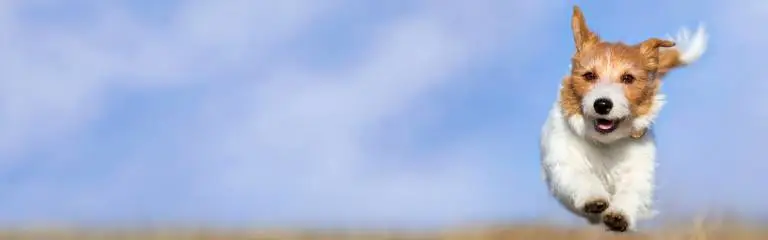
Gaits in dogs describe the biomechanically different movement patterns of locomotion.
Content
Gaits in dogs describe the biomechanically different movement patterns of locomotion. The four main gaits, walk, trot, gallop and pace, differ in leg sequence, speed and the time during which all paws touch the ground.
What gaits do dogs have?
The four basic gaits follow different biomechanical principles. In the walk, at least one paw always touches the ground; the legs move in diagonal pairs with a clear overlap time. The trot uses the same diagonal leg sequence but with a more springy movement and short suspension phases between steps.
The gallop shows a characteristic four-beat sequence: hind paw, other hind paw, diagonal front paw, other front paw, followed by a suspension phase in which all paws leave the ground. In the pace, the legs on one side of the body move synchronously, which rarely occurs spontaneously in healthy dogs.
How can I recognise gait problems in my dog?
Asymmetrical stride lengths between the right and left legs indicate one-sided pain. A dog with hip dysplasia often shows a shorter stride of the hindquarters and avoids longer trotting distances.
Sudden pacing behaviour can indicate back problems; the dog avoids diagonal leg coordination because it twists the spine. Lameness is not only shown by lifting the paw but also by a shortened loading time of the painful leg.
Which gait does my dog choose when?
Relaxed dogs switch to a walk at 2–4 km/h and to a trot at 5–8 km/h. The transition occurs automatically; if you force a slower dog into a trot, its gait appears stiff.
Gallop sets in for most dogs from 15 km/h, but also at lower speeds with moderate excitement or play behaviour. Some breeds, such as sighthounds, prefer galloping over trotting, even at medium speeds.
What do gait changes mean for health?
Stiffer movements in the morning that resolve after 10–15 minutes indicate early-stage osteoarthritis. A dog that limps after rest periods and then walks normally may have joint problems in the early stages.
Older dogs often develop a “short-stride gait”, with shorter, more frequent steps instead of longer strides. This compensates for declining muscle strength and balance. In puppies, an unsteady gait between the 8th and 16th week indicates normal development; persistent coordination disorders afterwards should be checked by a vet.
More from the Wiki
All wiki entries →Plum
The plum is a stone fruit of the genus Prunus. Its stone contains cyanogenic glycosides; the …
Rhubarb
Rhubarb is a knotweed whose leaves are rich in soluble oxalic acid. For dogs, the leaves …
Why is dog faeces white?
White dog faeces occurs when normal digestion is disrupted or certain substances change the colour of …
Dog licks its anus, what to do?
Anal licking in dogs is a normal grooming behaviour that serves for cleaning and emptying the …