How to stop a dog’s bleeding with a pressure bandage in five steps
How to assess bleeding in your dog, treat it with pressure and a bandage, and recognise when only the trip to the vet counts.
Content
- What comes first when your dog is bleeding?
- How do I assess the bleeding: oozing, flowing or spurting?
- How do I apply direct pressure properly?
- How do I apply a pressure bandage step by step?
- What is different about paw pads, ears and claws?
- Can I use a tourniquet on a limb?
- What if something is stuck in the wound?
- What should I do about a nosebleed?
- How do I recognise shock after heavy blood loss?
- When does a bleeding dog need to see a vet immediately?
- What belongs in the first-aid kit?
- How do I find a good dog trainer to get my dog used to bandaging?
- Frequently asked questions
Updated October 21, 2026Responsible editor: Roger Klein
Featured image: AI-generated illustrative image (Seedream 5 Pro).
A bite wound on the ear, a shard of glass in a paw pad, a torn claw: if you live with a dog, sooner or later you will find yourself looking at blood and having to decide in seconds what to do. A small bleed can usually be stopped with pressure and calm. With large, spurting or deep wounds, every minute on the way to the vet counts.
The order of steps below is tried and tested in first aid. It does not replace an examination by a vet, but it helps you do the right thing until you get there.
What comes first when your dog is bleeding?
First you, then calm, then the wound. A dog in pain may bite even its owner, however gentle it normally is. Speak quietly, crouch down and keep the dog from jumping up or running around, because every movement pumps more blood out of the wound. With an injured, agitated dog, put on a muzzle loop before you touch the wound. Use a wide gauze bandage, a lead or a scarf, never anything that could cut off the air supply. The loop must not be tight. If the dog vomits, struggles to breathe or pants, take it off straight away. Do not use a muzzle loop for facial injuries, breathing difficulties, chest injuries or with short-nosed breeds such as Pugs or Bulldogs. Never leave a muzzled dog alone.
Then move the dog to a quiet spot, ideally onto a surface you can wash later. If someone is with you, they should hold the head and talk to the dog while you deal with the wound. If you can, call the practice or the emergency service before you bandage and tell them you are on your way. Calling ahead saves time at the practice, and you often get an assessment over the phone.
How do I assess the bleeding: oozing, flowing or spurting?
The type of bleeding tells you how urgent the situation is. If blood oozes slowly, drop by drop, from a scratch or a superficial graze, it usually comes from small vessels and stops by itself with gentle pressure. If it flows steadily and dark red from a wound, a vein is more likely to be involved. You then need firm, steady pressure and often a bandage. If bright red blood spurts or pulses in time with the heartbeat, an artery is injured. That is an emergency: apply pressure immediately and head for the practice at the same time, ideally with a second person driving.
Depth matters too. If you can see muscle, tendons or bone in the wound, or if it gapes and cannot be held together with your fingers, your dog needs a vet, even if the bleeding seems to have stopped after bandaging. Deep wounds often need stitches, and the sooner that happens, the better they heal.
How do I apply direct pressure properly?
Direct pressure is the most important measure for stopping a bleed. Take a clean compress, a fresh cloth handkerchief or a clean tea towel and press it firmly, but not roughly, onto the bleeding spot. Keep the pressure even, without slipping or rubbing. The most common mistake is checking every few seconds whether it has stopped. Every time you lift the pad, you tear open the clot the body is just forming. Keep up the pressure for several minutes without changing the pad.
If blood soaks through the pad, do not remove it. Put another layer on top and keep pressing. The first layer already holds the fresh clot, which you do not want to disturb. If you can reach the wound and the dog lets you, also hold the injured limb slightly above heart level, which slows the blood flow. Do not force the dog into this position if it hurts.
How do I apply a pressure bandage step by step?
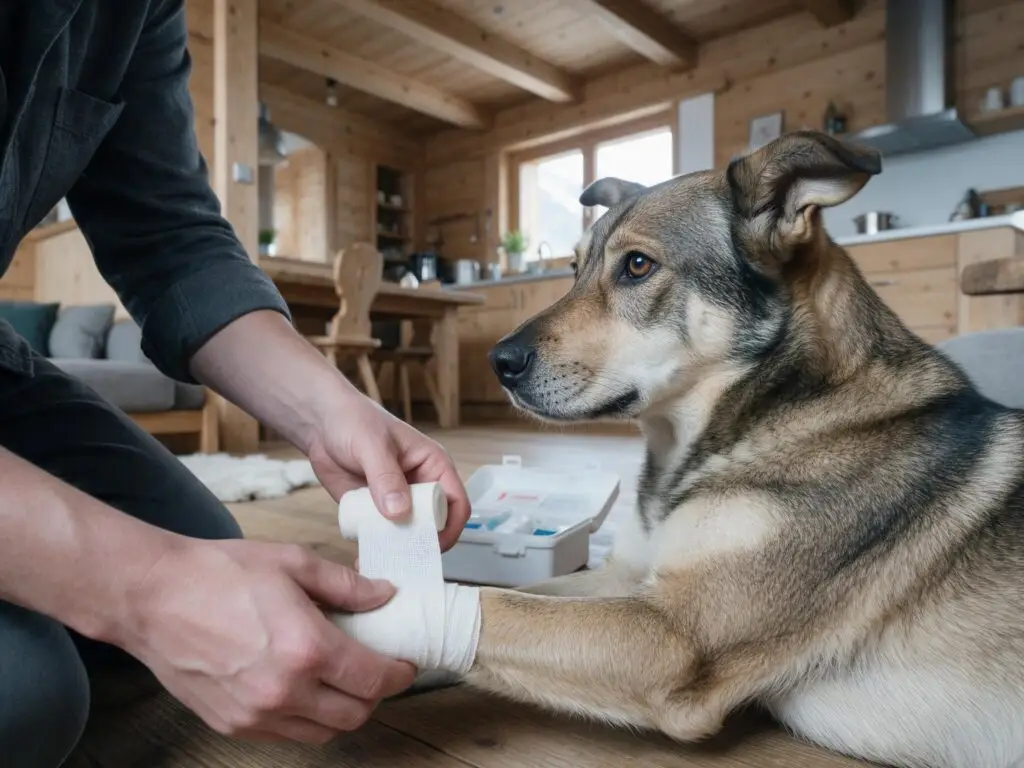
Use a pressure bandage when hand pressure alone does not stop the bleeding or when you need to transport your dog. It has three layers: wound dressing, pressure pad and bandage. The pressure is concentrated on the wound without cutting off the blood supply to the whole limb.
- Place a sterile, or at least clean, dressing directly on the wound and hold it in place with one hand.
- Put a pressure pad on top, for example a rolled-up gauze bandage, a small pack of compresses or a folded clean cloth. It concentrates the pressure on the wound.
- Wrap an elastic or self-adhesive bandage from bottom to top, each turn overlapping the previous one by about half. Pull evenly, without constricting.
- Start below the wound and finish above it, so that the bandage does not slip and blood does not back up.
- Check the toes: warm, normal colour, not swollen. If they feel cold, look bluish or swell up, the bandage is too tight and needs loosening.
A good bandage sits so that you can still slide two fingers underneath. If blood comes through all the layers, add another layer on top and drive to the vet. Never leave a bandage unchecked for hours, because a bandage that is too tight can also damage tissue.
What is different about paw pads, ears and claws?
These three areas bleed particularly heavily and are hard to bandage.
Paw pads and cuts from shards
The paw pad has a rich blood supply and cuts there often bleed alarmingly. With a cut from glass or metal, first check whether a splinter is still in the wound. If so, press next to the splinter. Place a compress on the wound, put padding between the toes and wrap the paw from the pad upwards to above the wrist or hock. A sock or a clean dog boot over the bandage keeps it dry and stops the dog chewing at it. Even cuts on the pad that look small should be seen by a vet, because they can go deeper than they appear and easily become infected.
Ears bleed heavily
Ears often bleed heavily because they are thin and full of blood vessels. Every time the dog shakes its head, blood ends up all over the room. The most important thing is therefore to stop the shaking. Place a compress on each side of the ear flap, then fold the ear flat against the head and secure it there. A bandage wrapped around the head does the job, as long as it leaves the eyes and nose uncovered and is not tight around the neck. With long, floppy ears you can instead fold the ear up and fix it on top of the head. An ear wound that does not stop bleeding quickly needs a vet, because ears heal poorly on their own and often need stitches.
A torn or split claw
A torn claw bleeds a lot and is very painful, because nerves and a blood vessel run through the claw. Press a compress onto the toe and hold it for five to ten minutes. If it keeps bleeding, sprinkle styptic powder from a pharmacy or pet shop, or at a pinch a little flour, on the tip of the claw. You can then bandage the paw loosely. Do not try to remove a half-torn claw yourself, as it hurts the dog unnecessarily. The practice can numb the toe, trim the claw cleanly and treat the wound. Have the claw seen to at the practice the same day, because the exposed claw can easily become infected.
Can I use a tourniquet on a limb?
A tourniquet is the very last resort. It does stop the bleeding, but it cuts off the entire blood supply below that point, and a thin cord also injures nerves and vessels. If it is applied for too long or too tightly, tissue can die and, in the worst case, the limb is lost. So the rule is: direct pressure first, then a pressure bandage. Only if a life-threatening bleed on a leg or the tail cannot be stopped any other way is a tourniquet above the wound justifiable. Use a wide cloth or a wide bandage for it, never a cord. Note the time, set off immediately and call the practice. They will tell you whether and when to loosen it briefly. Never apply one to the neck, the body or the head.
What if something is stuck in the wound?
Do not pull out anything that is stuck in the wound. A stick, a shard of glass, a piece of metal or a tooth may be sealing an injured vessel. If you remove the object, the bleeding may only really start, and you cannot see how deep it goes. Instead, pad it all round with gauze or a cloth so that it cannot move, and secure everything loosely. Then go to the vet without delay, as only a vet can remove the object under controlled conditions.
What should I do about a nosebleed?
Nosebleeds in dogs have very different causes, from an inhaled blade of grass to an injury, clotting disorders or diseases of the nose. Keep the dog calm, place a cold pack wrapped in a cloth on top of the bridge of the nose and do not put anything into the nostrils. Do not tilt the head back, or the blood will run into the throat. If it does not stop within a few minutes, keeps coming back or comes from only one nostril, your dog needs to see a vet. Recurring nosebleeds are never a case for waiting and seeing.
How do I recognise shock after heavy blood loss?
A dog that loses a lot of blood can go into shock before the wound has even been treated. Watch for pale to white gums, cold paws and ears, fast, shallow breathing, a weak, racing pulse and a dog that becomes listless or collapses. You can do a simple test on the gums: press briefly with your finger until the spot turns white, then let go. The pink colour usually returns within about two seconds. If it takes noticeably longer or the spot stays pale, that is a warning sign of poor circulation. Keep the dog warm, cover it, keep it lying still and set off immediately. What to do if your dog collapses is covered in our guide to collapse and shock.
When does a bleeding dog need to see a vet immediately?
Go to the practice or the emergency service straight away, without waiting, if any of these apply:
- The blood spurts or pulses in time with the heartbeat.
- The wound is deep, gapes or shows muscle, tendon or bone.
- The wound comes from a bite, because bite wounds often look small but carry bacteria deep into the tissue.
- Something is stuck in the wound.
- The bleeding is on the chest, belly, neck or head, where organs lie close to the surface.
- The dog shows signs of shock.
- The bleeding does not stop even after several minutes of firm, steady pressure.
Even once the bleeding has stopped, a check by a vet is worthwhile for anything deeper than a graze. The sooner a wound is treated at the practice, the better it can be cleaned and closed. In Switzerland, you reach the veterinary emergency service through your own practice, whose answering machine usually refers you to the vet on duty, or through a veterinary clinic with an emergency service. Save the number on your phone in advance.
What belongs in the first-aid kit?
For bleeding you do not need much, but it has to be clean and within reach. Useful items are sterile compresses in several sizes, a self-adhesive elastic bandage, a gauze bandage, a first-aid dressing pack as a pressure pad, round-tipped scissors, tape for securing, tweezers, disposable gloves and a blanket or foil rescue blanket against chilling. Add a note with the numbers of your practice, the emergency service and a veterinary clinic. You will find the complete kit with every item in our guide to the dog first-aid kit. If you go hiking with your dog, pack a small version in your rucksack, because injuries rarely happen where the bandages are kept.
How do I find a good dog trainer to get my dog used to bandaging?
A dog that enjoys having its paws and ears touched is much easier to treat in an emergency. Training for this pays off in quiet times: touching the paws, putting on a bandage during play, getting the dog used to a fabric muzzle loop with food rewards. A good dog trainer works without force and without aversive tools, explains the steps and builds a handling programme with you that the dog joins in with voluntarily. Look for certified training, transparent methods and a willingness to explain the training plan. In Switzerland, prong collars and slip collars without a stop are banned under Art. 73 para. 2 let. b of the Animal Welfare Ordinance (TSchV), and devices that deliver electric shocks under Art. 76 para. 2. Avoid trainers who use or recommend such tools. You can find suitable dog trainers in your area in our directory.
Frequently asked questions
Can I rinse my dog’s wound with water?
For small, superficial wounds without heavy bleeding, yes: rinse gently with clean, lukewarm water or saline solution to remove dirt. With heavy bleeding, pressure comes first and rinsing comes later. Do not use hydrogen peroxide or alcohol, as both irritate the tissue and can interfere with healing. If you are unsure, cover the wound with something clean and let the practice clean it.
How long should I apply pressure to a bleed?
Keep up the pressure until the bleeding stops, but for at least several minutes without a break and without checking. If blood comes through the pad, add another layer on top instead of removing the first. If the bleeding does not stop even after prolonged firm pressure, drive to the vet and keep pressing on the way. There is no fixed number of minutes that applies to every wound, because the depth and location of the wound make the difference.
Can I use plasters or wound spray made for people on my dog?
Plasters do not stick well to fur and come off quickly. At most they are useful for securing a bandage. Wound sprays and ointments made for people can irritate the wound or be licked off by the dog, and are not a good idea without advice from a vet. A clean compress and a bandage are better. What goes on the wound afterwards is for the practice to decide.
My dog licks the bandage and tries to pull it off. What should I do?
Keep your dog occupied, distract it and keep it calm until you reach the practice. A cone collar or a soft recovery collar stops the dog getting at its paw or ear. A bandage the dog chews no longer protects the wound and can slip. If your dog keeps at it regardless, have the bandage checked and replaced at the practice.