
From Pain to Recovery: The Process of a Bone Fracture
A bone fracture in a dog requires immediate action and professional treatment. In adult dogs, healing usually takes 8 to 12 weeks.
Content
Your dog suddenly yelps and refuses to get up. The hind leg hangs down oddly. A bone fracture means that a bone has been partially or completely broken by external force.
What should I do if my dog has broken a bone?
Avoid any movement of the injured area. Lift your dog carefully; for larger dogs, do so with two people, one supporting the chest and the other the pelvis. Place it on a firm surface such as a board or a blanket.
Do not touch the injured area. A broken bone can have sharp edges that cause further damage when moved. Go to the vet immediately; call ahead so they can prepare.
How can I reliably identify a bone fracture in a dog?
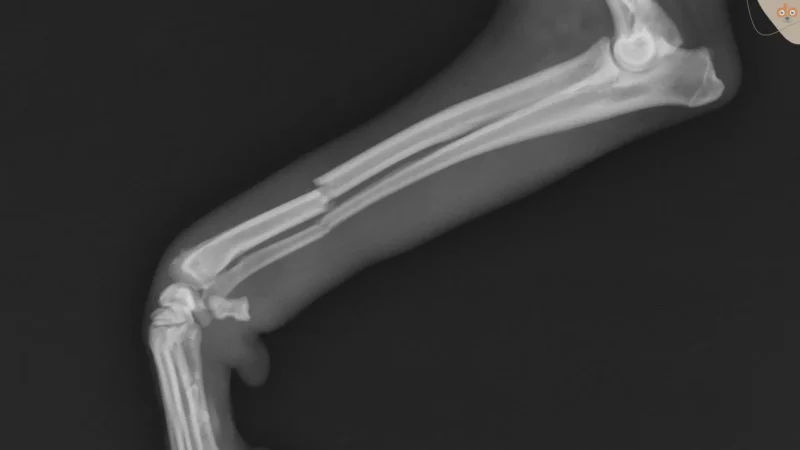
A dog with a broken bone shows these signs: it no longer bears weight on the affected leg at all, or only minimally. The area swells visibly within 30 minutes. In open fractures, you can see bone fragments or an unnatural bulge under the skin.
Some dogs become aggressive due to pain; even the most affectionate family dog may snap if you touch the injured area. A clear sign: the dog assumes an unnatural posture and avoids any movement that could trigger pain.
What treatment does my dog need for a bone fracture?
The vet will first X-ray both sides of the affected bone. Whether a bandage suffices is not determined by severity, but by location: only fractures below the elbow and knee, and even there only stable ones with minimal displacement. Thighs and upper arms should never be put in plaster or splints, as the joint above the fracture cannot be immobilised there. A bandage is harmless anyway: In an evaluation of 60 animals, 63 per cent developed pressure sores or soft tissue damage underneath. Everything else requires surgery with plates, screws or intramedullary nails.
Surgery costs between €1,500 and €4,000, depending on the type of fracture and the size of the dog. Conservative treatment with plaster costs €300–800. Follow-up checks every two weeks and possibly physiotherapy are additional costs.
How long does healing take after a bone fracture?
The duration of healing depends on age, the type of fracture and the treatment provided, not on which bone is affected. In adult dogs, it is approximately 8 to 12 weeks; puppies need at least four weeks, adult and older animals at least eight. Older dogs heal more slowly, but this cannot be quantified precisely. The type of fracture weighs heavier than age: a comminuted fracture carries a risk roughly four times higher that healing will be delayed or fail.
The first two weeks are critical; the bone must not bear any load. From the third week, controlled movement begins: five minutes on a lead daily, then increasing by another five minutes weekly. Full loading only after veterinary clearance via control X-rays.
Overweight dogs heal more slowly. Overweight puts strain on joints and rehabilitation; however, that it delays bone healing is not proven in dogs: In the largest evaluation involving 442 dogs, open fractures, comminuted fractures, age, infections and implant failure are among the risk factors, but body weight is not.
What happens if the fracture does not heal properly?
Fractures that heal incorrectly lead to lifelong lameness. Without proper immobilisation, the bone can knit together in the wrong position. Then only a repeat operation helps, with higher costs and a longer path of suffering for your dog.
Does my dog need physiotherapy after a bone fracture?
After prolonged immobilisation, muscles atrophy. Physiotherapy is part of aftercare, but not with the promise of shortening healing time. What is proven is different: it prevents muscle loss and keeps the joint mobile. Treatment costs €40–80 per session; usually 8–12 sessions are necessary.
When can my dog walk normally again?
More time passes before your dog can do everything again than the bone needs to knit together; muscles, tendons and joints must catch up. There is no fixed rule of thumb for this; whether jumping and running are allowed again is decided in practice based on the control X-ray.
- Marshall WG et al. (2022): Fracture healing complications in dogs. Vet Surg 51:1073-1082
- Meeson RL, Davidson C, Arthurs GI (2011): Soft-tissue injuries associated with cast application for distal limb orthopaedic conditions. Vet Comp Orthop Traumatol 24:126-131
- American College of Veterinary Surgeons: Fractured Limbs