How to secure and move an injured dog without getting bitten
How to secure an injured dog, use a muzzle loop and a stretcher correctly, and get it gently to the vet without putting yourself at risk.
Content
- How do you secure the scene before you touch the dog?
- Why does even your own dog bite when it is in pain?
- How do you approach an injured dog you do not know?
- When and how do you put on a muzzle loop?
- How do you move an injured dog without causing more harm?
- How do you position the dog and keep it warm?
- How do you take the dog to the vet?
- Frequently asked questions
Updated October 21, 2026Responsible editor: Roger Klein
Featured image: AI-generated illustrative image (Seedream 5 Pro).
A dog is lying at the roadside, its hindquarters buckled, its tongue hanging out to one side. You have stopped, your car is parked at an angle, someone is honking. In this situation, the first few minutes decide whether you help the animal or end up in hospital yourself.
Before you can move an injured dog, you secure the scene first, then yourself, then the dog. Reverse that order and you soon have two casualties.
Important. This guide helps you bridge the time until you reach the vet. It does not replace an examination by a vet, even if your dog seems unhurt after the accident.
How do you secure the scene before you touch the dog?
You secure the scene first, because a second accident would harm the dog and you far more than a minute’s delay. Hazard lights on, high-visibility vest on, warning triangle set up at a sufficient distance, and extra light in the dark. In Switzerland, you place the warning triangle at least 50 m behind the car, and at least 100 m on fast roads. If the dog is on the carriageway, use hand signals to ask other road users to slow down before you approach it. A dog in pain that hears cars can bolt in panic into the oncoming lane. If you can, get a second person to keep an eye on the traffic while you look after the animal.
Why does even your own dog bite when it is in pain?
Pain can make even the gentlest family dog snap. It bites out of pain and fear, because its body reads every touch as a further threat. Warning signs are flattened ears, a fixed stare, raised lips, growling, backing away or suddenly freezing. Some dogs show nothing at all and only snap when you touch the injured spot. So always expect an injured dog to snap, and protect your face and hands.
How do you approach an injured dog you do not know?
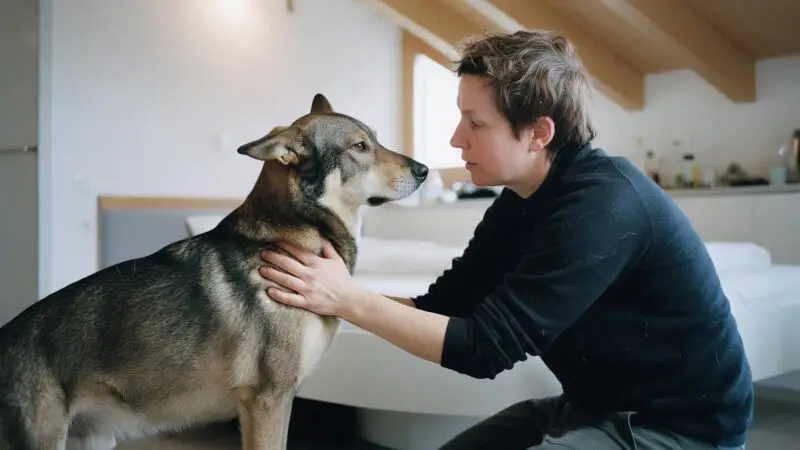
Approach slowly, from the side and crouching, without eye contact and without rushing. Speak quietly and evenly, and stay level with its shoulder rather than reaching over its head from the front. Never stretch your hand out towards its face. If it seems aggressive or lies where you cannot reach it safely, keep your distance, call a vet, the police or an animal emergency line, and wait until someone with experience and equipment arrives. A bite at night on a country road helps nobody. If the owner is there, let them act first and only help as they direct.
When and how do you put on a muzzle loop?
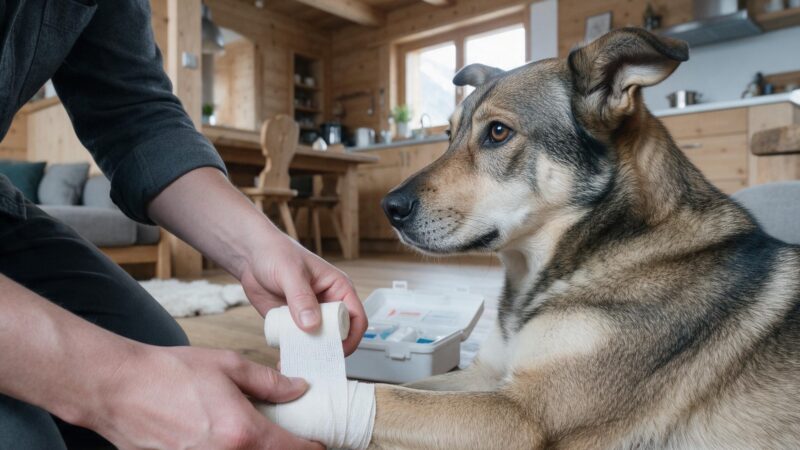
Put on a muzzle loop if the dog is conscious, in pain and might snap at you, but is still breathing freely. The loop slows down bites, but it does not replace caution. A wide strip of material such as a lead, a bandage, a scarf or a gauze bandage, about one metre long, will do.
- Tie a loose loop with a simple knot in the middle.
- Slide the loop over the muzzle from the front, with the knot on top of the bridge of the nose.
- Tighten the loop until the dog can no longer open its mouth. The band should be wide and must not cut in.
- Cross the ends under the lower jaw and tie them behind the ears at the back of the neck.
- Check that the nostrils stay clear.
Never put on the loop if the dog is struggling to breathe, vomiting, unconscious or has weak circulation, or has a head, face or chest injury. With short-nosed breeds such as Pugs, French Bulldogs or Boxers, do not use a loop at all, because they struggle to get air as it is. A loop on a dog that is vomiting can cause choking. In these cases, protect yourself with a cloth laid loosely over the head and eyes, leaving the nose and mouth free, and work from behind.
How do you move an injured dog without causing more harm?
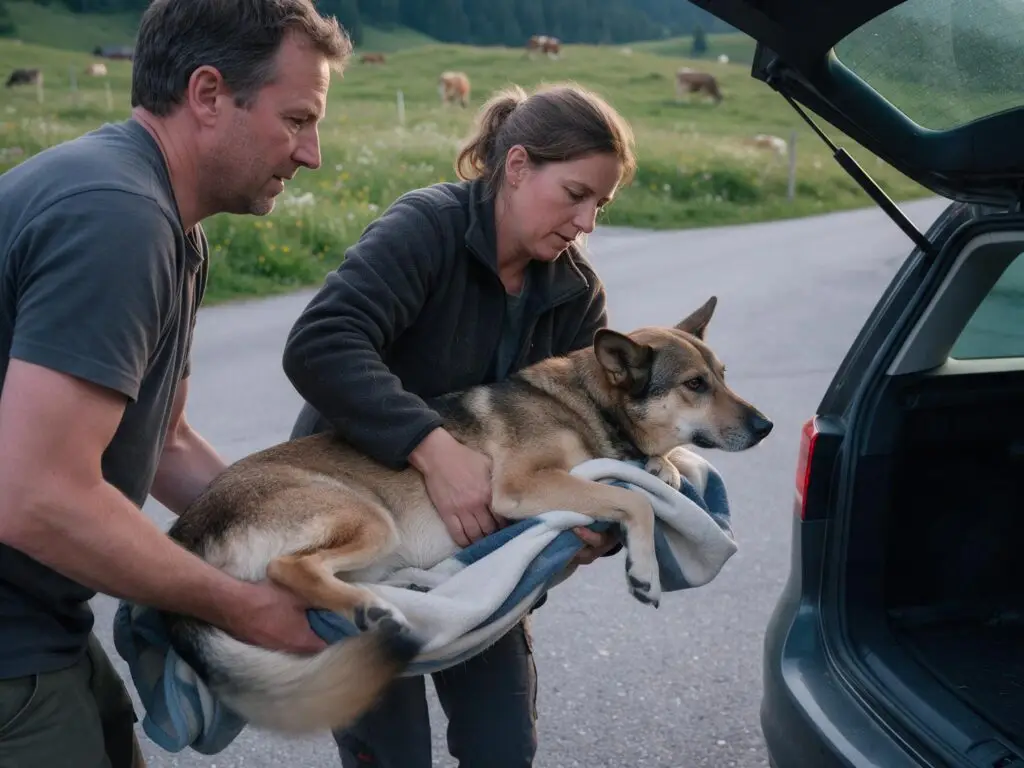
Move the dog as little as possible and never jerkily, because every twist can further damage the spine, the ribcage or internal organs. A blanket, a jacket or a board can serve as an improvised stretcher. Lay it next to the dog, slide the dog onto it on its side, keeping the body in one piece as far as you can, and then lift the blanket by all four corners with a second person. The back stays straight and the head level with the body or slightly above it. If you suspect a spinal injury, for example with paralysed hindquarters, no response to pain or resistance when the back is moved, a firm board or a door is the better base.
Pick up small dogs with both hands under the chest and the hindquarters, or put them in a carrier padded with a towel. Large dogs always need two people. One holds the front, the other the back, and you move in sync.
How do you position the dog and keep it warm?
If the dog is conscious, leave it in the position that hurts it least. If it is unconscious and breathing, lay it on its right side. Stretch the head and neck in line with the back and pull the tongue out of the side of the mouth. Put a blanket under and over it so it does not get cold from the ground either. Cover it loosely, with no heat pad directly on the fur. Treat heavy bleeding with a clean cloth and pressure, not with a tourniquet. You will find more on collapse and shock, the emergency card and the first-aid kit in the matching guides in this series.
How do you take the dog to the vet?
Call the vet or the veterinary clinic before you set off. Say what happened, how the dog is breathing, whether it is bleeding and when you will arrive. That way the team can prepare space and equipment and, if necessary, send you to a better-equipped clinic. In the car, a second person sits with the dog, talks to it calmly, checks its breathing and gum colour and keeps the head and body steady. Never leave a dog with a muzzle loop alone. The dog lies on the stretcher blanket on the back seat or in the boot, never on the front passenger seat. Drive smoothly and brake gently. If you are on your own, put the dog in a crate in the boot or on a blanket wedged firmly in place so that it does not slide.
Frequently asked questions
Do I have to report a dog that has been hit?
Yes, if you have hit a dog with your car or your bike. Legally, an injured dog counts as damage to property. In Switzerland, you stop immediately, secure the scene and notify the owner straight away, giving your name and address. If you cannot reach anyone, inform the police without delay. In Germany, you must not drive away before the owner or the police have been able to take your details, or before you have waited for a reasonable time. Afterwards, you must contact the owner or the police without delay, otherwise you commit an offence. In Austria, you notify the nearest police station without undue delay, unless you and the owner have exchanged names and addresses. If in doubt, call the police.
Can I touch an injured dog I do not know?
Yes, if it seems calm and you can secure it without danger. If it seems threatening, keep your distance and get help. Speak slowly, approach from the side and never touch the head first. If the owner can be reached, let them act and only help as they direct.
Can I put on a muzzle loop if the dog is struggling to breathe?
No. If the dog is struggling to breathe, vomiting or unconscious, the loop can make breathing even harder or cause choking. Never with short-nosed breeds. In such cases, protect yourself with a cloth laid loosely over the head and eyes and call a vet straight away.
What do I do if nobody is there to help?
Secure the scene, call a vet or a veterinary clinic and follow the instructions on the phone. Put small dogs in a crate or on a blanket. Only move large dogs if the spot is dangerous. In that case, slide the dog onto a blanket in one piece and pull it carefully to a safe place.