
Submissive Urination in Dogs – 6 Steps to Success
 Source: legacy_text
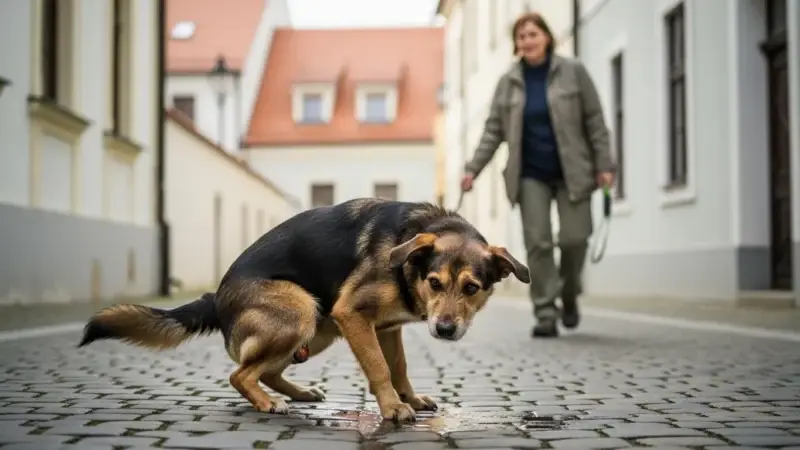
 Submissive urination – many owners know this: you come home, bend down towards the dog, and suddenly the floor is wet. This has almost nothing to do with lack of house training. What lies behind it and how you can help your four-legged friend, you will find out here.
What exactly is submissive urination?
When a dog urinates out of submission, fear or insecurity, it is called submissive urination. At its core, it is a form of communication – the dog signals that it does not pose a threat and submits to the other person or animal.
This frequently occurs in young dogs, especially during the puppy phase. With growing self-confidence, this often resolves on its own. In older dogs, an insecure past is usually behind it or traumatic experiences have become ingrained in their behaviour. Some dogs are simply more sensitive by nature – and therefore tend to do so more strongly.
Anti-Submissive Urination Training
Important beforehand: submissive urination is not a lack of house training and has nothing to do with your dog not knowing better. It is a reflexive reaction to certain stimuli – your dog simply cannot do otherwise at first. What it needs: security, consistent positive reinforcement and above all patience. The following tips will help you.
Body posture and contact
If your dog is prone to submissive urination, reduce direct contact between strangers and it to a minimum for now – or avoid it altogether initially. You are its most important training partner, so you should be the only one touching it for the time being.
Unwanted petting by strangers can often be prevented with a friendly “Please do not pet.” If someone is nevertheless persistent, simply position yourself as a physical barrier between the person and your dog – without any drama.
Dominance gestures of any kind are counterproductive: they appear threatening to the dog and trigger exactly what you want to avoid. Do not bend over it when greeting, do not surprise it from behind, and do not pressure it in any way. Touches on the head or neck – i.e., anything coming “from above” – are also often classic triggers.
Location, Time and Training Routine
It is best to practise outdoors. Especially at the beginning, one or two accidents will happen – this is normal and not a setback. Let your dog relieve itself regularly outside of training sessions so that you can distinguish more clearly: is it urinating out of submission, or does it – especially with puppies – simply not yet have full bladder control? A short walk before each training session is worthwhile so that it does not have quite as much “ammunition” with it.
- Start alone with your dog. You are its primary caregiver, its safe base. The more it understands that nothing threatening happens in your vicinity, the less often it will urinate out of submission.
- Work on your own approach. Pay conscious attention to your body language – calm, relaxed, no hectic movements. A few deep breaths before approaching help. Speak to your dog, if at all, in a calm tone.
- Practise the relaxed approach: when coming closer, turn sideways towards your dog rather than facing it directly, get down on your knees and keep your upper body as upright as possible. Do not bend over it, lean slightly away from it instead. Look past it and avoid direct eye contact. Let your hand hang loosely at head height – no grabbing, no placing on top.
- Instead of petting the head and neck, try scratching the chin. This comes from below and appears significantly less intimidating for most dogs.
- If your dog still reacts by urinating, simply ignore it. At the beginning of training, this will happen for a while – and that is okay.
- After the first real successes – which you can certainly celebrate with praise – bring a trusted person into the training. Explain the exact same routine to them. If several people, such as family members, regularly interact with the dog in everyday life anyway, it makes sense to involve everyone from the start.
Further Tips for More Composure
- Strengthen your dog’s self-confidence specifically – and exclusively through positive reinforcement. Punishments, whether physical or verbal, worsen the problem and damage the trust you are currently building.
- Ensure that your dog is well socialised: gradually, at its own pace, with different people, animals and environments. Positive experiences with the outside world sustainably strengthen its self-confidence.
- Basic commands such as “Sit”, “Down” or a reliable recall give your dog orientation. Clear structures mean predictability for it – and predictability means security.
- Learn to read your dog’s body language, especially the calming signals that dogs use to reduce stress. You can use the same signals yourself – turning away sideways, slow movements, yawning – to show it that no danger comes from you.
- Simply give your dog time. Submissive urination is a deeply rooted pattern – it will not disappear in a week. But with consistent, calm training, it moves in the right direction.