
01Summary
In a paragraph
If you only have 30 seconds.
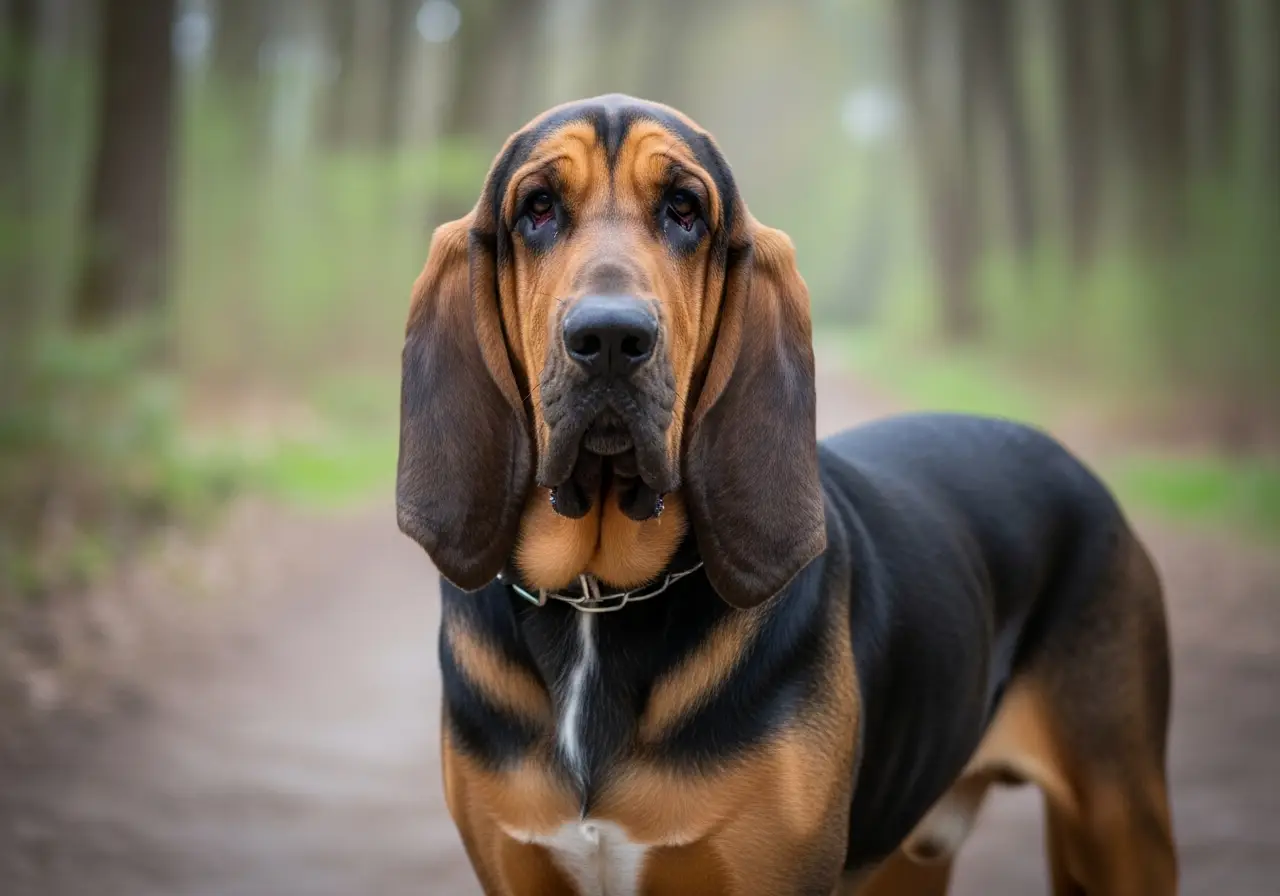
The Bloodhound is a highly specialised tracking dog with arguably the most powerful nose of all breeds, and an instinct to track that cannot be trained out but requires management. Anyone looking for a calm family dog sees the gentle gaze and overlooks the working dog behind it. Suitable for experienced owners with time for mantrailing or scent work, a rural environment, and tolerance for drooling, odour, and a short life expectancy of eight to ten years. A breed with a distinct profile, not an all-rounder.
02Introduction
What makes the Bloodhound special
The Bloodhound is a Belgian-British tracking hound, FCI Group 6, with the most powerful nose of all dog breeds, standing 58–69 cm at the withers.
03Profile
Key facts and suitability
- Origin
- Belgien/Grossbritannien
- Original purpose
- Tracking and search for missing persons
- FCI
- No. 84 · Group 6 · Sektion 1.1: Große Laufhunde, mit Arbeitsprüfung
- height at the withers
- 58–69 cm
- Weight
- 36–50 kg
- Life expectancy
- 10–12 Years
- Coat type
- Short-haired
- Minimum exercise
- 60 min/day
- Puppy price
- 1'200–2'000 CHF
- Waiting period
- 9 months
- Sports
- Mantrailing · Scent work
04Temperament
How the Bloodhound shows up in everyday life
In everyday life, the Bloodhound shows two poles that do not contradict each other but need to be distinguished. On the internal axis, it has a moderate need for social contact: It seeks family connection, but is not a velcro dog that demands closeness every second. Its need for mental work is high, its need for movement lies in the upper middle range. On the external axis, it meets strangers openly to neutrally; it is neither a guard dog nor a mistrustful loner.
When you come home, this means concretely: a short greeting with deep woofing, then it lies down again. It does not run hysterically through the apartment. On the walk, the world is perceived through the nose. As soon as it picks up a scent trail, the mode changes. The head goes down, the gait becomes even, the ears act like scent catchers. Responding to commands hardly works in this state anymore.
With children of its own family, it is patient, although its tail wagging alone can sweep a cup off the table. With conspecifics, it usually gets along well due to its pack background. It rarely seeks conflicts.
In the house, it drools. After drinking, water hangs from the jowls, which it distributes over a large area when shaking its head. Anyone who expects a clean apartment is in the wrong place with this breed.
05Needs
What this breed needs daily
The Bloodhound needs 90 to 120 minutes of exercise daily, including at least three times a week a real nose task, such as mantrailing, scent trail work or structured search work. Pure walks without mental work are not enough. Anyone who only physically exercises the dog will get an under-stimulated tracking dog that finds its own tasks: rummaging through trash cans, searching for traces in the garden, escape attempts.
Mental stimulation is the crux. The Bloodhound works independently and over long distances, making its own decisions. This is exactly what makes classic obedience training arduous. A Bloodhound that has been trailing for an hour is deeply relaxed afterwards; a Bloodhound that has walked on a leash next to a bike for two hours is exhausted but not mentally fulfilled.
Forms of movement must be joint-friendly, especially in the first year of life. The dog grows for a long time. Climbing stairs, jumping out of the car and jogging on hard surfaces before growth is complete (around 18 months) increase the risk of hip and elbow dysplasia.
A securely fenced area is practically mandatory. As soon as the dog picks up a scent trail, it is gone. Off-leash walking only works in areas without wildlife crossings and only with dogs with a solid recall, which remains the exception with this breed.
Exercise
High
mental work
A lot
Social needs
Medium
training
Demanding
06Sport & Mental and Physical Stimulation
What sports the Bloodhound is suited for
Realistic in terms of physiology and genetics – not every breed suits every sport.
Structurally and physiologically suitable: Suitable for mantrailing, dummy work and tracking · CaniCross / bikejoring possible.
07Quick Check
08Suitability
Who this breed is suitable for – and who it isn't
✓Matches
The Bloodhound suits owners with concrete experience in independently working hunting dogs and at least two to three hours of available activity time daily. A rural or suburban environment with access to large areas of forest or fields is a must. Connection to a mantrailing club or a scent hound handler group makes sense; the breed needs the job, not just the meadow.
The dog is suitable for singles or couples from mid-thirties who spend their free time actively outdoors, as well as for families with children from about eight years old. A fenced garden or at least secured exercise area belongs to the basic equipment. Anyone working from home and able to use breaks for trail units has structural advantages.
Police human tracking dog handlers, search and rescue dog handlers and professional hunters with a focus on blood tracking also find the right partner here. Important: Readiness for drool, odour, size and a shorter life expectancy than in medium-sized breeds.
×Doesn't match
The Bloodhound is not suitable for first-time owners without experience with independently working hunting dog breeds. Anyone looking for an on-call companion dog will fail due to the tracking drive. Full-time professionals without care solutions and without daily trail opportunities are also the wrong address; the dog responds to under-stimulation with barking, destruction and escape.
Apartments without an elevator in higher floors become problematic in old age, as hip and elbow problems are common. Cleanliness fanatics suffer from drool streaks on walls, trouser legs and sofa edges. Anyone with allergy sufferers in the household or who does not accept the breed-typical odour should choose another breed.
The dog is also unsuitable for pure sports enthusiasts without interest in nose work; jogging or cycling does not replace a scent trail session. Anyone looking for a protection dog is also mistaken: The open friendliness towards strangers is breed-typical, not a training error.
10Line reality
Show line, working line, breeder market
A classic three-way division into show, field trial and working lines as seen with the Labrador does not exist for the Bloodhound. The population is too small, and the FCI standard explicitly requires suitability for work; a dog bred solely for appearance formally fails to meet the standard.
Nevertheless, two focuses emerge in practice. Firstly, the working line, maintained primarily in the USA, Belgium and France: more compact dogs with pronounced scent drive, less loose skin, clearer eyes, used by police and mantrailing clubs. Secondly, the show line, more frequently seen in English and German show rings: heavier dogs with more abundant folding, a pronounced dewlap, and more droopy eyelids.
The FCI standard explicitly lists as undesirable exaggerations: eyes set too low or too small, slack eyelids, excessively abundant loose skin, overly developed dewlap, head too narrow, body too large and too massive. This warning is not in the standard by chance; it reflects real breeding tendencies.
Regional differences: Belgian and French lines often orient themselves more towards the original Saint-Hubert type, British lines tend towards a heavier appearance. US lines are often the most work-oriented.
Before buying: Ask the breeder specifically about the working performance of the parents, eye examination results and fold formation. Anyone who wants a functional dog looks at function, not show titles.
11Health · Reality
What you need to plan for medically with your Bloodhound
The life expectancy of the Bloodhound is seven to ten years, significantly shorter than that of medium-sized breeds. A 2014 UK Kennel Club survey cites a median of 8.25 years, placing the breed among the shortest-lived of recognised FCI breeds.
The most common cause of death is gastric torsion (Gastric Dilatation Volvulus, GDV). Studies by Purdue University show that deep-chested large breeds like the Bloodhound carry a lifetime risk of over 30 per cent for gastric torsion. Prevention: two to three smaller meals instead of one large one, rest after eating, no raised food bowl according to current research findings. A prophylactic gastropexy during neutering is worth discussing.
According to data from the Orthopedic Foundation for Animals (OFA), hip dysplasia occurs in around 25 per cent of examined Bloodhounds, and elbow dysplasia in about 14 per cent. Both figures are above the average for large breeds. Breeding selection with HD-A or HD-B parents reduces the risk but does not eliminate it.
The long floppy ears require weekly checks due to otitis externa. The deep skin folds on the head and neck must be kept clean and dry, otherwise pyoderma will develop. Ectropion and entropion of the eyelids are typical for the breed.
Overweight massively accelerates joint wear. The Body Condition Score should be between 4 and 5 out of 9, a goal frequently missed with this breed.
12Structured data
Health by the numbers
Prone to diseases
Gastric torsion (bloat), hip dysplasia, elbow dysplasia, eye problems (ectropium/entropium), ear infections
Recommended health tests
Hip and elbow X-rays, eye examination
13Myths ↔ Reality
What is often said incorrectly about this breed
Five myths, five realities, five sources.
The Bloodhound is called that because it follows blood trails.
The name derives from the English term blooded hound and means scent hound of pure blood, i.e. a purebred dog. This is explicitly confirmed by FCI Standard No. 84. The designation has nothing to do with following blood trails etymologically, even though the dog is indeed used for tracking human scent.
Bloodhounds are calm sofa dogs because they look so cosy.
The appearance is deceptive. The FCI standard describes a very enduring working dog that follows a scent trail over long distances in rugged terrain. The daily exercise requirement is 90 to 120 minutes plus regular nose work. Whoever mistakes the calm impression for lack of demands will end up with an under-stimulated dog with behavioural problems.
With consistent training, the scent drive can be trained out.
The scent drive has been genetically selected for over twelve centuries. As soon as the dog picks up an interesting scent trail, it systematically ignores environmental stimuli. Management and secure fencing are mandatory, not a failure of training. The dog can be channelled, not switched off.
Bloodhounds are well suited for apartment living because they are calm indoors.
Weighing 40 to 54 kilograms and with a height at the withers of up to 69 centimetres, the dog needs space. Added to this is the intense drooling due to the loose jowls and the breed-typical odour. Apartment living is possible, but depends on ground-floor access, elevator suitability for older dogs and neighbours' tolerance of loud barking.
14animal welfare
The animal welfare perspective
Breeder market, designer versions, animal shelter reality — what no one writes in the puppy ad.
The Bloodhound is not a fashion breed in the German-speaking region, which protects it from the worst pressure of the mass-breeding market. Nevertheless, Bloodhounds and Bloodhound mixes end up in animal welfare organisations every year, often between their second and fourth year of life, precisely when the tracking instinct is fully developed and owners clash with their expectations. Typical surrender profile: dog regularly runs away, destroys things when left alone, barks too loudly for the rented flat, drools more than expected.
Designer versions such as Bloodhound mixes from uncontrolled breeding appear mainly on online platforms. These dogs often carry the tracking instinct of the Bloodhound without the size proportions or health checks of the parents being known. Buyers get a dog with unclear movement and exercise needs, and in doubt, double the problems.
Three points are burdensome due to breeding: first, the short life expectancy of around 8 years on average; second, the high incidence of gastric torsion; third, the tendency towards excessive skin folds and heavy jowls if show breeding exaggerates appearance. The FCI standard explicitly warns against exaggerations such as too slack eyelids, excessive loose skin, and overly developed dewlap, a clear indication that these tendencies really exist and harm health.
Adoption as an equal option is not just lip service here. Adult Bloodhounds from animal welfare have the advantage that character, intensity of tracking instinct, and health status are already visible. Anyone who is honest with themselves and realises that a puppy is a lottery ticket will often find a more suitable dog in animal welfare. Organisations such as Bloodhound-in-Need initiatives in Germany and Switzerland mediate specifically, although waiting times are longer than for a puppy application.
15Costs · Transparency
What this breed realistically costs
Getting a dog from a reputable breeder: €1,800 to €2,500, in individual cases more for working lines with mantrailing proof. Animal welfare adoption: protection fee usually €350 to €600. Unreliable online offers under €1,500 often mean imported goods without health checks; the apparent saving effect reverses itself upon the first HD diagnosis.
Running costs per year realistically estimated: High-quality food for a 45-to-50-kilogram dog comes to €900 to €1,400. Dog tax depending on municipality €60 to €200. Liability insurance €60 to €120. Health insurance with surgery cover is strongly recommended for this breed due to gastric torsion and joint risks: €400 to €900 annually, increasing with age.
Vet routine (vaccination, parasite prophylaxis, annual check): €250 to €400. A single emergency intervention for gastric torsion costs €2,500 to €5,000. Mantrailing or scent work courses €30 to €60 per hour.
Total costs realistically: €2,500 to €4,000 per year in healthy phases, significantly more in the last third of life.
16Puppy search
What you need to consider when choosing a breeder
- Serious Bloodhound breeding is limited in the German-speaking area.
- Pay attention to the breeder's membership in an association affiliated with VDH or FCI, such as the Saint Hubert-Bloodhound Club of Germany or the Basset and Bloodhound Club of Switzerland.
- Mandatory examinations of parent animals include HD and ED X-rays with evaluation, eye examination and ideally a gastric torsion risk assessment via chest depth measurement.
- Ask specifically about: How many litters per female dog per year?
- (Maximum according to VDH: one per year.) How old are the parent animals?
- What working performance have they demonstrated?
- Are the puppies handed over at least at eight weeks of age?
- Do you receive a written purchase contract with health guarantees?
- Puppy prices from serious breeders range between 1,800 and 2,500 euros.
- Offers under 1,500 euros, handover before eight weeks or meeting points in car parks are clear warning signs.
- Placement via animal welfare organisations is a fully-fledged alternative.
- Bloodhounds and Bloodhound mixes regularly end up in animal welfare because owners have underestimated the tracking drive.
- Adult dogs with known character spare you the puppy lottery.
FAQ
Frequently asked questions about the Bloodhound
Is Bloodhound suitable for beginners?
Bloodhound is considered suitable for first-time dog owners.
Is Bloodhound a family dog?
Bloodhound is considered suitable for families with good socialisation and species-appropriate care.
How much exercise does Bloodhound need?
At least around 60 minutes of exercise per day.
What is the size and weight of Bloodhound?
Fully grown, Bloodhound reaches about 58–69 cm at the withers and weighs around 36–50 kg.
What is the life expectancy of Bloodhound?
The life expectancy of Bloodhound is approximately 10–12 years.
Which diseases are common in Bloodhound?
Gastric torsion (bloat), hip dysplasia, elbow dysplasia, eye problems (ectropium/entropium), ear infections
17Breed clubs
Official breed clubs in DACH
19Related
Similar breeds – and their differences
You might also be interested in
Participate
Do you have a good photo of your Bloodhound?
We are looking for expressive images for our breed profiles. Submit yours; the editorial team reviews every submission before publication.
Does this breed suit you?
The best nose in the world in a gentle large body. Drooling and floppy ears are part of everyday life. Does not need extreme exercise, but requires daily nose work.