
01Summary
In a paragraph
If you only have 30 seconds.
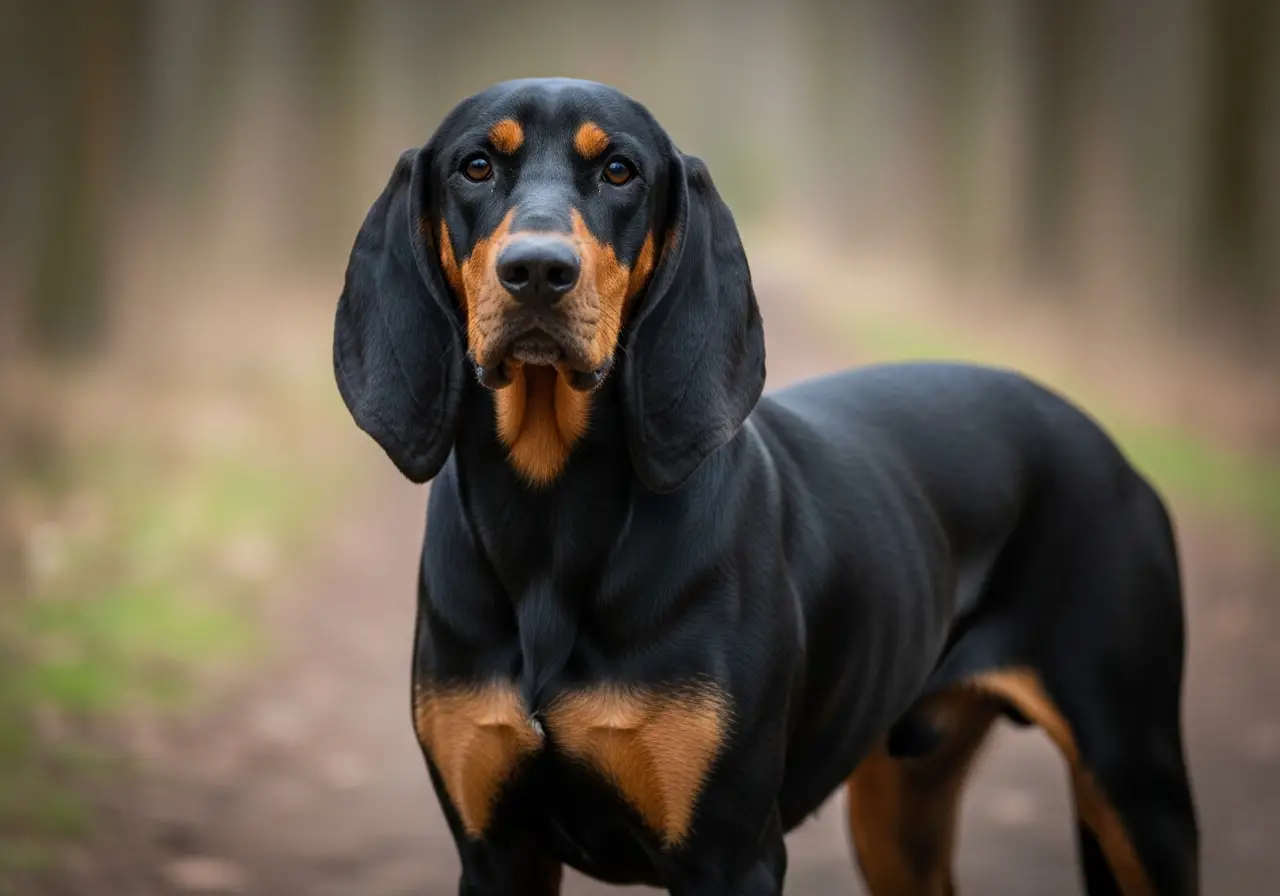
The Black and Tan Coonhound is an American scent hound bred for night-time raccoon hunting. Its nose ranks among the most powerful in dog sports, and its prey drive is deeply ingrained genetically. Anyone keeping this dog takes responsibility for an animal that requires intensive daily nose work and extensive exercise, and which pursues its own agenda as soon as a scent trail beckons.
02Introduction
What makes the Black and Tan Coonhound special
The Black and Tan Coonhound is an American hunting dog, FCI Group 6, known for its melodious bay and excellent nose, with a withers height of 58–69 cm.
03Profile
Key facts and suitability
- Origin
- USA
- Original purpose
- Raccoon and marten hunting
- FCI
- No. 300 · Group 6 · Section 1.1
- height at the withers
- 58–69 cm
- Weight
- 23–34 kg
- Life expectancy
- 10–12 Years
- Coat type
- Short-haired
- Minimum exercise
- 90 min/day
- Puppy price
- 800–1'500 CHF
- Waiting period
- 9 months
- Sports
- Hunting · Tracking · Mantrailing
04Temperament
How the Black and Tan Coonhound shows up in everyday life
The morning walk shows what makes the Black and Tan Coonhound unique: The nose goes straight to the ground, the dog pulls towards a scent trail, and everything else takes a back seat. This is not a phase of disobedience, but the normal state of a breed that has been selected over generations for independent tracking.
Internally, the dog requires at least two hours of active exercise daily, as well as structured nose work. Mental work in the form of tracking, mantrailing or search games is not an addition, but a basic prerequisite for a balanced dog. The need for social contact is high: the Black and Tan Coonhound is a pack dog and requires close contact with its reference group. Being left alone for more than four hours reliably leads to constant barking or destructive behaviour if there has been no prior stimulation.
Externally, the dog generally behaves openly and calmly towards strangers; friendliness towards unknown people is pronounced (external axis: value 4 out of 5). However, this must not be confused with general sociability. As soon as a scent trail is picked up, the dog is mentally absent to all social signals. Children in the household experience a gentle, patient dog, provided it is sufficiently stimulated. An under-stimulated Coonhound, on the other hand, is loud, restless and difficult to handle.
The dog regularly uses its deep, melodious voice in everyday life. Those living in an apartment building or in close proximity to neighbours often underestimate this characteristic.
05Needs
What this breed needs daily
The Black and Tan Coonhound requires at least two hours of active exercise daily, a considerable proportion of which must be guided nose work. A walk on a lead through the city park does not meet this need. The dog requires terrain where it is allowed to sniff, search and follow a trail.
Nose work in the form of mantrailing, tracking according to FCI rules or structured search games in the forest represents the most effective form of mental stimulation. The need for mental work is high (value 4 out of 5): a dog that is only physically exercised but not mentally challenged will develop compensatory behaviour.
Being left alone is limited to a maximum of four hours, and is only tolerable if the dog has been sufficiently stimulated beforehand. A Coonhound that is not stimulated and is left alone will bark. Loudly, persistently and at a pitch that calls neighbours and building management into action.
A secure open area, an enclosed garden or regular access to dog meadows with a stable fence is not a matter of comfort, but a safety measure. The prey drive overrides every recall when picking up a trail. Free running in unsecured terrain is irresponsible for this breed without specialised training.
The need for social contact is high. The dog requires close integration into family life and generally gets along well with other dogs; its pack background makes it a cooperative cohabitant, provided the socialisation is correct.
Exercise
High
mental work
A lot
Social needs
Medium
training
Demanding
06Sport & Mental and Physical Stimulation
What sports the Black and Tan Coonhound is suited for
Realistic in terms of physiology and genetics – not every breed suits every sport.
Structurally and physiologically suitable: Suitable for mantrailing, dummy work and tracking · CaniCross / bikejoring possible.
07Quick Check
08Suitability
Who this breed is suitable for – and who it isn't
✓Matches
The Black and Tan Coonhound suits owners who can plan at least two hours of active outdoor exercise daily, with a substantial proportion as structured nose work or tracking. A rural environment with access to forest and meadows, as well as a secure open area, is a realistic basic prerequisite.
Experience with hunting-motivated dogs or hounds is not a recommendation, but a necessary basis. Those who are already familiar with mantrailing, tracking or hunting dog handling understand the dog's independence as a strength, not a problem.
Families with children from about eight years of age, in which at least one person takes on the stimulation daily, are suitable, provided the exercise quota is consistently met. Owners who enjoy outdoor activities such as hiking, trail running or dog sports and are willing to familiarise themselves with nose work will find an enduring partner in this breed.
Those living in a house with a garden, having a stable daily routine and rarely leaving the dog alone for longer than four hours meet the basic conditions. Owners with a hunting background or active participation in dog sports clubs offering tracking or mantrailing are particularly well positioned.
×Doesn't match
The Black and Tan Coonhound does not suit owners who can devote less than two hours daily to active exercise and nose work. Those who are regularly away from home for eight or more hours and do not have a reliable dog care plan significantly underestimate the need for social contact and the vocalisations of this breed.
Keeping the dog in an apartment in multi-storey buildings or densely populated city quarters is difficult to reconcile with the breed-typical sound; those who hope that the dog will "calm down eventually" will be disappointed.
First-time owners without prior experience with hunting-motivated dogs face a steep learning curve: the Coonhound's independence, ignoring all obedience signals when picking up a trail, requires a safety and management concept that beginners often underestimate.
Those looking for a calm companion dog for cafés, markets or busy city centres are choosing the wrong breed. Those who expect friendliness towards strangers to equate to easy handling are confusing the external reaction axis with the internal need profile. Distinguishing between both axes is particularly important for this breed.
10Line reality
Show line, working line, breeder market
The Black and Tan Coonhound is still bred primarily as a hunting dog; a pronounced show line in the European sense hardly exists. In the USA, the breeding scene distinguishes between pure working dogs, which are selected for nose performance, endurance, and bay, and the few dogs presented at AKC shows.
The working line dominates: breeders in the southern states of the USA take their dogs to hunting trials (so-called „Coon Hunts"), where nose performance, vocalisation volume, and independence are assessed. These dogs are designed for maximum hunting motivation; their drive is more intense, and their independence from humans more pronounced than in dogs from less hunting-selected lines.
In the DACH region, the breed is so rare that line differentiation is hardly practically relevant for interested parties. Anyone looking for a Black and Tan Coonhound generally finds dogs from US American working breeds or occasionally from Scandinavian imports. An independent European breeding line with a differing temperament profile does not exist to any significant extent.
Interested parties should explicitly ask about the purpose of the parent animals when searching for puppies: A dog from active hunting breeding brings higher drive intensity than a dog whose parents were kept primarily as family dogs.
11Health · Reality
What you need to plan for medically with your Black and Tan Coonhound
The Black and Tan Coonhound is considered a relatively robust working breed with a life expectancy of approximately 10 to 12 years. Reliable population studies specifically for this breed are limited due to its low prevalence in Europe; the available data primarily originate from US breeding registries.
Hip dysplasia (HD) occurs in the breed but is documented less frequently than in large Retriever breeds. The Orthopedic Foundation for Animals (OFA, as of 2023) reports an HD rate of approximately 8–10% among tested Black and Tan Coonhounds, a moderate value compared to other large breeds. Breeders should have parent dogs examined radiologically.
The greatest breed-specific health risk lies in ear health. The long drop ears block the ear canal and promote a warm, moist environment that predisposes to otitis externa (ear canal inflammation). Regular ear checks, at least weekly, and proper cleaning are mandatory components of the care routine. Recurrent ear infections require veterinary investigation, as chronic cases can lead to permanent changes in the ear canal.
Overweight is a real risk for this breed if its exercise needs are not met. An overweight dog puts strain on joints and measurably shortens active lifespan. Veterinary preventive examinations on an annual basis, weight monitoring, and dental care are recommended standard measures.
12Structured data
Health by the numbers
Prone to diseases
Hip dysplasia, ear infections (drop ears), eye problems
Recommended health tests
Hip X-ray, eye examination
13Myths ↔ Reality
What is often said incorrectly about this breed
Five myths, five realities, five sources.
„The Black and Tan Coonhound is an uncomplicated family dog due to its friendly nature.
Friendly social behaviour towards people does not mean that keeping the dog is easy. The dog has a genetically deeply rooted prey drive that overrides all other signals when it picks up a scent. Without consistent management, secure exercise opportunities, and daily nose work, behavioural problems such as constant barking or destruction develop.
"You cannot train scent hounds; they don't listen anyway.
The Black and Tan Coonhound is trainable, but strongly intrinsically motivated. Classical obedience exercises work if they are built up consistently and with high motivational value. However, recall in open terrain remains unreliable even with good training once a scent has been picked up. This is not a failure of training, but breed-typical genetics.
„The deep voice of the Coonhound is only an issue when hunting.
The melodious bay is a breed-typical characteristic that is regularly used in everyday life, due to boredom, under-stimulation, hearing unfamiliar noises, or being left alone. In densely populated residential areas or multi-family houses, this reliably leads to conflicts with neighbours. A rural environment with sufficient distance from other living units is not a recommendation, but a prerequisite.
„Nose work in sport completely replaces hunting-related stimulation.
Mantrailing, tracking, and nose work sports are valuable supplements and can cover a significant part of the need for stimulation. However, they do not replace the genetically anchored motivation to follow a game trail independently over long distances. Owners without a hunting background must compensate for this need through structured nose work with high intensity and frequency, daily, not occasionally.
„As a robust working breed, the Black and Tan Coonhound is completely healthy and requires no preventive care.
The breed is considered comparatively robust but has breed-typical weak points. The long drop ears promote a moist-warm environment in the ear canal, which predisposes to otitis externa. Hip dysplasia occurs occasionally. Regular ear checks and veterinary preventive examinations are not optional measures.
14animal welfare
The animal welfare perspective
Breeder market, designer versions, animal shelter reality — what no one writes in the puppy ad.
The Black and Tan Coonhound is so rare in the D-A-CH region that the classic backyard breeder market with mass production hardly plays a role. The risk lies elsewhere here: Because the breed appears exotic and is little known, impulse purchases arise from ignorance. Interested parties who learn about the dog through US social media channels or hunting videos systematically underestimate the effort involved, and the dog bears the consequences of a wrong decision.
Imports from the USA or Eastern Europe without personal inspection and without assessment of breeding conditions are a real problem. Puppies that arrive in a European household by air or transporter without adequate socialisation start with a deficit that manifests in training. Anyone planning an import takes responsibility for checking the entire supply chain.
Designer versions or hybrid trends hardly exist for this breed, which is an advantage. Breeding is predominantly functionally oriented, which has thus far prevented breeding extremes such as exaggerated physical traits. Nevertheless: dogs from pure high-performance hunting lines are structurally overwhelmed by life as a family dog without hunting-related activity. This is not a defect of the dog, but a mismatch between genetics and keeping conditions.
Animal welfare organisations in the USA, such as "Hound Rescue" or specialised Coonhound rescue centres, regularly rehome dogs from dissolved hunting operations or situations where they have been overwhelmed. These dogs are often adults, health-checked, and a fully valuable alternative to puppies for experienced owners. Anyone open to this option will find a dog with a known temperament and simultaneously spare an animal kennel life.
15Costs · Transparency
What this breed realistically costs
The acquisition costs for a Black and Tan Coonhound from reputable breeding are usually between 1,200 and 2,000 EUR in the D-A-CH region due to the rarity of the breed; imports from the USA or Scandinavia incur additional transport costs of 500 to 1,500 EUR. Offers significantly below 800 EUR without verifiable breeding documentation are a warning sign.
Annual maintenance costs consist of food (for a dog of this size approx. 600–1,000 EUR/year depending on food quality), care needs (ear cleaning, nail trimming, occasional grooming: approx. 100–200 EUR/year) as well as basic equipment and accessories. In addition come training costs for nose work or mantrailing courses, which can amount to 200–500 EUR/year depending on the provider.
Basic veterinary costs (annual vaccination, deworming, prevention) are approx. 200–400 EUR/year. With ear problems, a breed-specific increased risk, additional treatment costs of 100–300 EUR per incident arise. Pet insurance for a dog of this size costs between 50 and 120 EUR/month depending on the provider and scope of benefits, and is a sensible consideration given possible orthopaedic or ear treatments.
16Puppy search
What you need to consider when choosing a breeder
- Reputable breeders of the Black and Tan Coonhound can be recognised by a few clear criteria: they introduce both parent dogs, at least the mother in person, and can provide health certificates for hip dysplasia screening as well as ear examinations.
- A reputable breeder asks questions about the prospective owner's daily life and refuses to hand over the puppy if the environment does not suit the breed.
- As the breed is extremely rare in the DACH region, puppies often come from abroad, particularly from the USA or Scandinavia.
- Imports require careful examination of breeding conditions, vaccination and health documents, as well as transport conditions.
- Caution is advised with offers without personal inspection, without access to the mother bitch and with unusually short waiting times.
- Adoption through animal welfare organisations or specialised hound rescue centres is an equally valid option.
- Although Black and Tan Coonhounds rarely appear in animal welfare shelters in the D-A-CH region, there are organisations in the USA and occasionally in Europe that rehome Coonhounds from hunting operations or situations where they have been overwhelmed.
- These dogs are often adults, well-socialised, and a solid choice for experienced owners.
- No specific breeder recommendations are provided here; the entry section on rundum.dog lists verified contacts.
FAQ
Frequently asked questions about the Black and Tan Coonhound
Is Black and Tan Coonhound a family dog?
Black and Tan Coonhound is considered suitable for families with good socialisation and species-appropriate care.
How much exercise does Black and Tan Coonhound need?
At least around 90 minutes of exercise per day. As an active breed, more so — plus mental stimulation.
What is the size and weight of Black and Tan Coonhound?
Fully grown, Black and Tan Coonhound reaches about 58–69 cm at the withers and weighs around 23–34 kg.
What is the life expectancy of Black and Tan Coonhound?
The life expectancy of Black and Tan Coonhound is approximately 10–12 years.
Which diseases are common in Black and Tan Coonhound?
Hip dysplasia, ear infections (drop ears), eye problems
17Breed clubs
Official breed clubs in DACH
19Related
Similar breeds – and their differences
You might also be interested in
Participate
Do you have a good photo of your Black and Tan Coonhound?
We are looking for expressive images for our breed profiles. Submit yours; the editorial team reviews every submission before publication.
Does this breed suit you?
Loud, enduring hunting dog. Not suitable for neighbourhoods with thin walls. Needs exercise and nose work.