
01Summary
In a paragraph
If you only have 30 seconds.
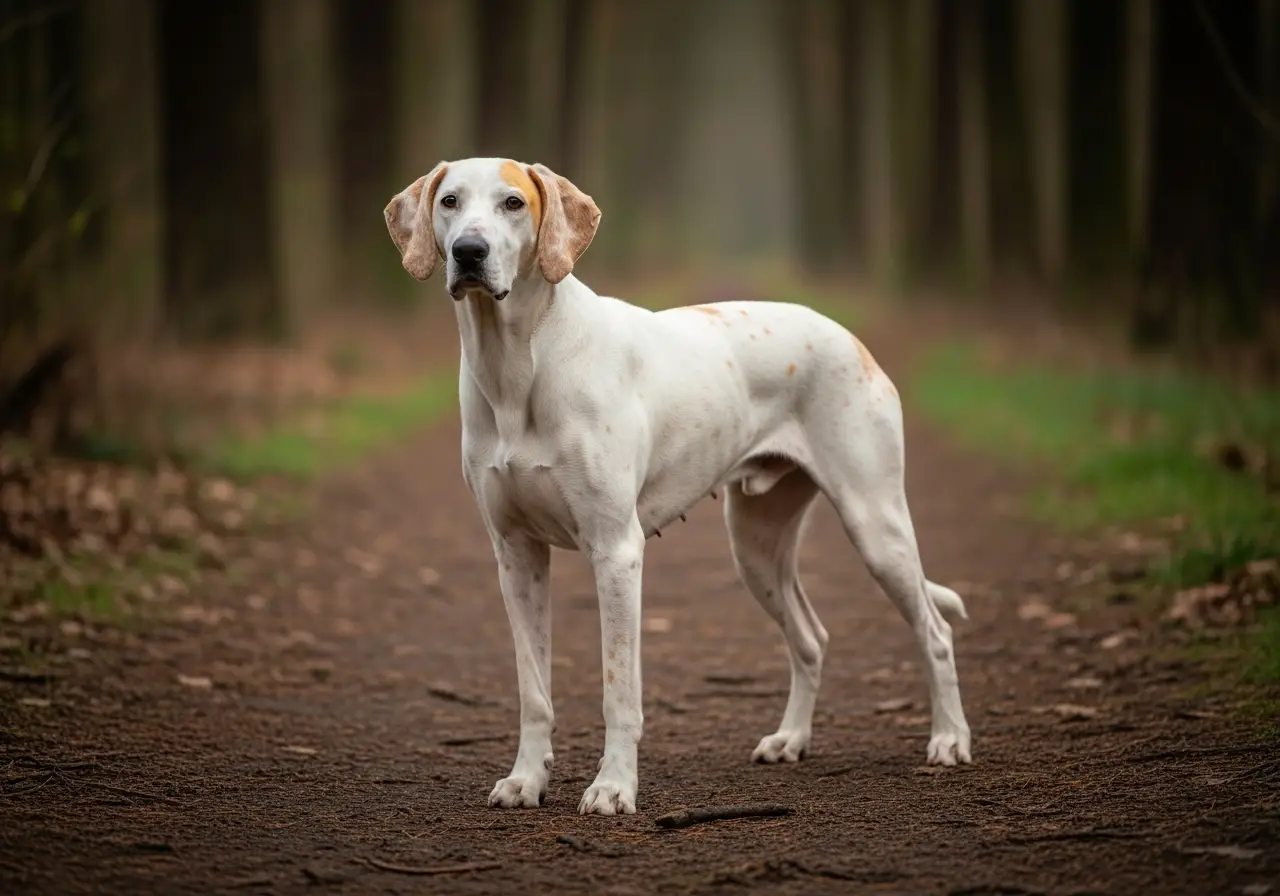
The Billy is a large, white French hound with a strong prey drive and pronounced need for exercise. Its calmness in the house deceives regarding its requirements: daily two hours of nose work and secure access to countryside areas are not a wishful thinking, but a keeping prerequisite. Outside France, the breed is a rarity; experience with hunting-motivated dogs is mandatory, not a bonus.
02Introduction
What makes the Billy special
The Billy is a rare white French pack hound, FCI Group 6, bred for big game hunting, withers height 58–70 cm.
03Profile
Key facts and suitability
- Origin
- Frankreich
- Original purpose
- Pack hunting for wild boar and roe deer
- FCI
- No. 25 · Group 6 · Section 1.1
- height at the withers
- 58–70 cm
- Weight
- 25–33 kg
- Life expectancy
- 10–12 Years
- Coat type
- Short-haired
- Minimum exercise
- 120 min/day
- Puppy price
- 800–1'500 CHF
- Waiting period
- 12 months
- Sports
- Hunting · Tracking
04Temperament
How the Billy shows up in everyday life
In the morning, when the leash comes out of the cupboard, the Billy reacts with immediate attention, not with exuberant jumping, but with concentrated anticipation. This difference is characteristic: The Billy is not a dog that demands affection loudly. It orients itself towards its primary caregiver without appearing clingy.
At home, it shows itself calm and adaptable. It lies relaxed on the sofa as long as its exercise needs have been met. If it has not been sufficiently stimulated, it seeks enrichment, and this rarely turns out constructively.
As soon as it picks up a scent trail in the field, it switches to another mode. The environment around it recedes into the background. Calls, signals, distractions: The Billy filters them out and follows the trail with complete concentration. This is not stubbornness, this is its genetic programming as a scent hound.
Towards strangers, it behaves openly to neutrally. It shows no pronounced territorial behaviour and no guarding instinct. Visitors in the house are registered, but not classified as a threat.
Internally, it requires intensive nose work and sufficient exercise daily; this is not an option, but a basic prerequisite. Externally, it generally reacts without problems to conspecifics, as its pack DNA has firmly anchored social behaviour with other dogs. It is important to keep these two axes apart: A Billy that reacts friendly to strangers still requires two hours of structured stimulation daily.
05Needs
What this breed needs daily
The Billy requires at least two hours of physical activity daily, not in the form of walks at a walking pace, but through forms of movement that appeal to its hunting instinct. Scent work, mantrailing or terrain-oriented runs with nose work meet its needs most effectively.
Mental work is not an addition for this breed, but a requirement. The Billy has been selected over generations to make independent decisions on the trail. Anyone who denies it this cognitive stimulation creates frustration, which manifests itself in vocalisation, destruction or restlessness.
It tolerates being left alone for up to about four hours, provided it has been sufficiently stimulated beforehand. Longer periods without enrichment and social contact contradict its pack background.
A rural environment with access to large, secure areas is almost a prerequisite. Urban keeping is only realistic if daily excursions into the countryside are possible and the living environment offers sufficient opportunities for retreat.
The need for social contact with conspecifics is pronounced. Keeping multiple dogs corresponds to its natural form of life. Single-dog keeping only works if the owner compensates for social contact through intensive joint activity.
Training requires patience and experience with hunting-motivated dogs. Classical obedience exercises are only of limited use in this breed if they are not linked to elements close to nose work. Management, particularly secure off-leash exercise, is not a transitional solution, but a permanent part of keeping.
Exercise
Very high
mental work
A lot
Social needs
Medium
training
Demanding
06Sport & Mental and Physical Stimulation
What sports the Billy is suited for
Realistic in terms of physiology and genetics – not every breed suits every sport.
Structurally and physiologically suitable: Suitable for mantrailing, dummy work and tracking · CaniCross / bikejoring possible.
07Quick Check
08Suitability
Who this breed is suitable for – and who it isn't
✓Matches
The Billy suits owners who can plan at least two hours of active time in the countryside daily, not just at weekends, but consistently. Anyone who enjoys tracking, Mantrailing or hunting-related enrichment will find a concentrated, enduring partner in this breed.
A rural or at least semi-rural environment with regular access to large, secure areas is a basic prerequisite. Owners with their own property or direct access to forests and fields have a structural advantage.
Experience with hounds or hunting-motivated breeds is not a recommendation, but a condition. Anyone who understands that a dog on the trail is no longer recallable, and designs their management accordingly, can work well with the Billy.
Multi-dog households offer the Billy optimal conditions, as its pack background has anchored social contact with conspecifics as a basic need. Owners who involve their dog in hunting activities, for example in collaboration with hunting clubs or dog sports clubs with a focus on tracking, also create a meaningful framework for this breed.
×Doesn't match
The Billy does not suit owners looking for a companion dog that is recallable at all times. Anyone who expects their dog to reliably respond to recall when off-leash will be permanently frustrated with this breed; this is not a training issue, but a genetic reality.
Households with little time for daily activity in the countryside are unsuitable. Two hours of exercise daily are not an ideal vision, but a minimum requirement. Anyone who can plan less than one hour of active dog time during the week should choose another breed.
Anyone who mistakes the Billy’s calm character in the house for contentment fundamentally underestimates its need for exercise and mental work. This confusion of the internal axis of needs with the external appearance regularly leads to keeping problems.
City dwellers without regular access to countryside areas and first-time owners without prior experience with hunting-motivated dogs are also not suitable owners for the Billy. Households in which the dog is regularly left alone for longer than four hours do not meet the keeping requirements of this breed.
10Line reality
Show line, working line, breeder market
The Billy is bred exclusively for performance. FCI Standard No. 25 requires a working test; a show line without hunting suitability assessment does not exist to any significant extent. This uniformity is unusual for such a small breed and simultaneously a quality feature: breeders who work according to standard select for function, not appearance.
Regional differentiations within France exist, but are hardly relevant for buyers outside the country of origin. The total population is too small to develop pronounced line differences as seen with widespread hunting dog breeds.
Anyone who acquires a Billy generally receives a dog whose ancestors were tested for hunting performance. This is an advantage for owners with hunting interest, and a hint for all others: The mandatory working test in the standard is not a bureaucratic detail, but a reflection of what this breed brings genetically.
11Health · Reality
What you need to plan for medically with your Billy
The Billy is considered a robust, functionally bred breed without the breed-typical extreme characteristics that occasionally occur in other hounds. The life expectancy is approximately 10 to 12 years according to breeder associations, a realistic range for large dogs of this size class (58–70 cm at the withers).
Hip dysplasia (HD) occurs sporadically; systematic screening data for the Billy are not available in a statistically reliable form due to the very small world population. Breeders who breed according to FCI standard with working tests generally carry out X-ray checks of the parent animals; this proof should be actively requested during the breeder discussion.
The Billy's long, floppy ears predispose it to moisture accumulation in the ear canal. Regular ear checks, at least weekly, reduce the risk of recurrent otitis externa. If redness, odour or frequent head shaking occurs, a veterinary examination is required.
Overweight is not a typical problem for Billys that get sufficient exercise. If activity is restricted, for example after injuries, calorie intake should be adjusted, as the metabolism of large hounds is designed for high activity levels.
Preventive examinations should include annual general check-ups, dental checks and ear inspections. Vaccination protection and parasite prevention must be maintained particularly consistently for a dog that works regularly in the field.
12Structured data
Health by the numbers
Prone to diseases
Hip dysplasia, ear problems, generally robust breed
Recommended health tests
Hip X-ray
13Myths ↔ Reality
What is often said incorrectly about this breed
Five myths, five realities, five sources.
“The Billy is a relaxed family dog at home due to its calm nature.
The calmness at home is deceptive. The Billy immediately switches to full performance in the field as soon as it picks up a scent trail. Its exercise requirement is at least two hours of intense activity daily. Anyone who does not meet this need will not get a calm dog, but a frustrated one.
"Scent hounds are easy to train because they obey in the pack.
The Billy works independently in the pack and makes its own decisions. Classic recall obedience takes a back seat to its hunting motivation once it has picked up a trail. Off-leash running without secured terrain is not realistic with this breed.
“White dogs are more sensitive and prone to illness than coloured ones.
Coat colour has no direct influence on health robustness. The Billy is considered a functionally bred breed with relatively few breed-typical diseases. Breeding selection and living conditions are decisive, not pigmentation.
“A dog from the pack gets along poorly with other dogs.
The opposite is true. The Billy has been selected for pack work over centuries. Contact with conspecifics is not a burden for it, but a basic social need. Isolated single-keeping contradicts its genetic makeup.
14animal welfare
The animal welfare perspective
Breeder market, designer versions, animal shelter reality — what no one writes in the puppy ad.
The Billy is not a breed produced in significant quantities by breeders or trend sellers; demand outside France is too low and the breeder base too small. This protects the breed from the worst pressures of the puppy market, but creates its own risks.
Because the Billy is so rare, potential buyers often lack any opportunity to compare breeders directly or obtain references. Anyone finding a "Billy" on classifieds platforms should check the pedigree documentation very carefully. Without FCI papers and verifiable studbook registration, breed identification is not guaranteed, and buying a dog of unknown origin under a breed name is a common pattern in the low-price segment.
There is no breeding-related animal welfare problem in the classical sense (brachycephaly, exaggerated skin folds, extreme growth) with the Billy. The breed was bred for performance and shows no disqualifying exterior traits that structurally impair well-being. This is an advantage over many fashionable breeds.
The keeping-related risk lies elsewhere: A Billy that is not sufficiently stimulated suffers from chronic under-stimulation. Nose work and movement in the field are not leisure activities for this breed, but a basic need. Keeping without this framework is relevant to animal welfare, not because the dog suffers physically, but because its genetic predisposition is systematically ignored.
Adoption as an equivalent option is hardly realistic for the Billy, as the breed practically does not occur in German-speaking animal shelters. Anyone who still wishes to take in an adult dog can research specialised hound protection organisations in France. This requires language skills and willingness to travel, but is a legitimate and sensible option for experienced owners.
15Costs · Transparency
What this breed realistically costs
A Billy puppy from a reputable, FCI-recognised breeder costs between 1,000 and 1,800 EUR in France based on experience. Due to the extreme rarity of the breed outside France, import costs (transport, health certificates, entry documentation) can add another 200 to 500 EUR.
The annual living costs for a large dog of this weight class are approximately 1,500 to 2,500 EUR. This includes high-quality food (approx. 600–900 EUR/year for a dog weighing 25–33 kg), grooming needs, accessories and basic equipment.
Veterinary costs for routine care (vaccinations, parasite prevention, annual preventive examination) average 300 to 500 EUR per year. In case of illness or injury, individual treatments can quickly reach 500 to 2,000 EUR.
Dog health insurance for a large dog costs between 50 and 120 EUR per month depending on the provider and scope of benefits. Given the small breeding population and limited data on hereditary diseases, coverage is recommended.
16Puppy search
What you need to consider when choosing a breeder
- The Billy is one of the rarest dog breeds worldwide.
- Outside France, there are hardly any specialised breeders.
- Anyone looking for a Billy must expect waiting times of a year or more, and should use this time for thorough breeder research.
- Reputable breeders place value on working tests, as the FCI standard explicitly provides for such.
- They present health certificates of the parent animals, allow a visit to the litter and ask questions about the living situation.
- A breeder who hands over a puppy without prior discussion and without interest in the future keeping is not a reliable contact.
- Offers appear on classifieds platforms that advertise with the term “Billy”, but cannot provide documented pedigree.
- Without FCI papers and studbook entry, breed identification is not secured.
- Since the Billy practically does not occur in German and Austrian animal shelters, rehoming as an equivalent option is hardly realistic in this case.
- Anyone who nevertheless wishes to take in an adult dog can research specialised hound rescue organisations in France.
- Even there, Billys are rare, but not excluded.
FAQ
Frequently asked questions about the Billy
Is Billy a family dog?
Billy is considered suitable for families with good socialisation and species-appropriate care.
How much exercise does Billy need?
At least around 120 minutes of exercise per day. As an active breed, more so — plus mental stimulation.
What is the size and weight of Billy?
Fully grown, Billy reaches about 58–70 cm at the withers and weighs around 25–33 kg.
What is the life expectancy of Billy?
The life expectancy of Billy is approximately 10–12 years.
Which diseases are common in Billy?
Hip dysplasia, ear problems, generally robust breed
17Breed clubs
Official breed clubs in DACH
19Related
Similar breeds – and their differences
You might also be interested in



Participate
Do you have a good photo of your Billy?
We are looking for expressive images for our breed profiles. Submit yours; the editorial team reviews every submission before publication.
Does this breed suit you?
Rare, exclusively hunting-used French pack hound. Hardly to be found outside of hunting.