
01Summary
In a paragraph
If you only have 30 seconds.
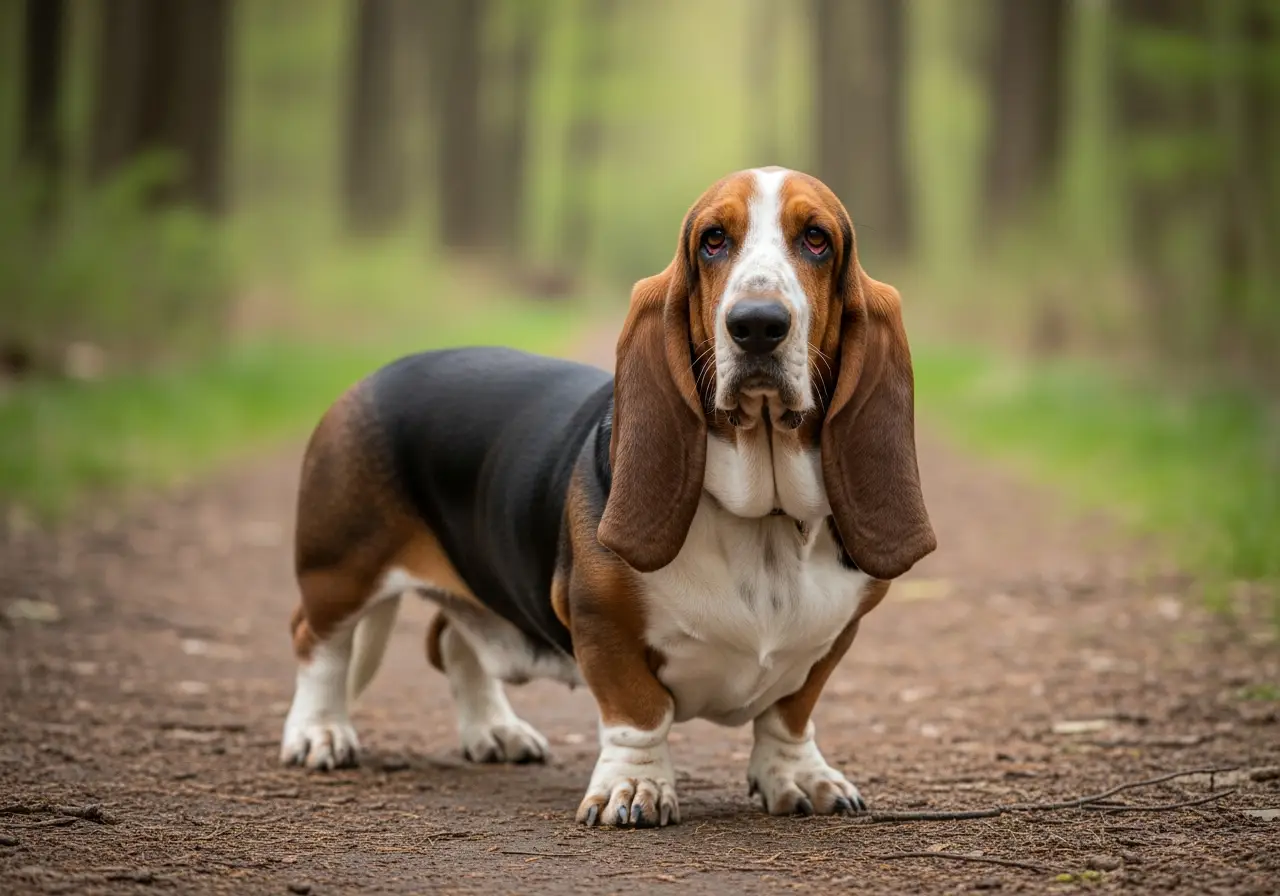
The Basset Hound is a specialised scenthound from British-French breeding history, not sofa décor. Its pronounced scent drive, independence and anatomical peculiarities demand an owner with a realistic outlook, patience and the willingness to understand nose work as genuine enrichment. Anyone who brings this to the table will receive a calm, people-oriented dog with an unmistakable character.
02Introduction
What makes the Basset Hound special
The Basset Hound is a phlegmatic British scent hound with drooping ears, FCI Group 6, known for its excellent nose, height at withers 33–38 cm.
03Profile
Key facts and suitability
- Origin
- Grossbritannien
- Original purpose
- Slow hunting of hares on foot
- FCI
- No. 163 · Group 6 · Section 1.3
- height at the withers
- 33–38 cm
- Weight
- 20–35 kg
- Life expectancy
- 10–12 Years
- Coat type
- Short-haired
- Minimum exercise
- 45 min/day
- Puppy price
- 1'000–2'000 CHF
- Waiting period
- 9 months
- Sports
- Scent work · Mantrailing
04Temperament
How the Basset Hound shows up in everyday life
During the morning walk, what defines the Basset Hound becomes apparent: The nose hits the ground, the pace slows down, and the surroundings temporarily cease to exist for it. This is not defiance; this is genetics. A hound that tracked scents independently for centuries does not switch off this mode on command.
Internally, the Basset Hound requires daily nose work as its primary form of mental stimulation. Mantrailing, search games in the garden, or structured sniffing rounds fulfil this need more effectively than pure running distances. The need for social contact is high; it is strongly oriented towards its reference group and tolerates isolation poorly. Four hours alone is the maximum; beyond that, vocalisations and restlessness occur.
Externally, it behaves openly and friendly towards strangers. A Basset Hound announcing visitors does so with its deep, melodious voice, not out of aggression, but out of a desire to communicate. With other dogs, it generally shows tolerance due to its pack background, provided socialisation begins early.
These two axes must not be confused: A high need for social contact means a close family bond, not automatically openness towards every stranger. And friendliness outwards does not mean that it cooperates on demand; its profile of independence remains constant.
In the evening on the sofa, it is a calm companion that enjoys physical contact. Anyone who sees this contrast (independent outside, affectionate inside) as an enrichment will find in the Basset Hound a dog with genuine character.
05Needs
What this breed needs daily
The Basset Hound requires 60 to 90 minutes of exercise daily, divided into several sessions. Pure running distances are not sufficient; nose work is a central component of its stimulation. Sniffing rounds, mantrailing, search games with hidden food, or dummy work engage its primary sensory performance and mentally tire it more effectively than physical exertion alone.
Climbing stairs should be reduced to a minimum due to the long spine and short limbs. Jumping from elevated surfaces (sofa, car, stairs) places permanent strain on intervertebral discs and joints. Ramps or climbing aids are not luxury equipment, but preventive measures.
The need for social contact is rated at 3 on the internal axis: The Basset Hound is strongly oriented towards its reference group and requires regular contact. Being left alone is possible for up to four hours if it has been built up gradually. Longer absences without alternative care lead to vocalisation and stress.
Mental work is also rated at 3: It requires mental enrichment, but not highly intensive training sessions. Short, varied sequences with food motivation are more effective than long drill sessions.
Weight control is not an optional aspect, but a duty. A Basset Hound that is overweight places disproportionate strain on the spine and joints. The daily amount of food must be adjusted to the activity level and physical condition, not to what the dog demands.
Exercise
Low
mental work
Medium
Social needs
Medium
training
Demanding
06Sport & Mental and Physical Stimulation
What sports the Basset Hound is suited for
Realistic in terms of physiology and genetics – not every breed suits every sport.
Structurally and physiologically suitable: no jumping sports (risk of slipped disc) · Suitable for mantrailing, dummy work and tracking.
07Quick Check
08Suitability
Who this breed is suitable for – and who it isn't
✓Matches
The Basset Hound suits owners who understand nose work as a genuine form of enrichment and are willing to offer it regularly. A structured daily routine with fixed exercise times and clear rules provides orientation.
Households with a garden or direct access to green spaces, where sniffing rounds are possible without logistical effort, are suitable. Families with children of school age are an option if the children are experienced in handling dogs and respect the dog's independent character.
Owners with a moderate activity level, 60 to 90 minutes of exercise daily, are well positioned. Anyone who brings patience to training, uses positive reinforcement consistently, and does not expect immediate obedience works with the dog's character rather than against it.
Households that already have experience with independent breeds benefit from this. First-time owners are not excluded in principle, provided that a dog training school with experience in hounds is involved from the start. Anyone willing to budget for veterinary costs for preventive examinations (back, ears, weight) is prepared for the health requirements of the breed.
×Doesn't match
The Basset Hound does not suit owners who expect a dog with a reliable recall in open terrain. Anyone planning off-leash walks without a secured area structurally underestimates the scent drive of this breed.
The breed is not suitable for households where the dog is left alone for more than four hours daily and no alternative care exists. Its need for social contact is real and cannot be fully compensated by toys or enrichment items.
Anyone seeking peak athletic performance (agility at competition level, intensive running rounds, bicycle accompaniment) chooses the wrong breed with the Basset Hound. Its anatomy and movement profile are not designed for high performance.
Owners who interpret independence as an obedience problem and react with pressure will be in permanent conflict with this dog. Anyone who confuses the internal axis (high need for social contact, pronounced nose orientation) with the external axis and assumes that a friendly dog is automatically an obedient dog will experience disappointment.
Households with very young children under four years of age should realistically assess their capacity for care: A Basset Hound requires active guidance and weight control, both of which require time that may be scarce during intense family phases.
10Line reality
Show line, working line, breeder market
In the Basset Hound, two clearly distinguishable lines exist, which differ in body structure, temperament, and requirements profile.
The show line is selected for exterior and breed type. Dogs of this line often show stronger skin folding, more pronounced dewlap, and heavier body structure. The focus lies on conformity with the FCI standard in the judging ring. Health risks (eye irritation from excess skin folds, joint and back strain from high body weight) are statistically documented more frequently in this line.
The working line is selected for nose performance, stamina, and tracking ability. Dogs of this line are generally lighter built, more movement-oriented, and show higher motivation during nose work. In France and Great Britain, Basset Hounds of this line are still taken to working tests today. The temperament is more active and demanding than that of show dogs.
For owners who plan nose work or mantrailing as the main activity, the working line is the more suitable choice. For owners looking for a calmer companion dog, the show line may be suitable, provided that health parameters (eyes, weight, back) are actively checked and documented by the breeder.
Anyone who buys a Basset Hound without asking about its line affiliation makes a decision without essential information.
11Health · Reality
What you need to plan for medically with your Basset Hound
According to data from The Kennel Club UK (Health Survey 2014), the life expectancy of the Basset Hound is an average of 11.3 years, with a range of 8 to 14 years. Dogs that are overweight or have spinal problems reach the upper end of this range significantly less often.
Intervertebral disc disease (IVDD) is the most common orthopaedic diagnosis in chondrodystrophic breeds such as the Basset Hound. Studies show that chondrodystrophic dogs have up to ten times the risk of IVDD compared to normal-sized breeds (Bergknut et al., Veterinary Journal, 2013). Climbing stairs, jumping and being overweight demonstrably increase this risk.
Otitis externa (ear canal inflammation) occurs frequently due to the long, poorly ventilated ear flaps. Regular ear cleaning, at least weekly, and veterinary checks for redness, odour or scratching are mandatory components of care.
Being overweight is a structural risk in this breed: the Basset Hound shows a high willingness to eat despite a comparatively low basal metabolic rate. According to a study by the University of Liverpool (German et al., 2010), Basset Hounds belong to the breeds with an above-average risk of obesity. Each additional kilogram puts disproportionate strain on the spine and joints.
Recommended preventive examinations: annual weight check with body condition score, ear check at every veterinary visit, spinal assessment from the fifth year of life. Eye checks are also relevant for dogs with pronounced skin folds in the head area (ectropion, entropion).
12Structured data
Health by the numbers
Prone to diseases
Back problems (disc), ear infections, eye problems (ectropion), overweight, thrombopathy
Recommended health tests
Eye examination, blood test for thrombopathy
13Myths ↔ Reality
What is often said incorrectly about this breed
Five myths, five realities, five sources.
"The Basset Hound is lazy and requires hardly any exercise.
The Basset Hound is a stamina-oriented hound that, according to the FCI standard, should be capable of great endurance in the field. It requires 60–90 minutes of moderate exercise plus nose work daily. Insufficient stimulation leads to frustration, vocalisations, and destructive behaviour, not to a calm dog.
"Basset Hounds are stubborn and untrainable.
The Basset Hound works independently; this is a genetically anchored trait of the hound, which must make decisions alone in the field. With consistent positive reinforcement and realistic expectations, it is certainly trainable. Pressure and impatience reinforce independent behaviour but do not resolve it.
"The long ears are merely decorative.
The long, inwardly curled ear drops of the Basset Hound serve a functional purpose: they fan scent particles towards the nose while sniffing and support the concentration of the scent trail on the ground. At the same time, they are a risk factor for otitis externa (ear canal inflammation), as air circulation is restricted and moisture accumulates.
"A Basset Hound can easily run freely.
The pronounced scent drive of the Basset Hound means that an interesting smell overrides all other signals. Recall during free running is not reliable without intensive, long-term training. Fenced areas or a leash are not just an option in unsecured areas, but a safety standard.
"Basset Hounds are no longer real hunting dogs because of their short legs.
The FCI standard explicitly describes the Basset Hound as a working hound with working tests. It is capable of enduringly pursuing its natural prey type, the hare, over extraordinary distances. In countries such as France and Great Britain, Basset Hounds are still used in working tests today.
14animal welfare
The animal welfare perspective
Breeder market, designer versions, animal shelter reality — what no one writes in the puppy ad.
In Germany and Switzerland, the Basset Hound regularly ends up in animal shelters, not because it is a difficult dog, but because expectations at the time of purchase and the reality of ownership diverge. Common reasons for surrendering: underestimated veterinary costs for back and joint problems, vocalisation in the apartment when left alone for too long, and frustration over the independent character.
On the backyard breeder market, the Basset Hound is a sought-after breed. Its unmistakable appearance (droopy ears, wrinkles, sad eyes) generates high demand, which unscrupulous suppliers cater to. Typical warning signs: puppies without sight of the mother, no proof of health examinations, sale under eight weeks of age, prices significantly below the market average (under 1,200 EUR is an indicator, not a guarantee).
Over-typing is an active breeding problem. Dogs with extremely excessive skin in the head area develop eye irritation more frequently due to ectropion or entropion. Very heavy show dogs with pronounced wrinkling carry a higher risk of movement restrictions. Reputable breeders actively select against this over-typing and disclose health data.
Adopting an adult Basset Hound from an animal shelter or a breed rescue organisation is an equally valid option. Adult dogs already show their temperament, which is speculative with a puppy, whereas it can be directly observed in an adult dog. Organisations such as the Basset Hound Club of Germany place dogs from emergency situations and provide professional support during the handover.
Anyone who decides on a Basset Hound makes an informed decision, provided that health risks, follow-up costs and the character profile are known before purchase.
15Costs · Transparency
What this breed realistically costs
A puppy from a reputable breeder with club membership costs between 1,400 and 2,200 euros or CHF in Germany and Switzerland. Offers significantly below this usually come from uncontrolled breeding without health screening of the parent animals.
The annual living costs for an adult Basset Hound are typically between 1,800 and 3,000 EUR. Food (quality-oriented, weight-controlled): 600–900 EUR/year. Care (ear cleaning, nail trimming, occasional grooming): 200–400 EUR/year.
Veterinary costs for this breed should be planned for at an above-average level: preventive examinations, ear checks and weight management add up to 300–600 EUR/year in normal circumstances. In the event of slipped discs, a real risk in chondrodystrophic breeds, treatment costs can range between 2,000 and 8,000 EUR, depending on severity and necessary intervention.
Pet insurance with surgical cost coverage is recommended for this breed. Monthly premiums range between 40 and 90 EUR depending on the provider and scope of benefits. Comparison is worthwhile; the sum insured and exclusions for breed-typical diseases are the decisive parameters.
16Puppy search
What you need to consider when choosing a breeder
- A reputable breeder allows a visit to the litter with the possibility of seeing the mother dog in her familiar environment.
- Puppies presented without their mother or handed over at neutral locations are a clear warning sign.
- Health documents are standard: proof of eye examinations of the parent animals, information on spinal health and weight development of the mother dog.
- Breeders who are members of the Basset Hound Club of Germany (basset-hound.de) or the Basset Hound Club of Switzerland (bassethoundclub.ch) are subject to breeding regulations that define minimum standards.
- The earliest release age is eight weeks; earlier releases demonstrably impair social development.
- A breeder who answers questions about lineage, health parameters and husbandry requirements without reacting defensively is a positive sign.
- Adopting an adult Basset Hound from animal shelters or breed rescue organisations is a fully valid alternative.
- Adult dogs have an assessable character, are often already basic socialised and are looking for a new home without any fault of their own.
- Breed rescue contacts can be obtained through the breeding clubs.
FAQ
Frequently asked questions about the Basset Hound
Is Basset Hound suitable for beginners?
Basset Hound is considered suitable for first-time dog owners.
Is Basset Hound a family dog?
Basset Hound is considered suitable for families with good socialisation and species-appropriate care.
How much exercise does Basset Hound need?
At least around 45 minutes of exercise per day.
Does Basset Hound suit an apartment?
With enough exercise and enrichment, Basset Hound can also be kept in an apartment.
What is the size and weight of Basset Hound?
Fully grown, Basset Hound reaches about 33–38 cm at the withers and weighs around 20–35 kg.
What is the life expectancy of Basset Hound?
The life expectancy of Basset Hound is approximately 10–12 years.
Which diseases are common in Basset Hound?
Back problems (disc), ear infections, eye problems (ectropion), overweight, thrombopathy
17Breed clubs
Official breed clubs in DACH
19Related
Similar breeds – and their differences
You might also be interested in
Participate
Do you have a good photo of your Basset Hound?
We are looking for expressive images for our breed profiles. Submit yours; the editorial team reviews every submission before publication.
Does this breed suit you?
Relaxed, friendly scent hound. When it picks up a scent, it ignores everything else. Strongly prone to overweight – limit food quantity consistently.