
01Summary
In a paragraph
If you only have 30 seconds.
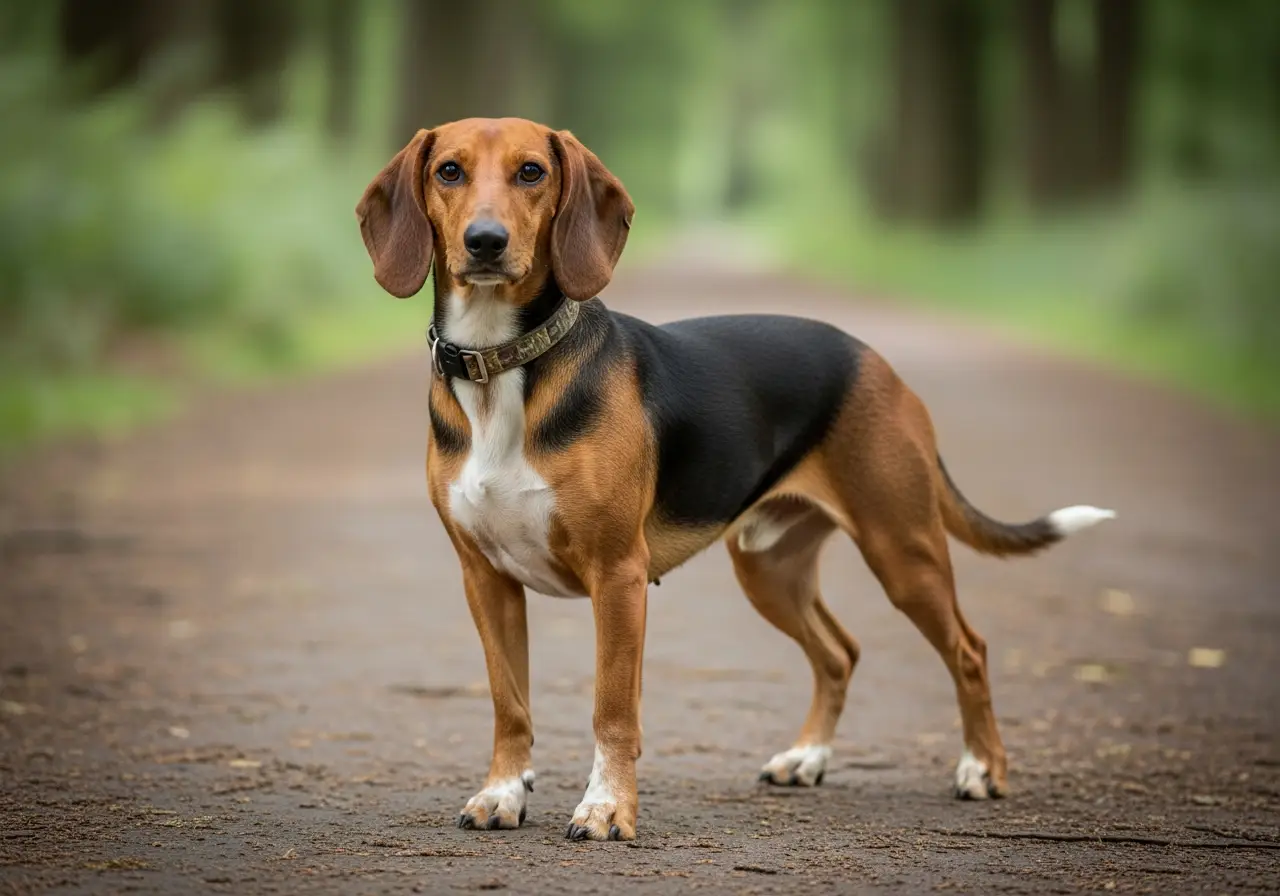
The Westphalian Dachsbracke is a low-slung hunting dog with a deeply ingrained drive to follow scent trails and clear vocalisation. Anyone looking for a compact, manageable dog while underestimating its hunting background will quickly become overwhelmed. This breed demands daily structured stimulation, hunting-related enrichment and an owner who knows and respects hound behaviour, rather than trying to retrain it.
02Introduction
What makes the Westphalian Dachsbracke special
Westphalian Dachsbracke: short-legged Westphalian hunting dog, enduring and nose-loving, and suitable for families
03Profile
Key facts and suitability
- Origin
- Deutschland
- Original purpose
- Small game hunting
- FCI
- No. 100 · Group 6 · Section 1.3
- height at the withers
- 30–38 cm
- Weight
- 15–20 kg
- Life expectancy
- 14–17 Years
- Coat type
- Short-haired
- Minimum exercise
- 60 min/day
- Puppy price
- 900–1'500 CHF
- Waiting period
- 4 months
- Sports
- Scent work Mantrailing
04Temperament
How the Westphalian Dachsbracke shows up in everyday life
The morning walk reveals what the Westfälische Dachsbracke truly is: the nose goes straight to the ground, the body follows the scent trail, and the owner becomes secondary. This is not an obedience problem; it is hound behaviour, deeply rooted in genetics.
Internally, the Westfälische Dachsbracke requires daily intensive tracking work, mental stimulation and sufficient exercise. The need for mental work is high: a dog that does not get a scent trail will find one itself, in the garden, in the forest, or on the way to the supermarket. The need for social contact is also pronounced; the breed wants to work in contact with its primary caregiver, not wait isolated in a kennel.
Externally, the Westfälische Dachsbracke tends to be reserved towards strangers. Friendliness towards unknown people is restrained; there is no mistrust in an aggressive sense, but also no open joy in greeting. Anyone expecting the dog to warmly welcome every visitor will be disappointed. These two poles (high internal need for social contact with the primary caregiver, cautious external reaction to strangers) must not be confused.
In the house, the breed is calm if its need for stimulation is met. An evening on the sofa after two hours of tracking work is realistic. An evening on the sofa after a short walk ends with a dog that opens cupboards, chews carpets or becomes noisy.
Tolerance for being left alone is around four hours, provided there is appropriate preparation and sufficient stimulation beforehand. Longer absences without a care solution are incompatible with this breed.
05Needs
What this breed needs daily
The Westfälische Dachsbracke requires at least 90 to 120 minutes of active exercise daily, not a walk in the sense of leisurely strolling, but structured stimulation involving nose work or hunting-related enrichment.
Tracking work takes top priority. Whether in a hunting context or as dog sport (mantrailing, tracking according to SchH/VPG rules, scent-tracking exercises), the nose must be challenged daily. A dog that does not receive this work will develop avoidance behaviour: excessive barking, destruction, restlessness.
Mental work complements physical stimulation. Search games, nose work in the terrain and structured training sessions cover the high need for mental work of this breed. Pure exercise without cognitive demand is not sufficient.
The terrain plays a central role. The Westfälische Dachsbracke needs access to natural terrain, forest, meadows, field paths. An urban environment with concrete paths and dog parks does not structurally meet the need. A secure property or an enclosed area is almost a prerequisite, as off-leash activity without security poses a permanent risk due to the drive to track.
Social contact with conspecifics has a positive effect on well-being. The breed was traditionally kept in hunting groups; living as a single dog without regular contact with other dogs increases the care effort for the owner.
Training must be realistic and management-oriented. Recall upon contact with game is only conditionally reliable even with consistent training. Impulse control, secure loose-leash walking and clear safety management in open areas are central training topics, not optional extras.
Exercise
High
mental work
A lot
Social needs
Medium
training
Demanding
06Sport & Mental and Physical Stimulation
What sports the Westphalian Dachsbracke is suited for
Realistic in terms of physiology and genetics – not every breed suits every sport.
Structurally and physiologically suitable: no jumping sports (risk of slipped disc) · Suitable for mantrailing, dummy work and tracking · CaniCross / bikejoring possible.
07Quick Check
08Suitability
Who this breed is suitable for – and who it isn't
✓Matches
The Westfälische Dachsbracke suits owners with a hunting background or proven experience with high-drive scent hounds. Anyone who actively hunts and is looking for an enduring, reliable tracking dog for small game hunting or wounded game tracking will find a dependable partner in this breed.
Keeping the breed is also possible without a hunting licence, but only under clear conditions: the owner must be able to provide 90 to 120 minutes of structured stimulation with nose work daily. Tracking work as dog sport, mantrailing or comparable scent-oriented activities must be firmly anchored in everyday life.
A rural or at least suburban environment with access to forest and terrain is a prerequisite. A secure property significantly facilitates keeping the dog.
Families with older children from about ten years of age who actively participate in dog training are suitable, provided the adults ensure the need for exercise and stimulation. The breed generally gets along well with conspecifics if socialisation takes place early.
Owners who are willing to accept typical hound behaviour (barking on the trail, limited recall upon contact with game, pronounced tracking motivation) as breed characteristics and manage them accordingly will find a robust, loyal dog with a clear work ethic in the Westfälische Dachsbracke.
×Doesn't match
The Westfälische Dachsbracke does not suit owners looking for a calm, city-compatible companion dog. Anyone living in an apartment without a garden, residing in a densely populated urban area or lacking daily access to natural terrain will be structurally overwhelmed by this breed.
First-time owners without prior experience with hunting-motivated dogs should not choose this breed. The combination of a high drive to follow scent trails, limited recall reliability, and pronounced vocalisation requires experience in handling strong-drive hounds; it is not a learning ground for a first dog.
Anyone who is away from home for more than four hours daily and does not have a reliable care solution underestimates the need for social contact of this breed. The Westphalian Dachsbracke does not tolerate long periods alone without consequences.
Anyone who perceives reserve towards strangers as a problem and is looking for an openly friendly dog for social occasions will be disappointed. A high internal need for social contact with the primary caregiver does not mean external openness towards strangers; anyone who does not understand this difference will misinterpret the behaviour.
Households with small animals such as rabbits, guinea pigs or cats without secure separation are also unsuitable. The pronounced prey drive makes a conflict-free coexistence without consistent management unrealistic.
10Line reality
Show line, working line, breeder market
The Westphalian Dachsbracke does not know a pronounced split into show and working lines, as is documented in other breeds, such as the Labrador or Golden Retriever. Breeding remained historically closely oriented to hunting requirements, and the FCI standard prescribes a working test. This means: breeding animals must prove their working traits, not just their appearance.
In practice, differences still exist between litters from parent dogs actively used for hunting and those from breeding lines that focus more on conformation and show success. Anyone looking for a dog for active hunting work should specifically ask about parent dogs that are regularly used for tracking wounded game or in scent-tracking trials.
Breeding is regionally concentrated in Germany, with the Deutscher Bracken-Club e.V. as the responsible breeding club. In Switzerland, the SNLC (Schweizer Niederlaufhund- und Dachsbracken-Club) oversees the breed. Population numbers are low; annual litter counts in the lower double-digit range are realistic. This limits selection and makes thorough breeder research all the more important.
Anyone keeping a dog exclusively as a companion without hunting use should be aware that puppies with a pronounced drive to track can also come from parent dogs not used for hunting; the genetic predisposition is typical of the breed and not individually controllable.
11Health · Reality
What you need to plan for medically with your Westphalian Dachsbracke
The Westphalian Dachsbracke is considered a robust breed with a life expectancy of approximately 11 to 14 years. Breed-typical diseases with high prevalence have not yet been systematically recorded in large studies; the small population size makes reliable statistics difficult.
Due to its low-slung build (short limbs, long torso), there is an increased risk of spinal problems, particularly intervertebral disc disease (IVDD). This risk is well-documented in chondrodystrophic breeds: studies on related low-slung dogs show IVDD rates of up to 19% over the course of life (Brisson, 2010, Veterinary Clinics of North America). Jumping from raised surfaces, steep stairs and overweight significantly increase the risk.
Ear problems occur disproportionately frequently in dogs with floppy ears. The Westphalian Dachsbracke has medium-length, close-fitting ears; regular checking and cleaning are sensible for prevention, especially after use in wet terrain.
Hip dysplasia (HD) is not documented as a major problem in this breed, but should be considered when selecting breeding stock. Reputable breeders provide HD X-ray results for the parent dogs.
Overweight poses a serious risk: an overweight dog puts additional strain on the spine. Weight should be checked regularly, at least once a year by the vet, and more frequently if there is suspicion of weight gain. Annual check-ups, dental checks and parasite management (ticks after field work) are essential for this breed.
12Structured data
Health by the numbers
Prone to diseases
Ear infections Overweight
Recommended health tests
Ear check Weight control
13Myths ↔ Reality
What is often said incorrectly about this breed
Five myths, five realities, five sources.
“The Westphalian Dachsbracke is an uncomplicated family dog because of its size.
Body size says nothing about working drive. The Westphalian Dachsbracke was selected over generations for tracking work and baying. This drive is genetically anchored and occurs regardless of the form of keeping. Family life is possible, but only if the hunting-related stimulation needs are met daily.
“Hounds can be let off-leash everywhere; they always come back.
Hounds follow a picked-up scent with high concentration and effectively switch off recall in the process. Recall upon contact with game is only conditionally reliable in this breed, even with intensive training. Off-leash walking without a secured environment poses a considerable safety risk, for the dog and for the game.
“The breed is quiet and calm; hounds hardly bark.
The opposite is true. Vocalisation on the scent is an explicit breeding goal of the Westphalian Dachsbracke. The FCI standard describes the breed as a scenthound with working test; baying is not a fault, but a desired trait. In residential areas or apartment buildings, this regularly leads to conflicts.
“Whoever does not use the hound for hunting can simply keep it as a hiking dog.
Hiking partially covers the exercise need, but does not replace structured nose work. The Westphalian Dachsbracke needs mental stimulation through scent-oriented tasks, mantrailing, tracking work or hunting-related exercises. Pure movement without cognitive demand leads to frustration and undesirable behaviour.
“Hounds are pack dogs and therefore easy to get along with other dogs.
Traditional leading in hunting groups does not automatically mean conflict-free coexistence with any dogs. Compatibility with conspecifics depends on socialisation, structure and leadership. Hounds that have grown up together and work together generally show good compatibility; however, this is not automatic.
14animal welfare
The animal welfare perspective
Breeder market, designer versions, animal shelter reality — what no one writes in the puppy ad.
The Westphalian Dachsbracke belongs to the rare German hunting dog breeds. The limited supply of reputable breeders creates a market that backyard breeders and dubious suppliers exploit. Puppies from uncontrolled breeding often end up with owners who have not been informed about the breed characteristics or the need for stimulation, with predictable consequences.
The most common animal welfare issue with this breed is not breeding for harmful traits in the morphological sense, but inadequate housing conditions. Owners who look for a compact, manageable dog while underestimating the pronounced prey drive give up the animals, often after just a few months. The reasons given are then: "too loud", "runs away", "not recallable". These are not training errors, but breed characteristics that should have been known before getting a dog.
Designer versions or trend crossbreeds are not a relevant issue for the Westphalian Dachsbracke; the breed is too unknown for the lifestyle market. This is an advantage: breeding has remained largely in hunting hands with a focus on working traits.
Animal welfare organisations and Bracken clubs occasionally rehome surrendered animals. A dog from rehoming is an equally valid option, often even advantageous, because the temperament of the adult animal can already be assessed. Anyone taking on a hound with prior experience knows what to expect.
Anyone buying or taking on a Westphalian Dachsbracke assumes responsibility for an animal with specific needs. Education before the decision protects the dog and the owner from a situation that overwhelms both.
15Costs · Transparency
What this breed realistically costs
A puppy from reputable breeding with pedigree, health checks of the parent animals and proof of working tests costs between 800 and 1,400 EUR or CHF in Germany and Switzerland. Offers significantly below this, particularly from Eastern Europe without papers, often originate from uncontrolled breeding.
The annual living costs consist of food (high-quality dry food or BARF for a medium-sized dog: approx. 600–900 EUR/year), basic vet care (vaccinations, parasite protection, annual check-up: approx. 300–500 EUR/year) and care (ears, paws, occasional bathing after field use: low, approx. 50–100 EUR/year).
Unforeseen vet costs, for example in the case of a slipped disc, can quickly reach 2,000 to 5,000 EUR. Pet insurance costs between 40 and 90 EUR/month for this breed depending on provider and scope of benefits and is a sensible safeguard given the IVDD risk in low-set dogs.
Dog sports and tracking work as an alternative to hunting incur additional costs: club membership, course fees and equipment add up to approx. 200–400 EUR/year. Realistic total costs per year: 1,500 to 2,500 EUR.
16Puppy search
What you need to consider when choosing a breeder
- Reputable breeders of the Westphalian Dachsbracke can be found through the German Bracken Club (Deutscher Bracken-Club e.V.) or the Swiss SNLC.
- Both associations appoint breeding supervisors and check breeding suitability, which serves as a first quality filter.
- Specific criteria for a reputable breeder: The parent dogs have documented health examinations (hip dysplasia X-rays, eye examination), the breeder provides proof of working tests and allows a visit to the litter before handover.
- Puppies are handed over no earlier than eight weeks of age; offers with earlier handover are a warning sign.
- Questions that a reputable breeder answers: How are the puppies socialised?
- What hunting experience do the parent dogs have?
- How many litters per year and per female dog?
- A breeder who has no time for follow-up questions or pressures you into a quick decision is not a reliable partner.
- Finding an adult dog through Bracken clubs or animal welfare organisations is an equally valid alternative.
- An adult dog already shows its temperament, which significantly reduces the risk of making the wrong decision.
- Contacting the breed clubs is sufficient as a first step; this platform does not provide named recommendations for individual breeders.
FAQ
Frequently asked questions about the Westphalian Dachsbracke
Is Westphalian Dachsbracke suitable for beginners?
Westphalian Dachsbracke is considered suitable for first-time dog owners.
Is Westphalian Dachsbracke a family dog?
Westphalian Dachsbracke is considered suitable for families with good socialisation and species-appropriate care.
How much exercise does Westphalian Dachsbracke need?
At least around 60 minutes of exercise per day.
Does Westphalian Dachsbracke suit an apartment?
With enough exercise and enrichment, Westphalian Dachsbracke can also be kept in an apartment.
What is the size and weight of Westphalian Dachsbracke?
Fully grown, Westphalian Dachsbracke reaches about 30–38 cm at the withers and weighs around 15–20 kg.
What is the life expectancy of Westphalian Dachsbracke?
The life expectancy of Westphalian Dachsbracke is approximately 14–17 years.
Which diseases are common in Westphalian Dachsbracke?
Ear infections Overweight
17Breed clubs
Official breed clubs in DACH
19Related
Similar breeds – and their differences
You might also be interested in
Participate
Do you have a good photo of your Westphalian Dachsbracke?
We are looking for expressive images for our breed profiles. Submit yours; the editorial team reviews every submission before publication.
Does this breed suit you?
Compact German hunting dog – not widely spread but robust and uncomplicated