
01Summary
In a paragraph
If you only have 30 seconds.
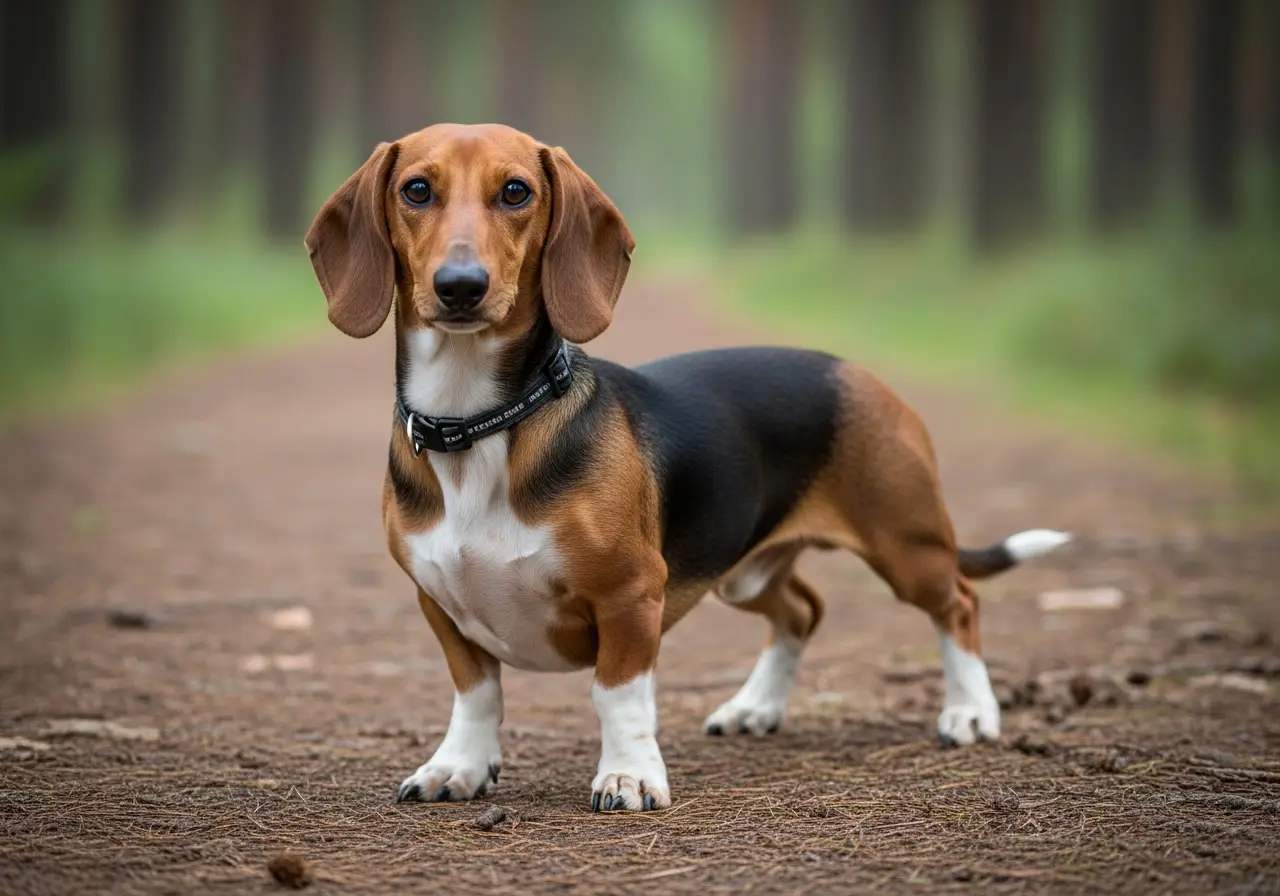
The Drever is a low-slung Swedish scenthound with a genetically ingrained prey drive and high independence. It works with endurance, bayingly loud vocalisation and a fine nose, and requires exactly that in everyday life too: structured guidance, intensive nose work and an owner with hunting understanding. Anyone looking for a calm companion dog is fundamentally mistaken about this breed.
02Introduction
What makes the Swedish Dachsbracke (Drever) special
Swedish Dachsbracke (Drever): short-legged Swedish scenthound, enduring, nose-loving and suitable as a family dog
03Profile
Key facts and suitability
- Origin
- Schweden
- Original purpose
- Small game hunting
- FCI
- No. 130 · Group 6 · Section 1.3
- height at the withers
- 30–40 cm
- Weight
- 12–16 kg
- Life expectancy
- 12–15 Years
- Coat type
- Short-haired
- Minimum exercise
- 60 min/day
- Puppy price
- 1'000–1'800 CHF
- Waiting period
- 4 months
- Sports
- Scent work Mantrailing
04Temperament
How the Swedish Dachsbracke (Drever) shows up in everyday life
The morning walk reveals what defines the Drever: its nose immediately goes to the ground, the dog purposefully follows a scent and is hardly interrupted by distractions. This is not a training issue; it is genetically ingrained tracking work.
Internally, the Drever requires intensive mental stimulation every day. Mental work in the form of nose work, mantrailing or hunting exercises is not a bonus but a basic need. The need for social contact is strongly directed towards the key people: the Drever forms a close, loyal bond and actively seeks proximity to its family. It should not be left alone for longer than four hours, and even then only after gradual conditioning.
Externally, the Drever behaves neutrally to reservedly towards strangers. Anyone expecting a friendly family dog to warmly greet every visitor will be surprised. The close bond with the family does not mean that the dog is open to all people. These two poles, high need for social contact within the family and reserve towards unknown people, must be actively taken into account during socialisation.
With other dogs, it generally shows itself to be compatible, which is due to its use in hunting groups. In everyday life without hunting, it needs clear structures, fixed routines and an owner who neither ignores nor underestimates its desire to track. Anyone who provides this will experience an enduring, attentive and character-strong dog.
05Needs
What this breed needs daily
The Drever requires at least 90 to 120 minutes of active exercise daily, not just walking but exercise with a task. Sniffing rounds on varying terrain, nose work, tracking or hunting exercises simultaneously cover its need for mental work (value 4 out of 5) and its need for physical activity (value 4 out of 5).
Pure off-lead exercise in a dog park is not sufficient. The Drever needs tasks that channel its desire to track. Without this stimulation, signs of frustration arise: excessive vocalisation, restlessness in the house, destructive behaviour.
A secure area is a considerable advantage in everyday life. The pronounced prey drive makes uncontrolled off-lead exercise in areas rich in wildlife risky. Recall training requires consistent, long-term development and reaches limits when actively tracking that no amount of training can fully overcome.
Socially, the Drever needs regular interaction with its key people. Being left alone should be limited to a maximum of four hours and must be trained gradually. A second child in the form of another dog can partially cover the need for social contact but does not replace human leadership.
Mentally, the Drever demands an owner who can read dog behaviour and understand hunting instincts. Consistency, clear communication and realistic expectations regarding recall are not options; they are a prerequisite for a functioning coexistence.
Exercise
High
mental work
A lot
Social needs
Medium
training
Demanding
06Sport & Mental and Physical Stimulation
What sports the Swedish Dachsbracke (Drever) is suited for
Realistic in terms of physiology and genetics – not every breed suits every sport.
Structurally and physiologically suitable: no jumping sports (risk of slipped disc) · Suitable for mantrailing, dummy work and tracking · CaniCross / bikejoring possible.
07Quick Check
08Suitability
Who this breed is suitable for – and who it isn't
✓Matches
The Drever suits hunters or owners with hunting experience who can offer 90 to 120 minutes of structured stimulation daily. Access to terrain for tracking or nose work is a prerequisite; owning land or regular access to a secure off-lead area significantly eases everyday life.
It is suitable for owners who have experience with high-drive or independently working dogs and understand the dog's desire to track not as a problem but as its core character. Families with children of school age are an option if the adults clearly take on the leadership role and everyday life offers sufficient exercise and tasks.
Those living in the countryside or in a rural region benefit from the natural opportunities for stimulation. Owners who are willing to establish nose work or mantrailing as a fixed daily routine create a good foundation. Owners interested in dog sports in the form of tracking or scent work also find a motivated partner in the Drever, provided the hunting context is maintained.
×Doesn't match
The Drever is not suitable for first-time dog owners who have no experience with high-drive or independently working breeds. Anyone who views the desire to track as a trainable problem will constantly hit limits.
It is not suitable for urban living situations without daily access to terrain for nose work. Anyone who is away from home for eight hours and has no reliable dog care plan will overwhelm the dog in terms of being left alone and stimulation simultaneously.
Anyone looking for an open, stranger-friendly dog that warmly greets every visitor should not confuse the Drever's external behavioural axis with its family bond: close loyalty to the family does not mean openness towards strangers.
It is also not a suitable choice for owners who rely on reliable off-lead exercise in areas rich in wildlife. Recall when tracking is genetically limited; this is not a training gap but breed character. Anyone who cannot or will not accept this should choose another breed.
10Line reality
Show line, working line, breeder market
The Drever is bred almost exclusively as a hunting dog in Sweden. A split into working and show lines, as observed in other breeds, hardly exists for the Drever. The breeding goal consistently focuses on utility: tracking drive, endurance, barking on the scent and suitability for Swedish soil and climate conditions are in the foreground.
Working tests are an integral part of the FCI classification (Group 6, Section 1.3, with working test). Breeders selecting for utility value proven hunting performance of the parent animals. Outside Sweden, particularly in Germany and Switzerland, the breed is so rare that no significant line differentiation can be spoken of. Anyone looking for a Drever will generally encounter hunters-oriented breeders from Sweden or Scandinavia. Regional peculiarities in breeding outside Sweden are not documented.
11Health · Reality
What you need to plan for medically with your Swedish Dachsbracke (Drever)
The Drever is considered a robust breed with a life expectancy of around 12 to 14 years. Breed-typical diseases with high prevalence are not comprehensively documented, which is partly due to the small population size outside Sweden.
Due to the long spine and low stature, there is an increased risk of disc problems (discopathy), as is generally known for low-slung breeds. Joint-friendly exercise during growth (no uncontrolled climbing of stairs, no jumping from raised surfaces) is recommended in the first 12 to 18 months of life. A study by the University of Zurich (2019) on disc disease in chondrodystrophic breeds confirms the increased risk in dogs with this body type (Cauzinille et al., 2019, Vet. Comp. Orthop. Traumatol.).
Overweight is a relevant risk: low-slung dogs with high food motivation tend to gain weight, which additionally strains the joints and spine. Regular weight checks at the vet, at least once a year, are sensible.
Preventive examinations should cover eyes, joints and spine. Hip dysplasia (HD) is documented in scenthounds of this size, however, no specific prevalence figures from large samples are available for the Drever. Breeders with a focus on utility generally carry out X-ray examinations of the parent animals; this proof should be requested when buying a puppy.
12Structured data
Health by the numbers
Prone to diseases
Ear infections Overweight
Recommended health tests
Ear check Weight control
13Myths ↔ Reality
What is often said incorrectly about this breed
Five myths, five realities, five sources.
„The Drever is a low-maintenance dog due to its size, requiring little exercise.
The compact build deceives regarding the actual need for stimulation. The Drever is a scenthound bred for enduring hunting operations. Its exercise needs are significantly higher than those of many medium-sized dog breeds. Without daily intensive stimulation, including nose work, it develops frustration and stress behaviour.
„As a hunting dog, the Drever is automatically well-suited for experienced dog owners without a hunting background.
Experience in handling dogs alone is not enough. The Drever requires an owner who understands, can assess and channel the dog's tracking drive. Underestimating this drive risks uncontrolled off-leash running and a dog that becomes unreachable upon contact with game. Basic understanding of hunting is not optional, but a prerequisite.
„The Drever is open and trusting towards strangers due to its friendly nature.
The Drever shows a neutral to reserved attitude towards strangers. Its need for social contact is primarily directed towards its key persons and hunting partners. Friendliness towards the family does not mean that the dog warmly greets unknown people. These two axes, close family bond and reserve towards strangers, must not be confused.
„A Drever can be reliably recalled with consistent training, even when it has picked up a scent.
Recall during active scent contact hits genetically determined limits with the Drever. Scenthounds have been selected over generations to follow a scent independently and enduringly. Barking on the scent is not a mistake, but a desired breeding goal. Off-leash running in game-rich areas without secure terrain is therefore associated with considerable risk.
„The Drever is suitable as a family dog for beginners because it is balanced and never aggressive.
The FCI standard describes the Drever as alert, balanced and never aggressive; this refers to character traits, not keeping requirements. A balanced character does not exempt one from the duty of consistent handling and species-appropriate stimulation. For owners without prior experience with high-drive dogs, the Drever presents a demanding challenge.
14animal welfare
The animal welfare perspective
Breeder market, designer versions, animal shelter reality — what no one writes in the puppy ad.
The Drever is an extreme niche breed in Germany and Switzerland. The low demand protects it so far from the typical problems of the backyard breeder market: mass production, lack of health checks, sale via online platforms without breeder contact. Nevertheless, this applies: anyone who receives an offer for a Drever via a classifieds platform without proof of breeding and without the possibility of viewing should be sceptical. Even rare breeds are traded by commercial breeders who do not document health certificates or hunting suitability of the parent animals.
Designer versions or trend crosses of the Drever are currently unknown. This is no coincidence: the breed does not have a mass-market image and is not marketed as a lifestyle dog. That protects it, as long as it remains so.
Housing-related problems with the Drever arise almost exclusively from misjudging the housing requirements. A dog bred for endurance hunting trips and kept in a city apartment without sufficient stimulation develops stress behaviour. This is not a character flaw of the dog; it is a housing decision that harms the animal. Education before purchase is more effective here than criticism afterwards.
Rehoming adult Drevers via animal welfare organisations is rare, but possible. Dogs given up from hunting households, for example after the death of the owner, occasionally end up in rehoming. An adult dog with a known history can be an equivalent, often even more predictable option for experienced owners than a puppy. Anyone open to this possibility should contact specialised hound clubs that accompany such rehoming.
15Costs · Transparency
What this breed realistically costs
A puppy from a reputable breeder costs between 800 and 1,400 EUR in Germany and Switzerland as a rule. Due to the rarity of the breed and long waiting times, prices at the upper end of this range are usual. Offers significantly below 600 EUR without proven health checks of the parent animals are a warning signal.
The annual living costs for a Drever are around 1,500 to 2,500 EUR depending on the form of keeping. This includes food (approx. 400–700 EUR/year depending on quality and body weight), care (low, as the coat is easy to care for), as well as basic equipment and accessories.
Basic veterinary costs (vaccinations, parasite prophylaxis, annual preventive examination) amount to approx. 300 to 500 EUR per year. In addition come possible costs for orthopaedic assessments (X-ray spine/hip: 150–350 EUR per examination) as well as treatment costs in case of illness, which can quickly reach 2,000 to 5,000 EUR in the event of disc herniation.
A dog health insurance or animal health insurance with surgery cover costs between 30 and 80 EUR per month for a Drever depending on provider and scope of benefits (as of 2025, DACH market). For a breed with low body build and corresponding spine risk, such cover is a sensible safeguard.
16Puppy search
What you need to consider when choosing a breeder
- The Drever is a very rare breed in Germany and Switzerland.
- Long waiting times with reputable breeders are the rule, not the exception.
- Anyone looking for a Drever should inform themselves early on at the Deutscher Bracken-Club e.V.
- (https://deutscher-bracken-club.de) or directly with Swedish breeding associations.
- A reputable breeder allows a visit to the litter, shows both parent animals or at least the mother bitch and provides health certificates.
- Puppies offered without the possibility of inspection or via intermediaries are a clear warning sign.
- Since the Drever is primarily bred as a hunting dog, breeders should be able to provide proof of hunting performance for the parent animals.
- Anyone without a hunting background should communicate openly how they intend to channel the dog's desire to track in everyday life; a good breeder will ask this question.
- Rehoming via animal welfare organisations is unlikely for the Drever due to the rarity of the breed, but not excluded.
- Adult dogs from rehoming can be an equivalent option, particularly for experienced owners who can assess the character of an adult dog better than that of a puppy.
FAQ
Frequently asked questions about the Swedish Dachsbracke (Drever)
Is Swedish Dachsbracke (Drever) suitable for beginners?
Swedish Dachsbracke (Drever) is considered suitable for first-time dog owners.
Is Swedish Dachsbracke (Drever) a family dog?
Swedish Dachsbracke (Drever) is considered suitable for families with good socialisation and species-appropriate care.
How much exercise does Swedish Dachsbracke (Drever) need?
At least around 60 minutes of exercise per day.
Does Swedish Dachsbracke (Drever) suit an apartment?
With enough exercise and enrichment, Swedish Dachsbracke (Drever) can also be kept in an apartment.
What is the size and weight of Swedish Dachsbracke (Drever)?
Fully grown, Swedish Dachsbracke (Drever) reaches about 30–40 cm at the withers and weighs around 12–16 kg.
What is the life expectancy of Swedish Dachsbracke (Drever)?
The life expectancy of Swedish Dachsbracke (Drever) is approximately 12–15 years.
Which diseases are common in Swedish Dachsbracke (Drever)?
Ear infections Overweight
17Breed clubs
Official breed clubs in DACH
19Related
Similar breeds – and their differences
You might also be interested in
Participate
Do you have a good photo of your Swedish Dachsbracke (Drever)?
We are looking for expressive images for our breed profiles. Submit yours; the editorial team reviews every submission before publication.
Does this breed suit you?
Compact hunting dog from Sweden – little known in Switzerland