
01Summary
In a paragraph
If you only have 30 seconds.
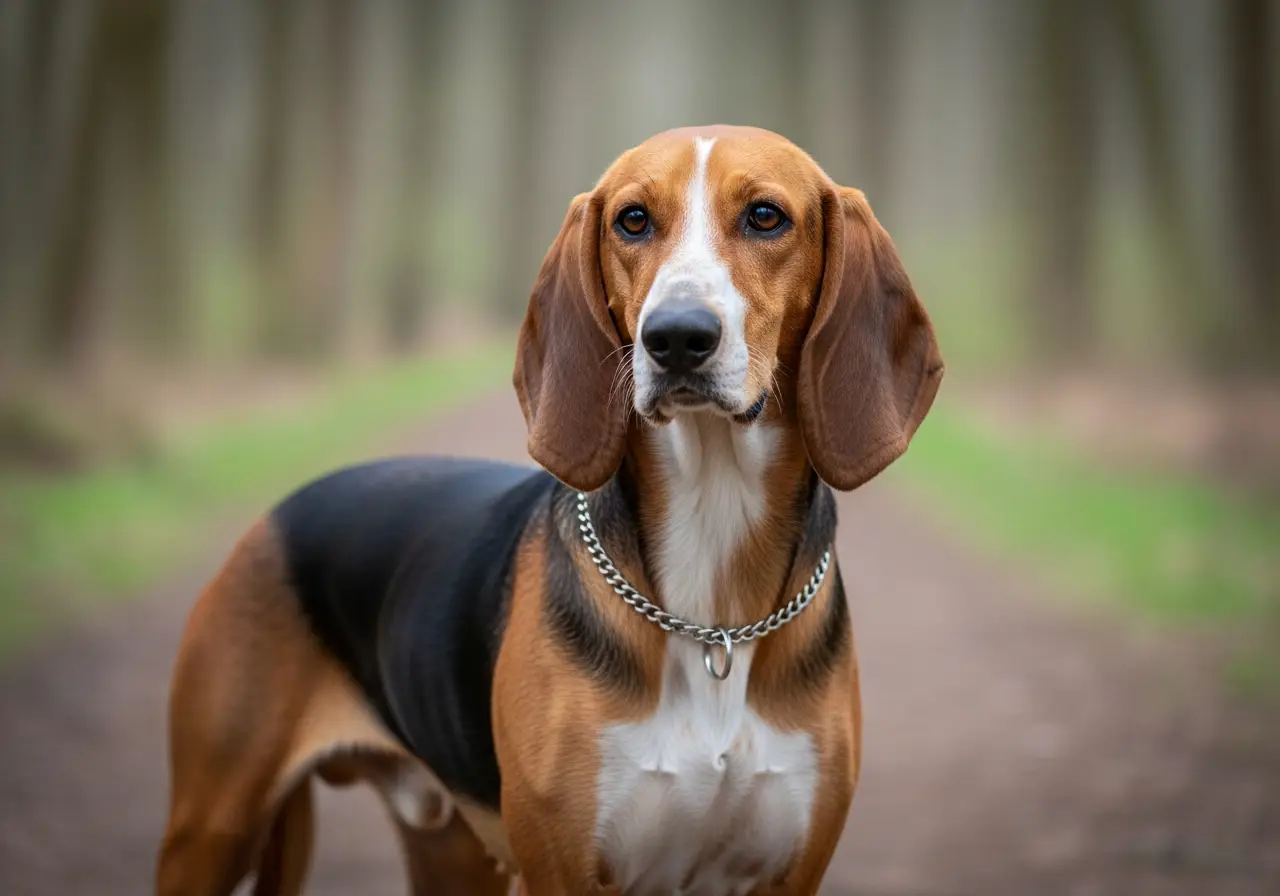
The German Hound is the only recognised German hound breed, an enduring, tri-coloured scenthound with a fine nose and a pronounced desire to follow trails. It was bred over generations for independent hunting work on hare and fox. Anyone keeping one takes responsibility for a dog whose genetic programme demands daily nose work, exercise, and clear management—not occasionally, but as a basic requirement.
02Introduction
What makes the German Hound (Deutsche Bracke) special
The German Hound is the only recognised German hound breed, FCI Group 6, tri-coloured and enduring, height at the withers 40–53 cm.
03Profile
Key facts and suitability
- Origin
- Deutschland
- Original purpose
- Hunting hare and roe deer, bloodhound
- FCI
- No. 299 · Group 6 · Sektion 1.3: Kleine Laufhunde. Mit Arbeitsprüfung.
- height at the withers
- 40–53 cm
- Weight
- 16–20 kg
- Life expectancy
- 12–14 Years
- Coat type
- Short-haired
- Minimum exercise
- 90 min/day
- Puppy price
- 800–1'400 CHF
- Waiting period
- 9 months
- Sports
- Hunting · Tracking · Mantrailing
04Temperament
How the German Hound (Deutsche Bracke) shows up in everyday life
The morning walk reveals what defines the German Hound: the nose immediately goes to the ground, the tail begins to wag, and the dog pulls purposefully after a scent trail. This is not disobedience; this is the genetic programme that has been bred over generations.
Internally, i.e. what the dog needs daily, the need for social contact is at a medium level. The German Hound bonds closely with its primary caregiver but is not a dog that demands constant physical closeness. It appreciates company but also tolerates short periods of rest if the mental and physical stimulation is adequate. The need for mental work is high: nose work, mantrailing or structured search tasks are not extras but basic care.
Externally, i.e. how the dog reacts to its environment, the German Hound shows a neutral to reserved attitude towards strangers. It is not a dog that greets every visitor joyfully. This reserve is not a sign of shyness but rather breed-typical sobriety. Anyone who expects an attentive hunting dog to simultaneously be an open dog for everyone is confusing two different characteristics.
In the evening, after sufficient exercise and nose work, the calm side of the breed becomes apparent: the dog lies down, relaxes and is pleasant in the house. Without this mental and physical stimulation, however, tension remains and manifests itself in vocalisation, restlessness or attempts to go exploring independently.
The German Hound generally gets along calmly with children, provided they interact respectfully with the dog. Toddlers who rush uncontrolled towards the dog can overwhelm the breed.
05Needs
What this breed needs daily
The German Hound requires at least 90 to 120 minutes of active exercise daily, not a cosy city walk, but exercise with content. Cross-country runs, extended hikes or controlled sniffing rounds in the forest correspond to its profile.
Nose work is not an optional addition but a central component of basic care. Mantrailing, tracking work, nose work courses or structured search games cover the high need for mental work. A dog that is not allowed to use its nose is an under-stimulated dog, with all the consequences for behaviour and well-being.
The tolerance for being left alone is around four hours. Longer absences without alternative care are incompatible with this breed. The close bond with the primary caregiver makes separation stress likely with poor preparation.
A rural or at least suburban environment with access to natural terrain is advantageous. Off-leash exercise without secured terrain or hunting management is not risk-free due to the pronounced desire to track. A secure, fenced garden or regular access to secured open space significantly eases daily life.
Training requires patience, clarity and realistic expectations. Impulse control training and a reliable recall are central training goals, and both require time as well as expert guidance, ideally through a dog training school with experience in hunting-motivated breeds.
Exercise
High
mental work
A lot
Social needs
Medium
training
Demanding
06Sport & Mental and Physical Stimulation
What sports the German Hound (Deutsche Bracke) is suited for
Realistic in terms of physiology and genetics – not every breed suits every sport.
Structurally and physiologically suitable: Suitable for mantrailing, dummy work and tracking · CaniCross / bikejoring possible.
07Quick Check
08Suitability
Who this breed is suitable for – and who it isn't
✓Matches
The German Hound suits owners who can provide at least 90 to 120 minutes of active exercise in natural terrain daily, not as an occasional weekend programme but as a fixed part of everyday life.
Hunters and hunting-active owners find in the German Hound a breed that was bred for vocal tracking work and fulfils this task with high motivation. Anyone who uses the breed for hunting directly serves its genetic profile.
Owners without a hunting licence can also live with the German Hound if they practise nose work, tracking work or mantrailing as serious leisure sports and actively channel the dog's desire to track. Experience with independently working dogs is a clear advantage in this regard.
Households with a garden or direct access to forest and fields are at an advantage. Families with children from about eight years of age, who are accustomed to calm handling of dogs, are also suitable, provided the exercise requirements are met.
Anyone who already has experience with hounds, brackes or other hunting-motivated breeds will find a reliable, enduring companion in the German Hound. The willingness to invest in professional training support is another characteristic of suitable owners.
×Doesn't match
The German Hound does not suit owners who are regularly away from home for more than four hours a day and cannot organise reliable alternative care. The bond with the primary caregiver is close; long hours alone burden the dog.
Anyone living in an urban apartment without access to natural terrain and restricting exercise to short city walks fundamentally underestimates the exercise and nose work needs of this breed. The result is a chronically under-stimulated dog.
Owners looking for a dog that reliably stays close off-leash once it picks up a scent will be disappointed with the German Hound. The desire to follow a trail is genetically ingrained; no training can eliminate it, only manage it.
Those who equate the reserved reaction towards strangers with a lack of socialisation and expect the dog to become an open greeting dog after just a few weeks misunderstand the breed-typical character. Internal bonding depth and external openness towards strangers are two different traits, and in the German Hound they diverge.
First-time owners without prior experience with hunting-motivated dogs and without a willingness to seek expert training support face a steep learning curve that can burden both the dog and the owner equally.
10Line reality
Show line, working line, breeder market
The German Hound does not exhibit a pronounced differentiation into lines in the sense of show and working lines, as is known, for example, with the German Shepherd Dog or the Labrador Retriever. Breeding is predominantly oriented towards utility; the FCI standard mandates a working test, thereby anchoring the hunting function as the basis for breeding.
However, regional differences in breeding focus exist within the breed. Dogs from active hunting breeding lines, which are regularly presented at working tests, generally show a more intense desire to track and greater endurance than dogs from lines where the hunting test is less of a priority.
Anyone looking for a German Hound for hunting work should specifically ask for breeders whose dogs are regularly taken to hound tests and can provide corresponding proof. For owners without hunting use, this question of lines is less decisive; the desire to track is present in any case and must be actively channelled, regardless of the breeding focus of the individual dog.
11Health · Reality
What you need to plan for medically with your German Hound (Deutsche Bracke)
The German Hound is considered a robust breed without the breed-typical extreme features that lead to structural health problems in other breeds. Reliable, breed-specific health statistics with large sample sizes are only available to a limited extent due to the small population size.
The life expectancy is stated in specialist literature and by breeding associations as 12 to 14 years, a solid value for medium-sized dogs.
As with many medium-sized scenthounds, hip dysplasia (HD) and elbow dysplasia (ED) are relevant health parameters. Reputable breeders have parent animals examined radiologically and document the results. Interested parties should request these certificates before purchase.
Ear infections are a known risk in dogs with long, hanging ears, such as the characteristic ear flap of the German Hound. Regular ear checks and cleaning are part of basic care. Redness, odour, or frequent head shaking requires veterinary investigation.
Overweight is an avoidable risk in this enduring breed, arising from insufficient exercise and uncontrolled feeding. A healthy body weight protects joints and extends the active life phase.
Recommended preventive examinations: annual veterinary check-up, HD/ED screening of parent animals in breeding, regular dental checks, and ear checks after every field use.
12Structured data
Health by the numbers
Prone to diseases
Hip dysplasia, ear problems
Recommended health tests
Hip X-ray
13Myths ↔ Reality
What is often said incorrectly about this breed
Five myths, five realities, five sources.
“The German Hound is a well-behaved family dog that can be kept easily even without hunting.”
The desire to follow a scent in the German Hound is genetically hardwired and not a switchable behaviour. Without regular nose work and sufficient stimulation, many dogs develop frustration symptoms such as baying, restlessness or uncontrolled hunting. Keeping without hunting-related management is possible but requires considerable effort and expertise.
“Hounds are gentle and never run away.”
On a trail, the German Hound switches to independent work; that is its original function. A recall upon contact with game is hardly reliable without intensive training and management. Free running without secured terrain poses a real safety risk, even for well-socialised dogs.
“The German Hound is a small, easy-to-keep breed.”
With a height at the withers of 40–53 cm, it belongs to the medium-sized scent hounds. More decisive than body size is its need for movement: at least 90–120 minutes of active exercise daily plus nose work are not a recommendation but a minimum requirement. Whoever underestimates that will overwhelm themselves and the dog.
“Hounds are difficult to train and stubborn.”
The German Hound learns quickly and is willing to learn as long as no game scent is involved. Its independence is not stubbornness but the result of centuries of selection for self-responsible hunting work. Whoever understands that and builds training accordingly works with the dog, not against it.
“German Hounds are loners and do not like other dogs.”
Historically, hounds were led in packs. The breed generally shows good tolerance towards conspecifics. Problems arise more from lack of socialisation or insufficient stimulation than from breed-typical aggression.
14animal welfare
The animal welfare perspective
Breeder market, designer versions, animal shelter reality — what no one writes in the puppy ad.
The German Hound is a rare breed with a manageable breeding stock. The backyard breeder market, i.e., commercial rearing without club affiliation and without working trials, plays a lesser role in this breed than in popular modern breeds. This does not mean, however, that all offered dogs come from reputable breeding. Even for rare breeds, there are offers without health certificates, without studbook registration, and without interest in the buyer's living situation.
Designer versions or hybrid forms of the German Hound are currently not a widespread phenomenon. The breed is not marketed as a trend pet, which keeps its population stable but also means that interested parties must actively search and waiting times for puppies are realistic.
The most common breeding and keeping-related problem with the German Hound is not structural but behavioural: dogs whose prey drive has been underestimated by the owner end up being given away. Typical reasons for surrender are uncontrolled hunting, bolting, and owners being overwhelmed because they had no plan for the dog's desire to follow trails. This is not a failure of the dog; it is an information problem before purchase.
Adopting a German Hound from animal welfare or through breed rescue is an equally valid option to buying a puppy. Adult dogs show their character more clearly, are often basic socialised, and seek a home that knows their needs. The Deutscher Bracken-Club e.V. can assist in finding dogs available for rehoming. Anyone who honestly asks themselves before purchase or adoption whether their own daily routine suits this dog makes the better decision, for themselves and for the dog.
15Costs · Transparency
What this breed realistically costs
A puppy from reputable breeding with club affiliation and proof of working trials for the parents usually costs between 800 and 1,500 EUR in Germany. Offers significantly below this range without proof of the parent animals' health and without studbook registration are a warning sign.
The annual cost of keeping a dog consists of several items: high-quality food for a medium-sized, active dog costs around 600 to 1,000 EUR per year, depending on the type of food and body weight. Basic care (ears, claws, coat) is relatively straightforward for this breed and incurs low costs if carried out by the owner.
Vet costs for routine care (annual vaccinations, parasite prevention, check-ups) are around 200 to 400 EUR per year. Unplanned treatments for injuries from field work or ear infections can increase this amount. Pet insurance or a health budget of at least 1,000 EUR as a reserve is recommended.
For dogs used in hunting, costs for examination fees, equipment and training support are added. For owners without hunting use, nose work courses and dog training school with experience in scent hounds are relevant cost items, realistically 300 to 600 EUR in the first year.
16Puppy search
What you need to consider when choosing a breeder
- Reputable breeders of the German Hound are usually members of the Deutscher Bracken-Club e.V.
- A first point of contact is the club's breeding list at www.deutscher-bracken-club.de.
- Breeders affiliated with the club are subject to a breeding regulation that defines minimum standards for health checks and rearing conditions.
- Characteristics of reputable breeding: The breeder asks questions about the planned daily routine and the experience of the interested party.
- Puppies grow up in a household environment and are accustomed to everyday noises.
- Both parent animals are known, and health certificates are available.
- The breeder is reachable after the purchase.
- Warning signs: Puppies without club affiliation, sale without a personal conversation, multiple litters available simultaneously, no interest in the buyer's living situation, suspiciously low prices.
- Adoption through animal welfare organisations is an equally valid option.
- German Hounds rarely end up in animal shelters, but they are occasionally given away when their prey drive has been underestimated.
- Breed-specific rehoming agencies or the Bracken-Club can also provide assistance here.
- An adult dog from a shelter often already has basic training and shows its character more clearly than a puppy.
FAQ
Frequently asked questions about the German Hound (Deutsche Bracke)
Is German Hound (Deutsche Bracke) a family dog?
German Hound (Deutsche Bracke) is considered suitable for families with good socialisation and species-appropriate care.
How much exercise does German Hound (Deutsche Bracke) need?
At least around 90 minutes of exercise per day. As an active breed, more so — plus mental stimulation.
What is the size and weight of German Hound (Deutsche Bracke)?
Fully grown, German Hound (Deutsche Bracke) reaches about 40–53 cm at the withers and weighs around 16–20 kg.
What is the life expectancy of German Hound (Deutsche Bracke)?
The life expectancy of German Hound (Deutsche Bracke) is approximately 12–14 years.
Which diseases are common in German Hound (Deutsche Bracke)?
Hip dysplasia, ear problems
17Breed clubs
Official breed clubs in DACH
19Related
Similar breeds – and their differences
You might also be interested in
Participate
Do you have a good photo of your German Hound (Deutsche Bracke)?
We are looking for expressive images for our breed profiles. Submit yours; the editorial team reviews every submission before publication.
Does this breed suit you?
Only indigenous German hound breed. Robust and passionate about hunting. For hunters and active rural owners.