
01Summary
In a paragraph
If you only have 30 seconds.
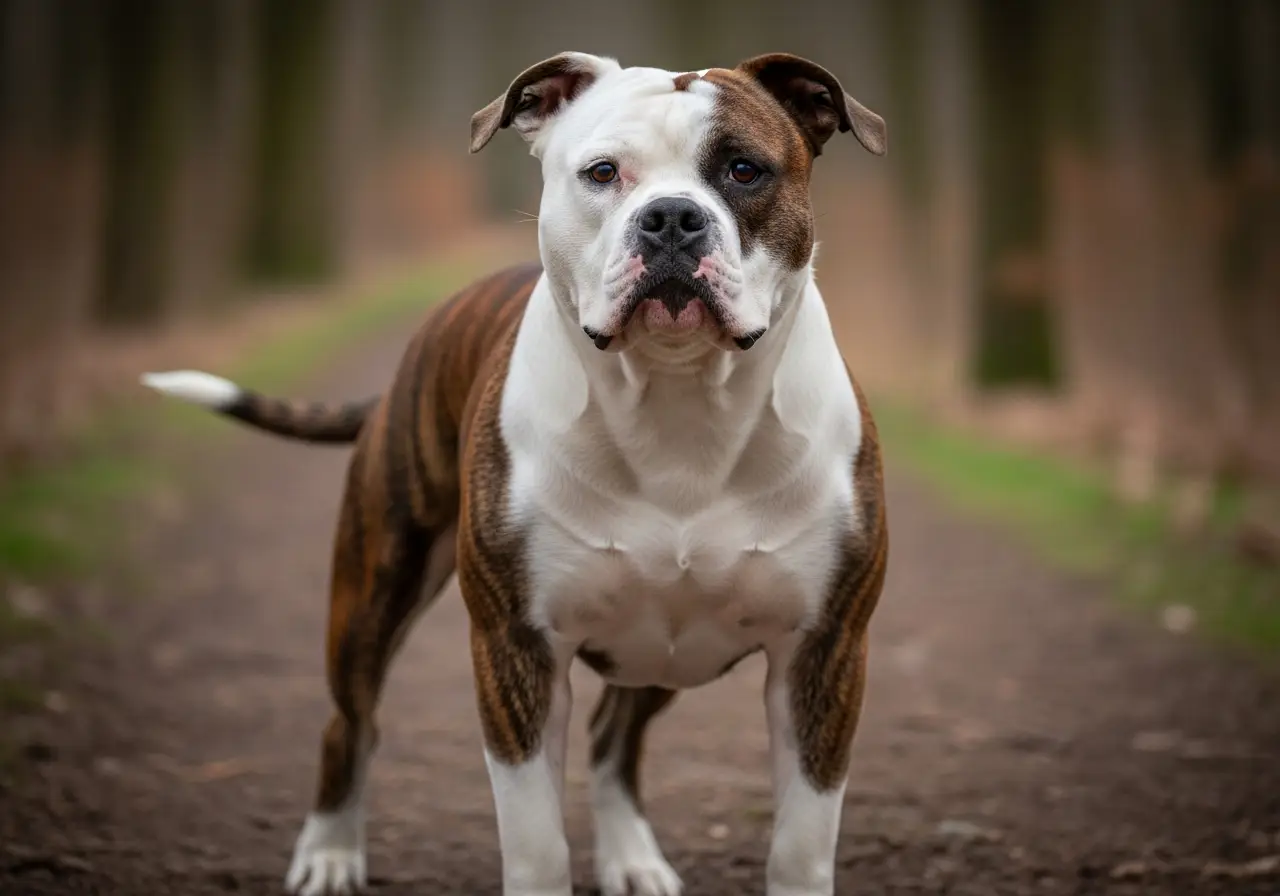
The American Bulldog is an athletic US working dog with a pronounced guarding instinct and a strong bond with its primary caregiver. It is not FCI-recognised, classified as a restricted breed in several German states, and requires daily structured leadership, consistent socialisation, and an owner experienced in handling powerful, protective dogs. Those who bring this to the table gain a loyal, resilient companion.
02Introduction
What makes the American Bulldog special
The American Bulldog is a powerful US working dog, not FCI-recognised, shoulder height 52–70 cm, partly classified as a restricted breed.
03Profile
Key facts and suitability
- Origin
- USA
- Original purpose
- Farm dog, wild boar hunting, protection
- height at the withers
- 52–70 cm
- Weight
- 27–54 kg
- Life expectancy
- 10–15 Years
- Coat type
- Short-haired
- Minimum exercise
- 90 min/day
- Puppy price
- 1'000–2'500 CHF
- Waiting period
- 6 months
- Sports
- Schutzhund · Weight Pulling · Agility
04Temperament
How the American Bulldog shows up in everyday life
When returning home, the American Bulldog shows what strong bonding means concretely: it registers the return of its primary caregiver immediately, reacts with full physical presence and actively seeks contact. This is not just a quick tail wag; this is a dog that treats its primary caregiver as the central point of orientation in its daily life.
Internally, regarding what the dog needs: The need for social contact is high. Long periods of being left alone without gradual introduction and habituation lead to restlessness and frustration. At the same time, the breed demands mental stimulation: tasks, a clear daily structure, and an owner who leads situations rather than reacting to them. A walk without structure is not sufficient.
Externally, how the dog reacts to stimuli: Towards strangers, the American Bulldog behaves attentively to reserved. This is not a deficit, but breed character; the dog assesses before accepting. Visitors who enter unannounced or impose themselves on the dog will encounter vigilance. Those who misinterpret this as "aggression" have not understood the breed's profile.
These two poles (high need for social contact with the primary caregiver, reserve towards strangers) must not be confused. A dog that bonds intensely with its family is not automatically open to everyone. In everyday life, this means: The owner actively takes on the role of mediator between the dog and its environment. On city walks, at the vet, in cafés, everywhere where strangers enter the dog's radius, leadership is required, not hope.
05Needs
What this breed needs daily
The American Bulldog requires 60 to 90 minutes of structured exercise daily, not free frolicking on a meadow as a substitute, but guided activity with a clear beginning and end. Depending on the line (Johnson type vs. Scott type), the athletic demand varies: The more athletic Scott type demands greater endurance load, while the heavier Johnson type benefits more from joint-friendly units.
Mental work is not a luxury, but a necessity. The breed has a medium to high need for mental work. Nose work, controlled mantrailing, or structured obedience training provide meaningful stimulation. Dog sports such as Schutzhund or Weight Pull are possible, but must be accompanied by experienced trainers.
Being left alone can be trained, but is not self-evident. The strong bond with the primary caregiver makes the American Bulldog susceptible to separation stress if being left alone is not trained early and systematically. Four hours are considered a realistic maximum for a well-conditioned dog; more requires active management or a care solution.
The living environment plays a role, but is not decisive. Keeping the dog in an apartment works if exercise and leadership are correct. A secured property significantly eases everyday life. In the city, keeping the dog requires intensive socialisation from the start; street noise, crowds of people, and other dogs must be associated positively early on so that the dog can navigate calmly.
Exercise
High
mental work
Medium
Social needs
High
training
Demanding
06Sport & Mental and Physical Stimulation
What sports the American Bulldog is suited for
Realistic in terms of physiology and genetics – not every breed suits every sport.
Structurally and physiologically suitable: CaniCross / bikejoring possible.
07Quick Check
08Suitability
Who this breed is suitable for – and who it isn't
✓Matches
The American Bulldog suits owners with proven experience in handling powerful, protective dogs. Those who have already handled a dog with pronounced territorial behaviour and know how to read and control situations bring the right starting position.
Concrete profiles that work: Individuals or couples with a regulated daily routine, at least two hours of active dog time per day, and the willingness to understand dog training school not as a one-off measure, but as a permanent component. Families with children from about ten years old, in which all household members actively learn how to handle the dog and consistently adhere to rules. Owners who live in states without restricted breed regulations or with a completed certificate of competence and have fully checked the legal situation. People with access to a secured outdoor area or the possibility to offer structured exercise units several times a day.
×Doesn't match
The American Bulldog does not suit owners who are keeping a dog for the first time and do not plan for accompanying dog training school with experience in protective breeds. The leadership demand of this breed structurally overwhelms those who understand dog ownership as passive cohabitation.
The breed is not suitable for households where the dog regularly spends more than four hours alone without a care solution existing. Those who equate the high need for social contact with openness towards strangers will be surprised by the dog's reserve and then react incorrectly. Households with toddlers under six years old, in which no adult person permanently accompanies the interaction, are a risk scenario. Owners in states with strict restricted breed regulations who cannot or do not want to provide the certificate of competence and temperament test should not consider getting a dog. Those looking for a calm, uncomplicated companion for everyday life will not find what they expect in this breed.
10Line reality
Show line, working line, breeder market
The American Bulldog exists in two historically developed main lines that differ in body structure, movement profile and intensity of guarding behaviour, resulting in noticeably different dogs in everyday life.
The Johnson type (also ‘Bully’ type) is the heavier, more massive representative. It shows a broader skull structure, shorter muzzle and more body mass. This increases the risk of brachycephalic features and orthopaedic strain. Exercise needs are present, but the intensity of exertion must remain joint-friendly. Heavy Johnson types tend to develop joint problems more quickly when overweight.
The Scott type (also ‘Standard’ type) is more athletic, leaner and more enduring. It is closer to the original working dog and demands greater exercise intensity. Its guarding instinct is also pronounced, but its physical resilience allows for more dog sports and endurance activities.
In practice, many crossbreeds of both lines exist, marketed differently by breeders. Anyone buying a puppy should explicitly ask about line affiliation and check the parent dogs for health traits. Show lines without a working background can vary greatly in guarding behaviour and body structure. A uniform FCI line does not exist, making the assessment of individual dogs more challenging.
11Health · Reality
What you need to plan for medically with your American Bulldog
The life expectancy of the American Bulldog is 10 to 13 years, with heavier Johnson types tending towards the lower end of this range. Reliable breed-specific HD/ED statistics from the German-speaking region are limited due to the lack of FCI recognition. The UKC recommends hip and elbow X-rays as well as eye examinations before breeding for the breed.
Hip dysplasia (HD) and elbow dysplasia (ED) are structurally relevant in large, muscular breeds. Overweight multiplies the risk: even 10–15% overweight demonstrably increases joint stress (Source: Veterinary Journal, 2018). Weight development must be controlled from puppyhood; a fat puppy is not a healthy puppy.
Skin problems and allergies (atopy, contact allergies) occur typically for the breed, particularly in the skin folds of heavier Johnson types. Regular fold cleaning is an essential part of care.
Brachycephalic features may be present in the Johnson type. Before purchase, the owner should have the airways of the parent dogs assessed; a dog that pants after short runs has a structural problem, not a temperament trait.
Recommended preventive examinations: HD/ED X-rays (from 12 months), eye examination, annual weight check with the vet, heart auscultation from the fifth year of life. Certified health tests for the parent dogs should be requested from the breeder.
12Structured data
Health by the numbers
Prone to diseases
Hip dysplasia, elbow dysplasia, heart problems, skin allergies, breathing problems (depending on line)
Recommended health tests
Hip and elbow X-rays, heart examination
13Myths ↔ Reality
What is often said incorrectly about this breed
Five myths, five realities, five sources.
‘The American Bulldog is the same as the English Bulldog, just bigger.
Decades of different breeding directions separate the two breeds. The English Bulldog was bred for a compact, calm appearance and today carries significant brachycephalic features. The American Bulldog remained functional: athletic, with free airway morphology and significantly higher exercise needs. Genetically and phenotypically, they are two fundamentally different dogs.
‘A restricted breed is automatically dangerous.
The restricted breed status is based on breed-typical characteristics such as physical strength, bite force and guarding instinct, not on individual behaviour. It obliges the owner to provide proof of competence, a temperament test and, in some cases, compliance with leash requirement, but it says nothing about the specific dog. Socialisation, leadership and keeping conditions are decisive.
‘The American Bulldog gets along effortlessly with other dogs.
Same-sex intolerance is possible as a breed-typical trait, especially with insufficient socialisation or between two dominant animals. Compatibility depends heavily on the line, early socialisation and consistent leadership. A blanket assessment is not possible; the owner must actively manage the situation.
‘Anyone who wants a powerful dog with guarding instinct must train it harshly.
Harsh, punishment-based methods destabilise trust and can lead to unpredictable behaviour in dogs with pronounced guarding instinct. Scientifically proven training approaches rely on positive reinforcement combined with clear, calm consistency. Authority arises from structure, not pressure.
‘The American Bulldog is suitable for every household due to its loyalty.
Loyalty towards the primary caregiver does not automatically mean sociability with children, visitors or other animals. The pronounced guarding instinct demands clear rules, confident children and an owner who actively assesses and controls situations. Households without prior experience with guarding dogs are structurally overwhelmed.
14animal welfare
The animal welfare perspective
Breeder market, designer versions, animal shelter reality — what no one writes in the puppy ad.
The American Bulldog belongs to the breeds that are disproportionately represented in shelters and rescue centres, not because the dog is problematic, but because owners' expectations and the reality of keeping regularly diverge. Strength, guarding instinct, and demand for leadership are underestimated; the dog ends up in rehoming after a few months.
Backyard breeder market: The lack of FCI recognition makes the breed attractive to dubious providers. Without kennel club oversight, binding health tests, lineage documentation, and socialisation standards are missing. Puppies from the internet, without access to parent dogs and without health certificates, statistically often come from conditions that do not promote either the health or character of the dog.
Designer versions and trends: Extreme Johnson types with an excessively broad skull and short muzzle are selectively bred for a specific appearance, at the expense of respiratory function. A dog that gasps after 200 metres of running is suffering. This is not a style feature, but a health problem. Anyone buying a puppy should actively have the airways of the parent dogs checked.
Keeping-related problems: American Bulldogs with insufficient socialisation and lack of leadership develop territorial behaviour that becomes problematic in public spaces. This leads to surrenders, confiscations, and legal consequences for the owner in states where it is a restricted breed.
Rehoming as an equally valid option: Many American Bulldogs in rehoming are not problem dogs; they are dogs that ended up in the wrong household. Animal welfare organisations with breed knowledge conduct temperament tests and provide rehoming with keeping advice. Those open to an adult dog often get a dog with a known character and completed socialisation.
15Costs · Transparency
What this breed realistically costs
The cost of getting a puppy from a reputable provider in Germany is between 1,200 and 2,500 euros, depending on lineage, health tests, and breeding standards. Offers significantly below this often come from conditions without health control. Rehoming an adult dog through animal welfare organisations usually costs a protection fee of 200 to 500 euros.
Ongoing costs per year (guidance values for Germany): Food for a large dog 600 to 1,200 euros depending on quality and weight. Basic vet care (vaccinations, parasite prevention, annual check-up) 300 to 500 euros. Unforeseen treatments (skin problems, joint issues) can cost 500 to 2,000 euros per incident. Dog liability insurance is partly mandatory in states where it is a restricted breed and costs 80 to 200 euros annually. Health insurance for the breed ranges from 600 to 1,500 euros per year depending on provider and tariff. Dog training school and training: 300 to 800 euros in the first year. Realistic total costs in the first year: 3,000 to 6,000 euros including acquisition.
16Puppy search
What you need to consider when choosing a breeder
- A reputable breeder of American Bulldogs provides health certificates for the parent animals, at least HD/ED X-ray findings and eye examination.
- Since the breed is not FCI-recognised, there is no central breeding association in the German-speaking region that enforces minimum standards bindingly.
- This demands more personal responsibility from the buyer when checking.
- Concrete criteria for reputable providers: Puppies grow up in the household, not in a kennel.
- The mother is on site and shows a balanced temperament.
- The breeder asks questions about the household and the buyer's experience; whoever serves every interested party without follow-up questions does not select.
- The breeder actively informs about the restricted breed status in the respective state.
- Warning signs: No viewing of the mother possible, no vaccination passport, prices significantly below 1,000 euros without explanation, handover under eight weeks, sale via classifieds platforms without prior conversation.
- The rehoming of an adult dog through a specialised animal welfare organisation is an equally valid alternative.
- Adult dogs bring a known character with them, which significantly reduces surprises.
FAQ
Frequently asked questions about the American Bulldog
Is American Bulldog a family dog?
American Bulldog is considered suitable for families with good socialisation and species-appropriate care.
How much exercise does American Bulldog need?
At least around 90 minutes of exercise per day. As an active breed, more so — plus mental stimulation.
What is the size and weight of American Bulldog?
Fully grown, American Bulldog reaches about 52–70 cm at the withers and weighs around 27–54 kg.
What is the life expectancy of American Bulldog?
The life expectancy of American Bulldog is approximately 10–15 years.
Which diseases are common in American Bulldog?
Hip dysplasia, elbow dysplasia, heart problems, skin allergies, breathing problems (depending on line)
17Breed clubs
Official breed clubs in DACH
19Related
Similar breeds – and their differences
You might also be interested in
Participate
Do you have a good photo of your American Bulldog?
We are looking for expressive images for our breed profiles. Submit yours; the editorial team reviews every submission before publication.
Does this breed suit you?
Powerful working dog, not FCI-recognised. For experienced owners with space. In Switzerland and Germany partly classified as a restricted breed.