
01Summary
In a paragraph
If you only have 30 seconds.
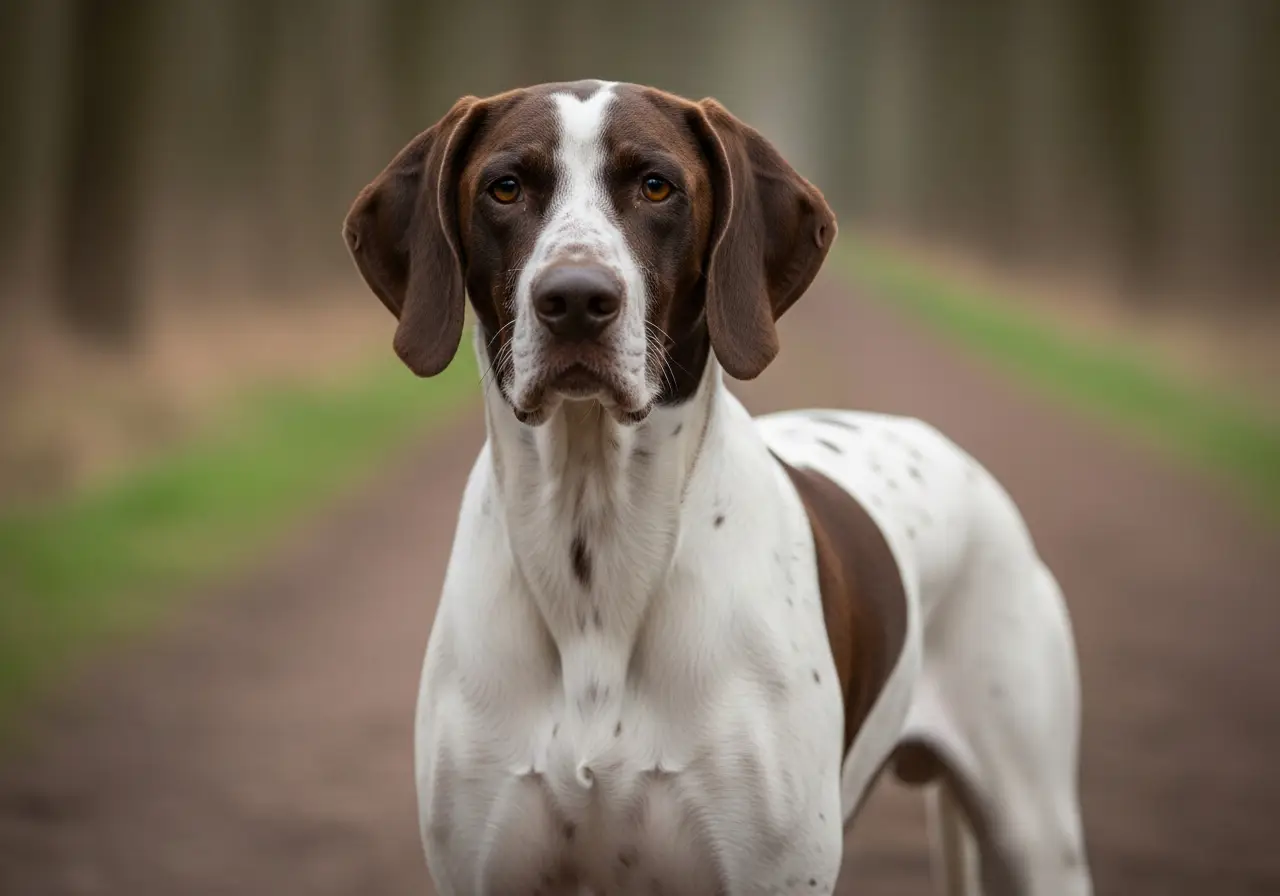
The Old Danish Pointer is a continental pointing dog from Denmark, FCI Group 7, with white and brown spotting and a withers height of 54 to 60 cm. Its strength lies in calm, controlled hunting work, not in high-performance speed. Anyone who keeps this breed takes responsibility for a dog with a genetically anchored prey drive that requires daily stimulation through nose work or hunting-related enrichment. Pure companion keeping without a task does not do justice to this dog.
02Introduction
What makes the Old Danish Pointer special
The Old Danish Pointer is a rare Danish hunting dog, FCI Group 7, with a spotted coat pattern and a withers height of 54–60 cm.
03Profile
Key facts and suitability
- Origin
- Dänemark
- Original purpose
- Pointing dog, retrieving
- FCI
- No. 281 · Group 7 · Sektion 1.1: Kontinentale Vorstehhunde. Mit Arbeitsprüfung.
- height at the withers
- 50–60 cm
- Weight
- 18–25 kg
- Life expectancy
- 10–12 Years
- Coat type
- Short-haired
- Minimum exercise
- 90 min/day
- Puppy price
- 1'000–1'800 CHF
- Waiting period
- 9 months
- Sports
- Hunting · Tracking · Retrieving · Field trials
04Temperament
How the Old Danish Pointer shows up in everyday life
On the morning walk, the Old Danish Pointer shows what makes up its character: On the street, it walks calmly beside its owner without pulling or rushing. As soon as it comes near fields and picks up game scent, however, it switches modes, becoming concentrated, independent, and focused. These two states are inseparably linked.
In the house, the dog behaves in a balanced and unobtrusive manner. It seeks closeness to its primary caregiver without constantly demanding attention. After a sufficiently long activity phase, it lies down and rests. Anyone who expects that it must be kept busy all the time is mistaken; so is anyone who expects it to find calm without stimulation.
Towards strangers, it shows itself as neutral to open. It does not bark at visitors and does not back away, but remains more reserved than many other pointing breeds. Here, the internal and external axes diverge significantly: The need for social contact with one's own family is high, whereas openness towards unknown people is moderate. Anyone who does not know this difference mistakenly interprets its reserve as shyness.
With other dogs, it is generally compatible, provided it has been well socialised. In hunting use or during nose work, it prefers to work alone rather than in a pack; this is not a social deficit, but breed character.
It perceives children calmly, as long as everyday life is structured. Unpredictable, loud situations can briefly confuse it, but it does not react aggressively. A calm introduction to family life pays off.
05Needs
What this breed needs daily
The Old Danish Pointer requires at least 90 minutes of active exercise daily, and not exclusively in the form of walks. Pure leash walks without a working component do not cover its needs in the long term. Nose work, mantrailing, dummy training, or hunting education are not extras, but an integral part of species-appropriate keeping.
The need for mental work is high. A dog that is genetically oriented towards searching, pointing, and retrieving requires tasks that appeal to these instincts. Anyone who does not possess a hunting licence will find suitable alternatives in nose work courses, mantrailing, or dummy training, provided they are offered regularly and in a structured manner.
Being left alone is possible if the dog has been sufficiently stimulated beforehand. Up to five hours are realistic if stimulation before being left alone is ensured. Anyone who leaves the dog unstimulated risks restlessness and destructive behaviour.
The environment plays an important role. A rural or at least suburban home with access to fields and forest considerably facilitates stimulation. Keeping in an apartment is possible, but requires significantly more planning effort and a consistent daily structure.
The bond with the primary caregiver is close. The dog needs clear, calm guidance, not strictness in the sense of pressure, but reliability and consistency in everyday life. Anyone who trains irregularly or does not set boundaries consistently will find that the dog makes its own decisions, especially in open areas.
Exercise
High
mental work
A lot
Social needs
Medium
training
Medium
06Sport & Mental and Physical Stimulation
What sports the Old Danish Pointer is suited for
Realistic in terms of physiology and genetics – not every breed suits every sport.
Structurally and physiologically suitable: Suitable for mantrailing, dummy work and tracking · CaniCross / bikejoring possible.
07Quick Check
08Suitability
Who this breed is suitable for – and who it isn't
✓Matches
The Old Danish Pointer suits owners who actively hunt or are prepared to seriously integrate hunting-related enrichment into their daily routine. Specifically: Anyone who spends at least 90 minutes daily on exercise with a working component, regularly offers nose work or dummy training, and lives in a rural or suburban environment creates the basic prerequisites.
Families with children from around eight years of age are suitable, provided that clear daily rules exist and the dog's workload does not depend on the children. Owners who already have experience with high-drive dogs will find in him an enduring, cooperative partner.
Owners without a hunting licence can also keep this breed, provided they understand the prey drive as a central characteristic and not as a problem that can be trained away. Anyone who enjoys structured collaboration with the dog and is willing to invest time in training will be rewarded with a calm, loyal dog.
A household with another compatible dog is possible. It is important that the Old Danish Pointer still receives individual stimulation; group exercise does not replace targeted work.
×Doesn't match
The Old Danish Pointer is not suitable for owners who can or want to devote less than 90 minutes a day to active enrichment. Anyone who is away from home for eight hours and does not have a reliable dog care plan will structurally overwhelm this dog.
Anyone who assesses the breed as an easy-to-care-for companion dog due to its calm demeanour in the house underestimates the prey drive. This misconception has serious consequences: An under-stimulated Old Danish Pointer develops initiative; in an outdoor enclosure, this means uncontrolled hunting, and in the apartment, destructive behaviour.
City dwellers without access to fields, forests or structured nose-work courses should critically consider keeping this breed. It is not city life itself that is the problem, but the lack of suitable forms of stimulation.
Anyone who is getting a dog for the first time and is not prepared to engage intensively with prey drive, recall training and nose work would be better advised with a less high-drive breed. Owners who expect an openly friendly dog towards strangers that enthusiastically greets every visitor will also be disappointed by its moderate openness towards unknown people.
10Line reality
Show line, working line, breeder market
The Old Danish Pointer is bred exclusively as a working line; a split into show and working lines, as is known with other pointing breeds such as the German Shorthaired Pointer or the Labrador Retriever, does not exist in this breed. The breeding population is small enough that such differentiation has not yet taken place.
This means in practice: Every Old Danish Pointer from reputable breeding carries the full hunting drive of its ancestors. There is no line type that has been toned down for pure companion keeping. Anyone who keeps the breed always keeps a dog with a functional prey drive.
In Denmark, the breed is still actively used in small game hunting today, particularly in bird shooting. The working test is anchored in the FCI standard and is used by Danish breeders as a selection criterion. Dogs without a working test or without proven hunting performance of the parent animals are the exception in reputable breeding.
For owners outside of hunting, this means: The choice of dog does not determine the degree of drive; it is constantly high due to the breed. The decision lies with the owner as to how they channel this drive.
11Health · Reality
What you need to plan for medically with your Old Danish Pointer
The Old Danish Pointer is considered a robust breed with functional anatomy and no breed-typical extreme features. According to Danish breeder associations, the life expectancy is 12 to 14 years, a realistic range for medium-sized hunting dogs.
Hip dysplasia (HD) is documented in the breed. Exact population data for the Old Danish Pointer are not widely available due to the small breeding population, as is the case with more common breeds. Reputable breeders carry out HD X-ray examinations on both parent animals and make the results public. Anyone who does not receive HD documentation from the breeder should regard this as a warning signal.
Eye problems are also described in isolated cases. An ophthalmological examination of breeding animals according to ECVO standards is recommended and should be requested from the breeder.
The short, dense coat requires little grooming effort but does not fully protect the dog against ticks during hunting use. Regular checks after field work are mandatory. Borreliosis prophylaxis should be discussed with the vet.
Overweight is a real risk in this breed if the need for movement is not met. A dog that is sufficiently stimulated is less prone to becoming fat, another argument for consistent workload. Regular weight checks with the vet, at least once a year, are sensible. Puppies should not be overfed, as too rapid growth can strain joint development.
12Structured data
Health by the numbers
Prone to diseases
Hip dysplasia, eye problems
Recommended health tests
Hip X-ray, eye examination
13Myths ↔ Reality
What is often said incorrectly about this breed
Five myths, five realities, five sources.
The Old Danish Pointer is considered a calm dog that can easily be kept as a pure family dog even without a hunting task.
The FCI standard describes the breed as a pointing dog specifically for feathered game with a pronounced prey drive. Calmness in the house does not mean that the dog manages without hunting-related stimulation. Underestimated prey drive is one of the most common reasons for surrendering hunting dogs overall.
It is often assumed that a garden is sufficient to meet the exercise needs of this breed.
A garden does not replace either the structured nose work or the hunting-related stimulation that the Old Danish Pointer genetically requires. The exercise need is at least 90 minutes daily, supplemented by active mental work. Free running in the garden without a task remains insufficient for this dog.
As a rare breed, the Old Danish Pointer is considered particularly healthy and free from hereditary diseases.
Rarity does not automatically protect against hereditary diseases. In small breeding populations, the risk of inbreeding effects increases. Hip dysplasia and eye problems are documented in the breed. Responsible breeders carry out appropriate health checks and disclose the results.
The Old Danish Pointer is considered a slow hunting dog and is therefore easy to handle for owners without a hunting licence.
The controlled, calm working style in the field does not mean that the prey drive is weak. As soon as the dog picks up game scent, it works with concentration and independence. A reliable recall in areas rich in game requires consistent, structured training, regardless of whether the owner holds a hunting licence.
Because the breed appears friendly and balanced, it is often classified as an uncomplicated first dog.
A balanced temperament and ease of keeping are not the same thing. The Old Danish Pointer requires an owner with experience in handling dogs with strong drives or at least a high willingness for intensive, hunting-related enrichment. A lack of structure and stimulation leads to the dog making its own decisions.
14animal welfare
The animal welfare perspective
Breeder market, designer versions, animal shelter reality — what no one writes in the puppy ad.
The Old Danish Pointer is one of the rarest hunting dog breeds in Germany, Austria and Switzerland. This has a direct effect on the animal welfare market: Unlike Labrador Retrievers or German Shorthaired Pointers, it rarely appears in animal shelters and placement platforms. Anyone looking for one will seldom find them there.
This does not mean, however, that the breed is unproblematic from an animal welfare perspective. Hunting dogs in general are surrendered disproportionately often when their predisposition for work is underestimated. The Old Danish Pointer is no exception. A dog that has grown up with hunting-related stimulation and then moves into a companion role without a task will develop behavioural problems, not because it is difficult, but because its basic needs are not being met.
Designer versions or trend crossbreeds do not exist for this breed to any significant extent. Its low profile has so far protected it from the fate of other breeds that have fallen victim to mass production due to media or social media hype. This protection is fragile; anyone who romanticises the breed in public shares responsibility for ensuring its preservation.
Breeding operations offering Old Danish Pointers without health documentation and without proof of working tests are rare, but not non-existent. Anyone buying a puppy from abroad without verifiable breeding documentation risks not only health problems for the dog, but also undermines the work of the few reputable breeders preserving this breed.
Rehoming adult dogs from hunting backgrounds is a fully valid alternative to buying a puppy. Dogs surrendered due to changes in household composition, such as after the death of a hunter or when giving up hunting, are often well-trained, socialised and familiar with clear structures. For experienced owners, this can be a considerable advantage over a puppy.
15Costs · Transparency
What this breed realistically costs
The purchase price for a puppy from reputable breeding is around 1,200 to 1,800 EUR for the Old Danish Pointer due to the small breeding population. Offers significantly below this should be scrutinised critically; missing health documentation or unclear origins are common reasons for low prices.
Annual keeping costs consist of several items. Food for a medium-sized hunting dog with a high activity level amounts to approximately 600 to 1,000 EUR per year, depending on food quality and body weight. Basic veterinary costs (vaccinations, parasite prevention, annual check-ups) amount to 300 to 500 EUR annually. In addition, there are unforeseen treatment costs, which can quickly rise into the four-figure range in cases of orthopaedic problems such as HD.
A dog health insurance or pet health insurance with coverage for surgical costs costs between 400 and 900 EUR per year, depending on the provider and scope of benefits, but significantly reduces financial risk in the event of major procedures. For a breed with documented HD risk, this cover is sensible.
Scent work courses, dummy training or hunting training are not optional extras, but part of species-appropriate keeping. Course costs vary, but should realistically be budgeted at 200 to 500 EUR per year.
16Puppy search
What you need to consider when choosing a breeder
- Reputable breeders of the Old Danish Pointer are extremely rare in Germany, Austria and Switzerland.
- Anyone looking for a puppy should expect waiting times of a year or more.
- This is not a disadvantage; it is a quality feature if a breeder does not produce puppies in stock.
- Characteristics of reputable breeding: The breeder is affiliated with a recognised association (VDH, ÖKV or SKG), openly provides health documentation for both parent animals (at least hip dysplasia X-rays, eye examination) and asks questions about the prospective owner's living conditions.
- Anyone offering a puppy without viewing the mother, without health documentation or at a suspiciously low price is not a reliable contact.
- Placement through hunting dog clubs or breed clubs is an equally valid option to searching for a breeder.
- Adult dogs from a hunting environment, given up due to changes in the kennel population, are often well-trained and socialised.
- A dog from placement is not a compromise; it is a serious alternative, especially for experienced owners.
- Stay away from offers from abroad without comprehensible breeding documentation.
- The Old Danish Pointer is not a trend item; anyone offering it through questionable channels is not acting in the interest of the breed.
FAQ
Frequently asked questions about the Old Danish Pointer
Is Old Danish Pointer suitable for beginners?
Old Danish Pointer is considered suitable for first-time dog owners.
Is Old Danish Pointer a family dog?
Old Danish Pointer is considered suitable for families with good socialisation and species-appropriate care.
How much exercise does Old Danish Pointer need?
At least around 90 minutes of exercise per day. As an active breed, more so — plus mental stimulation.
What is the size and weight of Old Danish Pointer?
Fully grown, Old Danish Pointer reaches about 50–60 cm at the withers and weighs around 18–25 kg.
What is the life expectancy of Old Danish Pointer?
The life expectancy of Old Danish Pointer is approximately 10–12 years.
Which diseases are common in Old Danish Pointer?
Hip dysplasia, eye problems
17Breed clubs
Official breed clubs in DACH
19Related
Similar breeds – and their differences
You might also be interested in
Participate
Do you have a good photo of your Old Danish Pointer?
We are looking for expressive images for our breed profiles. Submit yours; the editorial team reviews every submission before publication.
Does this breed suit you?
Good-natured, manageable hunting dog that also works as a family dog. Needs lots of exercise outdoors. Rare outside Scandinavia.