
01Summary
In a paragraph
If you only have 30 seconds.
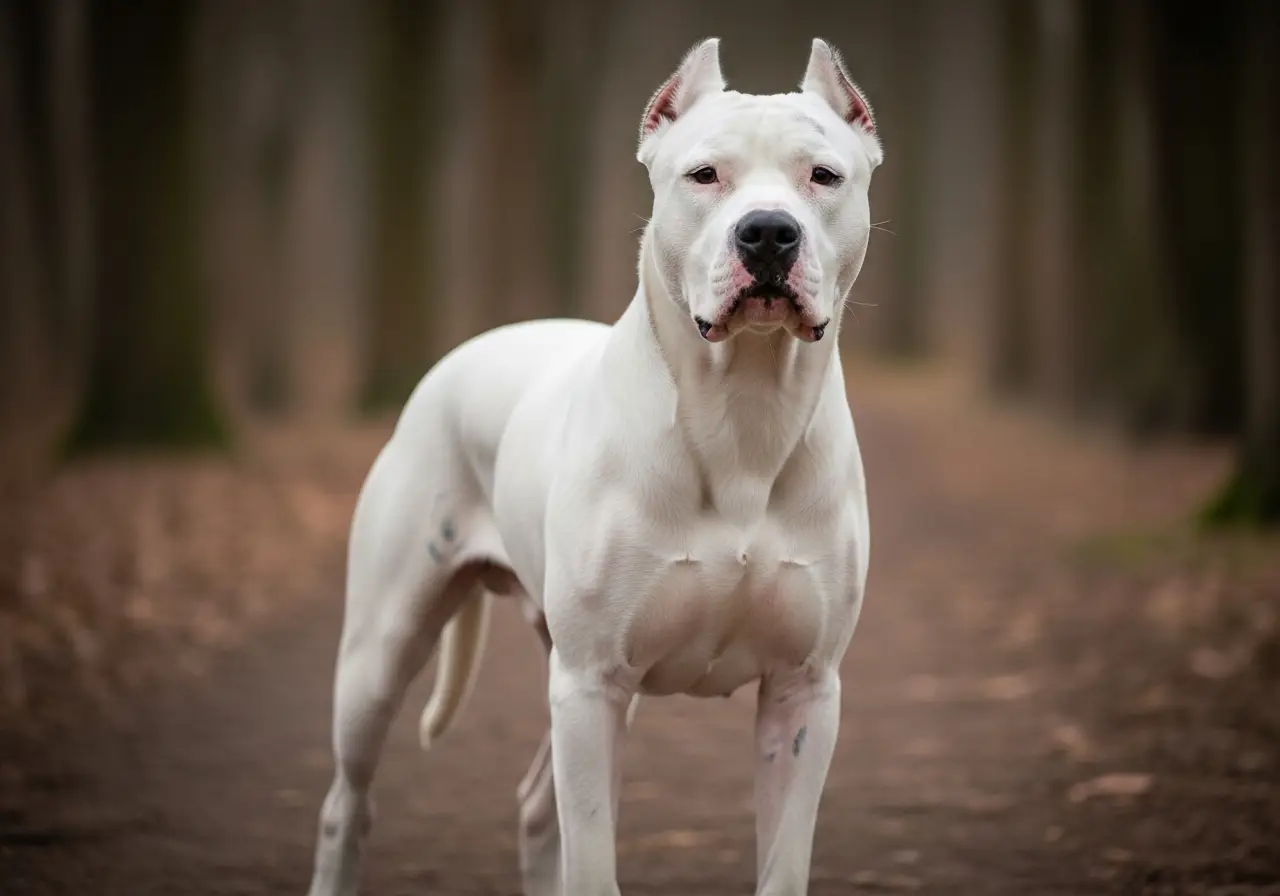
The Dogo Argentino is a white, muscular hunting dog from Argentina, bred for big game hunting of pumas and wild boar. Its pronounced prey drive and guarding instinct, its physical strength, and its status as a restricted breed in several DACH countries make it a breed that requires sovereign experience, clear leadership structure, and a thorough check of the legal situation before a decision is made.
02Introduction
What makes the Argentine Mastiff (Dogo Argentino) special
The Argentine Mastiff (Dogo Argentino) is a white Argentine hunting dog, FCI Group 2, muscular and brave, with a withers height of 60–68 cm.
03Profile
Key facts and suitability
- Origin
- Argentinien
- Original purpose
- Hunting pumas and wild boar, guarding dog
- FCI
- No. 292 · Group 2 · Section 2.1
- height at the withers
- 60–68 cm
- Weight
- 35–45 kg
- Life expectancy
- 10–12 Years
- Coat type
- Short-haired
- Minimum exercise
- 90 min/day
- Puppy price
- 1'200–2'500 CHF
- Waiting period
- 9 months
- Sports
- Schutzhund · Tracking · Agility
04Temperament
How the Argentine Mastiff (Dogo Argentino) shows up in everyday life
Morning exercise shows what makes the Dogo Argentino unique: it runs with stamina without rushing, keeps an eye on its surroundings and reacts quickly and decisively to prey stimuli. The prey drive is not an occasional flare-up; it is a constant basic pattern that requires active management in everyday life. Off-lead running without a secure environment is not a realistic option for this breed.
Internally (i.e. in what the dog brings with it from its genetics), the Dogo Argentino shows a high need for mental work and a pronounced drive to move. It requires clear tasks, structured activity and a primary caregiver who appears physically and mentally confident. The bond with the primary caregiver is close; the dog works cooperatively when leadership is consistent and calm. Being left alone for more than four hours represents a strain for many individuals and should be built up gradually.
Externally, that is in its reaction to stimuli from the environment, the Dogo Argentino behaves attentively to reserved towards strangers. It is not a dog that greets unknown people joyfully. The guarding instinct is present, but not permanently active. These two poles (close family bond on the one hand, reserve towards strangers on the other) must not be confused: A high need for social contact within the core family does not mean that the dog is open to everyone.
Tensions can arise with conspecifics, especially in same-sex constellations. Interaction with other dogs requires early, consistent socialisation. In calm, structured households with clear leadership, the Dogo Argentino shows remarkable composure; however, this calmness is the result of leadership, not a substitute for it.
05Needs
What this breed needs daily
The Dogo Argentino requires at least 90 minutes of structured exercise daily. This does not mean casual walks, but activities with physical and mental demands: trotting alongside a bicycle, cross-country running, controlled search work or pulling work. Standing around freely on the property does not replace this stimulation.
The need for mental work is at a high level. The dog requires tasks that demand its concentration, nose work, mantrailing or structured obedience training with clear requirements. Pure enrichment through toys is not sufficient. Anyone who does not offer the Dogo Argentino a meaningful task risks it finding one on its own, with unpredictable consequences.
Being left alone should be trained early and systematically. Four hours are considered a realistic maximum for a well-conditioned adult; longer absences require a reliable care solution.
A secured property is sensible, but no substitute for active leadership. The prey drive makes off-leash walking in unsecured terrain a calculable risk; the dog can track quickly and with endurance as soon as a prey stimulus is triggered.
Socialisation must take place early, broadly and consistently: various environments, people, noises and dogs. Anyone who neglects this phase creates deficits that are difficult to correct later. An accompanying dog training school with experienced trainers who are familiar with large Molosser breeds is not an option, but a basic requirement.
Exercise
High
mental work
A lot
Social needs
Medium
training
Demanding
06Sport & Mental and Physical Stimulation
What sports the Argentine Mastiff (Dogo Argentino) is suited for
Realistic in terms of physiology and genetics – not every breed suits every sport.
Structurally and physiologically suitable: Suitable for mantrailing, dummy work and tracking · CaniCross / bikejoring possible.
07Quick Check
08Suitability
Who this breed is suitable for – and who it isn't
✓Matches
The Dogo Argentino suits owners with proven experience in handling large, drive-strong dogs. Anyone who has already handled a Molosser or a working dog breed and understands how prey and guarding instincts are controlled in everyday life brings the right starting basis.
The breed is suitable for active individuals or couples with a structured daily routine that allows at least 90 minutes of activity time for the dog daily, even in bad weather and during the week. A property with a secured fence is a clear advantage.
Families with children from about ten years old, in which all household members understand and consistently implement handling of the dog, can keep a Dogo Argentino, provided that everyday life is calm and structured and visits remain predictable.
Anyone who is prepared to fully clarify the legal situation in their own canton and municipality in advance, take out liability insurance and provide proof of expertise if necessary, shows the willingness to take responsibility that this breed demands.
People who enjoy nose work, mantrailing or structured obedience training and are looking for a dog that works cooperatively and calmly with clear leadership will find a capable partner in the Dogo Argentino.
×Doesn't match
The Dogo Argentino is not suitable for first-time owners, even if they are particularly motivated or sportily active. Motivation does not replace experience in handling drive-strong, physically superior dogs.
Anyone who is regularly away from home for more than four hours a day and cannot organise a reliable care solution should not consider this breed. The same applies to owners who rely on off-leash walking in unsecured terrain or live in an environment that does not offer a secured area for movement.
Households with toddlers or with a very high volume of visitors (friends, tradespeople, changing care personnel) increase the management effort to a level that cannot be managed safely without solid experience.
Anyone who misunderstands the external axis of the dog, that is equates the close family bond with general openness towards strangers, greatly underestimates the profile of this breed. The Dogo Argentino is not a dog that fits into every situation by itself.
Anyone who does not want to or cannot check the legal situation in their own canton, or who lives in a canton where the Dogo Argentino is banned, has no legal basis for keeping it. In Switzerland, too, cantonal restrictions apply that must be clarified before getting a dog.
10Line reality
Show line, working line, breeder market
The Dogo Argentino is today bred in two functionally different directions, which can differ significantly in body structure, temperament and suitability for everyday life.
The hunting-oriented line, still actively used for large game hunting in Argentina and parts of South America, focuses on stamina, sense of smell, courage and ability to cooperate in the pack. These dogs are generally slimmer, more keen to move and show a more pronounced drive to work. Their prey drive is high and difficult to control in everyday life without appropriate management.
Breeding focused on shows and suitability as companion dogs tends to produce stockier, calmer dogs with a stronger focus on exterior characteristics according to the FCI standard. The prey drive is often less dominant in these lines, but the guarding instinct remains present.
In practice, the assignment to a specific line is often difficult for potential buyers to understand, as many breeders do not communicate a clear differentiation. A conversation with the breeder about the use history of the parent animals and their behaviour in everyday life provides more insight than merely looking at pedigree charts.
Those looking for a Dogo Argentino for sporting activities such as mantrailing or pulling work are better advised to choose a hunting-oriented line. Those seeking a calmer companion dog for a structured family life should specifically ask for show lines with documented temperament tests.
11Health · Reality
What you need to plan for medically with your Argentine Mastiff (Dogo Argentino)
According to breeding association data, the life expectancy of the Dogo Argentino is on average 10 to 12 years. As with all large Molosser breeds, joint health is a central issue.
Hip dysplasia (HD) is documented in the breed. Reputable breeders have both parent dogs examined radiologically and only use dogs with HD-A or HD-B for breeding. Prospective buyers should request the HD findings of both parent dogs in writing; a breeder who cannot provide these documents does not meet the minimum standard of reputable breeding.
The most well-known breed-specific health problem is congenital deafness, which is genetically linked to the white coat colour and lack of pigmentation. Studies on pigmentation-associated deafness rates in white dogs show that unilateral deafness often goes undetected because affected dogs compensate in everyday life. The BAER test (Brainstem Auditory Evoked Response) is the only reliable method for diagnosis; reputable breeders test all puppies before handing them over.
Skin problems, including sun sensitivity and demodicosis, occur in the breed. The short, white coat offers little UV protection; protection is necessary under intense sunlight.
Overweight is an underestimated risk for this muscular breed: too much body mass puts strain on the joints and shortens the active life phase. Regular weight checks with the vet, at least once a year, are recommended. During growth, joint-friendly training should take precedence over intense exertion.
12Structured data
Health by the numbers
Prone to diseases
Deafness (associated with white coat), hip dysplasia, skin problems
Recommended health tests
BAER test (hearing), hip X-ray
13Myths ↔ Reality
What is often said incorrectly about this breed
Five myths, five realities, five sources.
The Dogo Argentino is naturally aggressive towards people.
The FCI standard explicitly stipulates that the Dogo Argentino must never be aggressive towards people; this trait is listed in the standard as a strictly observed criterion. Aggression towards people is considered a serious character fault. Problematic behaviour usually arises from insufficient socialisation, unclear leadership or the owner being overwhelmed.
The white coat of the Dogo Argentino is a purely aesthetic trait with no relevance to health.
The white coat colour is genetically linked to an increased risk of deafness. Dogs with low pigmentation, particularly those without any pigment spots on the skull, show a statistically higher rate of congenital deafness. Reputable breeders carry out the BAER test (Brainstem Auditory Evoked Response) to check hearing ability.
The Dogo Argentino is a pure family dog that fits into any household without problems.
The Dogo Argentino was bred as a hunting dog for large game. Its prey drive is strongly pronounced as typical for the breed, and its guarding instinct is present. It behaves attentively to reservedly towards strangers. In households with frequently changing visitors, small children or inexperienced owners, the management effort increases considerably. An uncritical assessment as an uncomplicated everyday dog underestimates the profile of this breed.
Because the Dogo Argentino appears calm, it requires little stimulation.
The outward composure of the Dogo Argentino conceals its actual need for exercise and mental work. As a hunting dog with high stamina, it requires daily structured exercise of at least 90 minutes as well as mental enrichment. Insufficient stimulation leads to frustration, destructiveness and an increased risk of uncontrolled behaviour.
The restricted breed status of the Dogo Argentino is uniformly regulated throughout Germany.
Dog ownership law is a matter for the individual states in Germany. The Dogo Argentino is not on a breed list in all federal states; the regulations vary considerably. In some federal states, it is considered dangerous and subject to keeping bans or requirements, while in others there are no breed-specific restrictions. Owners must independently check the current legal situation in the respective federal state as well as in their municipality of residence.
14animal welfare
The animal welfare perspective
Breeder market, designer versions, animal shelter reality — what no one writes in the puppy ad.
The Dogo Argentino belongs to the breeds that attract a specific group of buyers due to their imposing appearance and rarity in the DACH region, unfortunately including owners who underestimate the actual requirements. This leads to a measurable problem: animal welfare organisations and breed clubs regularly report rehomed Dogo Argentinos whose owners were overwhelmed by prey drive, guarding instinct, or the management effort required in everyday life.
The backyard breeder market exploits the demand for this breed. Offers without BAER testing, without HD documentation, and without a pedigree are not uncommon; they are often sold at low prices via classifieds platforms. Anyone buying there finances structures that do not prioritise the health or temperament of the dogs and simultaneously bears an increased risk of high follow-up costs due to hereditary diseases.
Designer versions or colour variants of the Dogo Argentino (e.g., dogs with spotted coats marketed as rare variants) do not comply with the FCI standard. The standard specifies exclusively white coat, with a maximum of one dark spot on the skull. Deviations are not a quality feature but an indication of dubious breeding.
A particular animal welfare issue is the restricted breed status: In cantons where the Dogo Argentino is classified as dangerous, dogs from dissolved households or after incidents end up in shelters that have difficulty finding suitable owners. These dogs are not inherently problematic; they require experienced owners who know the legal situation and are willing to meet the corresponding requirements.
Adopting an adult Dogo Argentino through a breed club or a specialised animal welfare organisation is a fully valid alternative to buying a puppy. Adult dogs have an assessable temperament, are often already socialised, and simply seek a stable, experienced home.
15Costs · Transparency
What this breed realistically costs
The purchase price of a Dogo Argentino puppy from reputable breeding with complete health documentation typically lies between 1,500 and 2,500 euros in the DACH region. Offers significantly below this range without corresponding proof are a warning signal.
The annual living costs consist of several items. High-quality food for an adult Dogo Argentino with a body weight of 36 to 45 kg costs between 800 and 1,500 euros per year depending on the type of food. Care (nail trimming, occasional bathing, ear and dental care) is comparatively inexpensive for the short-haired type and amounts to approximately 100 to 200 euros annually.
Veterinary costs are significant for a large breed with breed-specific health risks. Annual preventive examinations, vaccinations, and parasite prevention cost an average of 300 to 500 euros. If treatment for HD, skin diseases, or deafness diagnostics is added, the costs can rise considerably.
Dog liability insurance is legally mandatory for the Dogo Argentino in many cantons and advisable in any case. The annual premium lies between 80 and 200 euros depending on the provider and coverage amount; in cantons with restricted breed status, it can be higher or linked to additional requirements.
Anyone who must obtain a certificate of competence or pass an official examination should budget additional costs of 50 to 200 euros.
16Puppy search
What you need to consider when choosing a breeder
- A reputable breeder of the Dogo Argentino carries out verifiable health examinations: BAER test for deafness, X-ray examination for hip dysplasia (HD) and eye examinations.
- Anyone who cannot or will not provide these proofs is ruled out as a reputable source.
- The breeder allows several visits to the litter, shows both parent animals, at least the mother, and parts with the puppies no earlier than eight weeks of age.
- A litter collection protocol, a vaccination passport and a pedigree from the responsible association are standard.
- Caution is advised with offers without papers, very low prices and breeders who offer several breeds simultaneously or send puppies without personal contact.
- Offers from abroad without clear documentation of health examinations should also be viewed critically.
- Adoption through animal welfare organisations or breed clubs is an equally valid option.
- Adult Dogo Argentinos are rehomed because owners have underestimated the demands; these dogs are often socialised and their temperament can be assessed.
- A trial period and an honest discussion with the adoption agency about prior experience and daily routine are standard practice.
- Before getting a dog, whether a puppy or an adult dog, the legal situation in your own canton and municipality must be fully clarified.
FAQ
Frequently asked questions about the Argentine Mastiff (Dogo Argentino)
Is Argentine Mastiff (Dogo Argentino) a family dog?
Argentine Mastiff (Dogo Argentino) is considered suitable for families with good socialisation and species-appropriate care.
How much exercise does Argentine Mastiff (Dogo Argentino) need?
At least around 90 minutes of exercise per day. As an active breed, more so — plus mental stimulation.
What is the size and weight of Argentine Mastiff (Dogo Argentino)?
Fully grown, Argentine Mastiff (Dogo Argentino) reaches about 60–68 cm at the withers and weighs around 35–45 kg.
What is the life expectancy of Argentine Mastiff (Dogo Argentino)?
The life expectancy of Argentine Mastiff (Dogo Argentino) is approximately 10–12 years.
Which diseases are common in Argentine Mastiff (Dogo Argentino)?
Deafness (associated with white coat), hip dysplasia, skin problems
17Breed clubs
Official breed clubs in DACH
19Related
Similar breeds – and their differences
You might also be interested in
Participate
Do you have a good photo of your Argentine Mastiff (Dogo Argentino)?
We are looking for expressive images for our breed profiles. Submit yours; the editorial team reviews every submission before publication.
Does this breed suit you?
Powerful hunting and guarding dog for very experienced owners. Classified as a restricted breed in Switzerland and some German federal states.