
Merle Gene and Merle Coat: Frequent Questions and Fascinating Answers
The merle gene creates beautiful marbled coat patterns, but can lead to severe disabilities with incorrect breeding. Why mating two merle dogs is prohibited.
Content
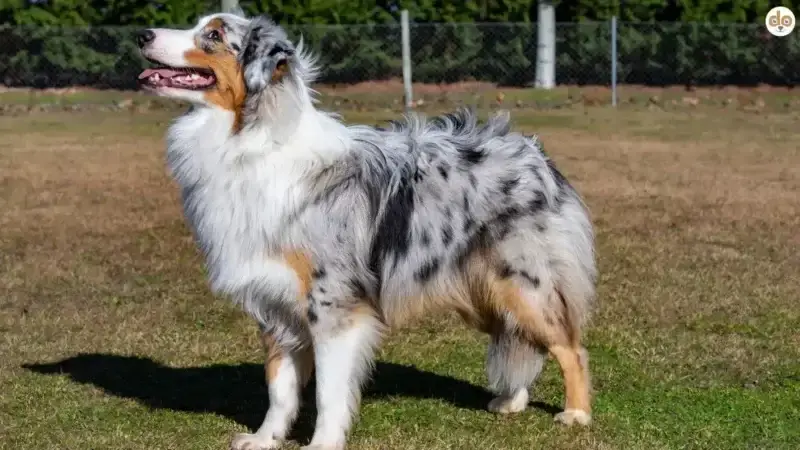
This marbled coat with its blue and grey patches on a black background – anyone seeing an Australian Shepherd for the first time often simply stops and stares. Behind this lies the merle gene. And with it, a topic that is heatedly discussed in the dog world – rightly so.
How does the merle coat pattern arise genetically?
The merle gene is located at the so-called M locus and is dominant. It directly interferes with melanin production in the hair follicles – but not uniformly. Instead, it dilutes random areas of the coat, and this precisely creates these irregular patches and speckled patterns that make every dog unique.
A dog needs only a single copy of the gene (Mm) for the pattern to become visible. The second copy then remains the normal allele (m) – the dog is heterozygous and generally healthy. It becomes critical when both copies carry the merle gene: this is called homozygous (MM), and that is exactly where the problems begin.
Melanin is not just found in the coat. It also plays a role in the development of the inner ear and the retina. If it is missing in these areas, hearing and vision damage can result – no small matter.
Why is breeding two Merle dogs prohibited?
If two heterozygous Merle dogs (Mm × Mm) are bred together, this statistically results in 25% homozygous puppies (MM). These so-called Double Merles carry a massively increased risk of severe disabilities – and the figures behind this are startlingly concrete.
Studies confirm: Up to 86% of Double Merle puppies are deaf, around 10% completely blind. Many have microphthalmia – meaning eyes that are too small –, in some cases eyes are missing entirely. In Germany, Austria and Switzerland, this breeding combination is therefore prohibited under the Animal Welfare Act (TSchG) and constitutes breeding for harmful traits (Qualzucht). No animal should suffer for a coat pattern.
Responsible breeders therefore take a simple but crucial path: They breed Merle dogs exclusively with solid-coloured partners (mm). Result: 50% Merle puppies (Mm), 50% solid-coloured puppies (mm) – and all healthy.
Which dog breeds carry the Merle gene?
Originally, the Merle gene is primarily found in herding dogs. Australian Shepherds, Border Collies and Shelties are the best-known representatives. In Collies, the blue variant even has its own name: Blue Merle – this is traditional.
But Dachshunds also know this pattern, where it is usually called Dapple. Cocker Spaniels can carry it too, as well as Catahoula Leopard Dogs, which are already known for their wild appearance.
What is thought-provoking, however: the trend in small breeds. Some breeders cross Chihuahuas or Pomeranians with Merle carriers – solely to produce the striking markings. The breeding lines are often not checked for health. This is genetically risky, and you should look very closely at such offers.
How do I recognise a responsible Merle breeder?
A responsible breeder carries out genetic tests – before every breeding, without exception. The Merle test costs around 50 to 80 euros, the DNA is obtained from saliva or blood, and the result is clear-cut: Mm (Merle carrier), mm (no Merle) or MM (Double Merle).
Responsible breeders provide these results unsolicited. In addition, there are BAER tests for hearing checks and eye examinations by the vet. Puppies receive health certificates with all findings – this is not a bonus, it is standard.
A few warning signs to watch out for: breeders who only have Merle puppies available, suspiciously low prices or cannot provide any health documents – these are red flags that must be taken seriously.
What do I need to consider with my Merle dog?
Even a healthy heterozygous Merle needs a bit more attention than the average family dog. The reduced pigments in white coat areas simply offer less UV protection. Ear tips and the nose area can get sunburnt more quickly – so in midsummer, it is better to stay in the shade or use dog sunscreen.
Regular eye checks make sense. Some Merle dogs develop cataracts or other eye problems more frequently with increasing age than solid-coloured dogs – nothing that needs to be dramatised, but something that should be kept in mind.
And if your dog has hearing problems: partial deafness occurs in about 2 to 3% of heterozygous Merles. Training then works differently – hand signals instead of voice commands. Anyone who has experienced this knows: these dogs often learn surprisingly quickly because they focus entirely on visual signals. Sometimes a supposed disadvantage is not one at all.
Are there other genes for marbled coat patterns?
Yes – and the risk of confusion is real. The Harlequin gene in Great Danes produces similar spots, but works according to a different mechanism: it partially masks the Merle pattern and simultaneously enhances the white areas.
Ticking – the small speckled patterns seen for example in many hunting dogs – is caused by completely different genes and carries no health risks. The Brindle pattern (striping) is also occasionally confused with Merle, but is genetically completely unproblematic.
In the end, only one thing really helps: a genetic test. Appearance alone is not sufficient proof. So-called Cryptic Merles carry the gene but show hardly any visible pattern – and are therefore easily overlooked. This can then lead to nasty surprises in the next litter.