
The three disciplines of IGP in detail
Tracking (Fährtenarbeit)
Imagine this: A person walked across a patch of grass hours ago. Your dog puts its nose to the ground – and follows this long-faded trail step by step until it finds the hidden objects made of wood or leather and indicates them by remaining calm. That is exactly what tracking is in IGP. The requirements increase with each class: From level 1 to 3, the trails become older, the routes longer, the distractions more numerous. It is concentrated nose work under real conditions – and for many dog handlers the most satisfying discipline of all.
Obedience (Unterordnung)
This is about precision and connection. Heelwork with changes of direction, sit and down combinations at a distance, retrieving exercises with different materials – the dog works closely with its handler, even under the stress of the trial venue. The IGP rulebook differs from pure obedience sport in some requirements, but overall it is little controversial and is considered a solid basis for a resilient human-dog relationship.
Protection work (Schutzdienst) – the controversial element
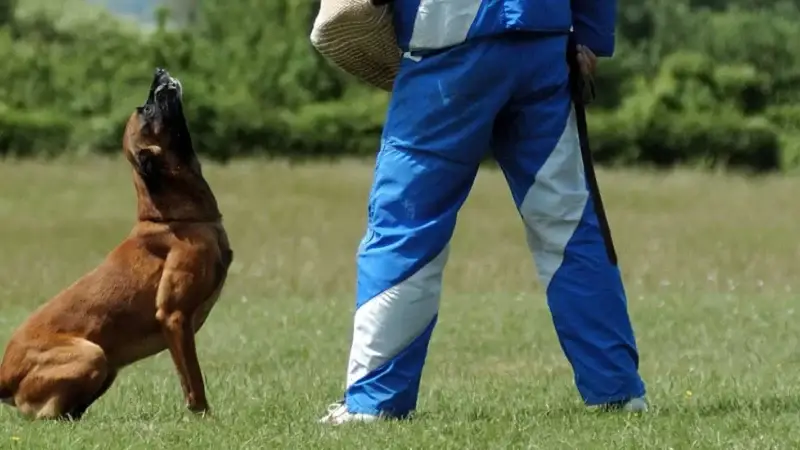
A helper wears a protection sleeve. The dog stands, barks, bites – and lets go on command. This brief description alone explains why protection work is the most controversial discipline in IGP sport. The dog is deliberately put into a state of high arousal, its prey drive and hunting behaviour are activated and triggered against the helper. Supporters point to strict rulebooks, continuous supervision by judges and the argument that the dog learns clearly defined problem-solving. Animal welfare advocates, on the other hand, ask which behavioural patterns such training promotes in the long term. This is not a black-and-white debate – but one that must be had.
The animal welfare discussion: Facts and perspectives
The criticism of IGP protection work is not unfounded. Professional associations and animal welfare organisations have been debating for years whether deliberately triggered prey drive and repeated biting – even if it hits a helper with a protection sleeve – corresponds to an ethically responsible handling of dogs. On the one hand: strict rulebook, experienced judges, the principle of controlled exercise. On the other hand: the possible risk of increased excitability in everyday life and fundamental moral questions that cannot be talked away.
At rundum.dog this critical reflection is important to us. IGP is not generally “wrong” – but anyone who practises this sport should be aware of which psychological mechanisms they activate in their dog, and how great their responsibility is.
Prerequisites for getting started in Schutzhund sport
Physical prerequisites
IGP is not the right thing for every dog. Breeds such as German Shepherd, Malinois and Rottweiler are often seen because they often bring the necessary working mentality from birth. Nevertheless: Before you start, an honest conversation – or better still an assessment – with an experienced behaviour specialist is worthwhile.
Psychological stability
Protection work training has an emotional impact that should not be underestimated. The dog is deliberately put into a high drive state – and dogs can feel how their handler is doing in the process. Anyone who goes into training insecure or unprepared transfers exactly that to their dog. Potentially problematic, sometimes dangerous. Therefore: Protection work training belongs exclusively under the guidance of experienced trainers with a clear rulebook. This is not a recommendation, it is mandatory.
Rulebook and animal welfare regulations
The VDH and FCI have developed detailed examination regulations – but the legal situation varies significantly from country to country. In some regions, Schutzhund sports are heavily regulated or restricted. You must definitely inform yourself about the situation in your home country before investing time and money into training.
Time and Commitment
It usually takes 2 to 3 years until the first test – with training several times a week. This is a considerable effort that must be planned soberly: training camps, trips for tests, club membership, equipment. IGP is not a casual sport. Anyone who does not assess this realistically does themselves – and their dog – no favours.
Suitable Breeds for IGP
German Shepherd, Malinois, Rottweiler – these three breeds dominate the IGP scene, and for good reason: they bring the combination of nerve strength, willingness to work and resilience that this sport demands. Responsible breeders selectively breed for IGP suitability. Theoretically, other breeds can also be trained – and sometimes you see surprising dogs at tests. But they remain the exception.
The Competition Path: IGP 1, 2 and 3
The FCI rulebook knows three performance levels with increasing demands. IGP 1 is the entry level, IGP 3 the highest difficulty level. Between the levels lies a minimum waiting period of 6 weeks – and the dog must have successfully completed the previous level before it may advance. Judging is based on fault points: The fewer faults, the better the placement. A simple system on paper – in practice, years of consistent training lie behind it.
The Most Important Questions
Is IGP Schutzhund sports suitable for private individuals? Yes, many private individuals train and test successfully. But experience and a sense of responsibility are not optional extras – they are the basic prerequisite. Ambition alone is not enough.
Does Schutzhund sports make my dog aggressive? No! With responsible training with clearly established abort commands and a psychologically stable dog, most animals retain control. But the risk, with incorrect training, is real and must not be downplayed.
Can I take the test without club membership? No. All recognised IGP tests require officially approved judges and a club structure. Going it alone is simply not possible here.