
Fire service dogs: From the Dalmatian as mascot to the modern rescue dog
Dalmatians used to run alongside fire brigade horse-drawn carriages and guard the equipment. Today, specially trained rescue dogs work at fires and during disasters.
 Source: legacy_text
 Content
Dalmatians and horse-drawn carriages: A historical partnership
Dalmatians did not sit on the driver’s seat – they ran alongside it. For hours, next to galloping horses, at speeds of up to 30 km/h. Anyone hearing this today would hardly believe it. But it was precisely this endurance that made the spotted dogs indispensable companions of the fire brigade hose wagons, which rushed to fires back then.
Their work was hands-on: While the firefighters extinguished the flames, the Dalmatians guarded the horses and equipment. That sounds simple, but it was anything but. Dalmatians have an innate calmness around horses – an instinct that other breeds simply do not possess. Strange dogs that spooked the horses? They were barked away. Period.
This symbiosis between Dalmatian and fire horse worked so reliably that the London Fire Brigade officially included the breed in its teams as early as 1870.
The transition to motorised fire brigades
When the horse-drawn carriages disappeared and motor vehicles took over the stables, Dalmatians lost their practical function. Many fire brigades still did not part with them – the dogs stayed, now as guard dogs and mascots, but no longer as working animals in the true sense.
The New York Fire Department was quite different: It developed a new tradition and trained dogs as arson detection dogs. These animals can smell accelerants such as petrol even days after a fire – an ability that can be crucial in determining the cause of fires.
Modern fire service dogs: Breeds and areas of deployment
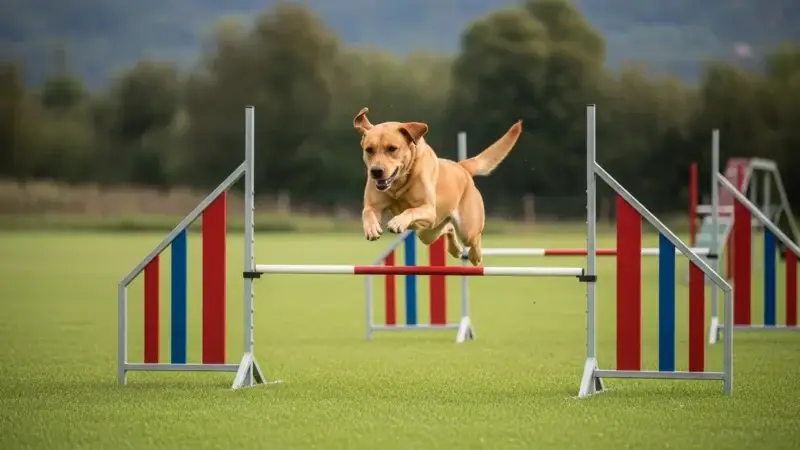
Today, it is mainly German Shepherds, Labrador Retrievers and Border Collies that work in fire service operations. The training lasts one to two years depending on the programme – and at the end, each dog specialises in one of three areas.
Search and rescue dogs find missing persons in collapsed buildings or after explosions. Their sense of smell is around 10,000 times more sensitive than that of humans – a figure that is hard to imagine. Arson detection dogs recognise tiny amounts of accelerants: A well-trained dog can find a single drop of petrol in an entire room. And cadaver dogs locate deceased persons after disasters or in difficult-to-access terrain where technology alone cannot help.
Training to become a rescue dog
It starts early – already in puppyhood. Before the actual training begins, potential fire service dogs must pass three basic tests: no fear of loud noises, willingness to climb over obstacles, and a pronounced play drive.
The play drive is particularly decisive, which surprises many. Rescue dogs do not work for treats. They search because they get their favourite toy at the end – this motivation holds up even in extreme situations where food as an incentive would long have failed.
After basic training, it is on to specialisation. An arson detection dog learns to distinguish between up to 15 different accelerants. Not every dog is suitable for this work – and that is a good thing. A considerable proportion of candidates drop out along the way; however, none of the training organisations publish reliable figures.
Dalmatians today: Tradition rather than deployment
Individual fire brigades still keep Dalmatians – but as tradition dogs, not as working animals. The Rochester Fire Department in New York has had a Dalmatian as a mascot uninterruptedly since 1951. A continuity that speaks for itself.
As rescue dogs, however, Dalmatians are of little use. Their breeding aimed at endurance running, not at the intensive scent work of modern detection dogs. In addition, there is a practical problem: Their white base colour makes them hardly visible in smoky environments.
Nevertheless – or perhaps precisely for that reason – the Dalmatian remains the face of the fire service in films, children’s books and at fire stations around the world. The spotted coat is so iconic that many people involuntarily think of a Dalmatian when they hear “fire service dog”. Reality looks very different nowadays. But some images just stick.