
01Summary
In a paragraph
If you only have 30 seconds.
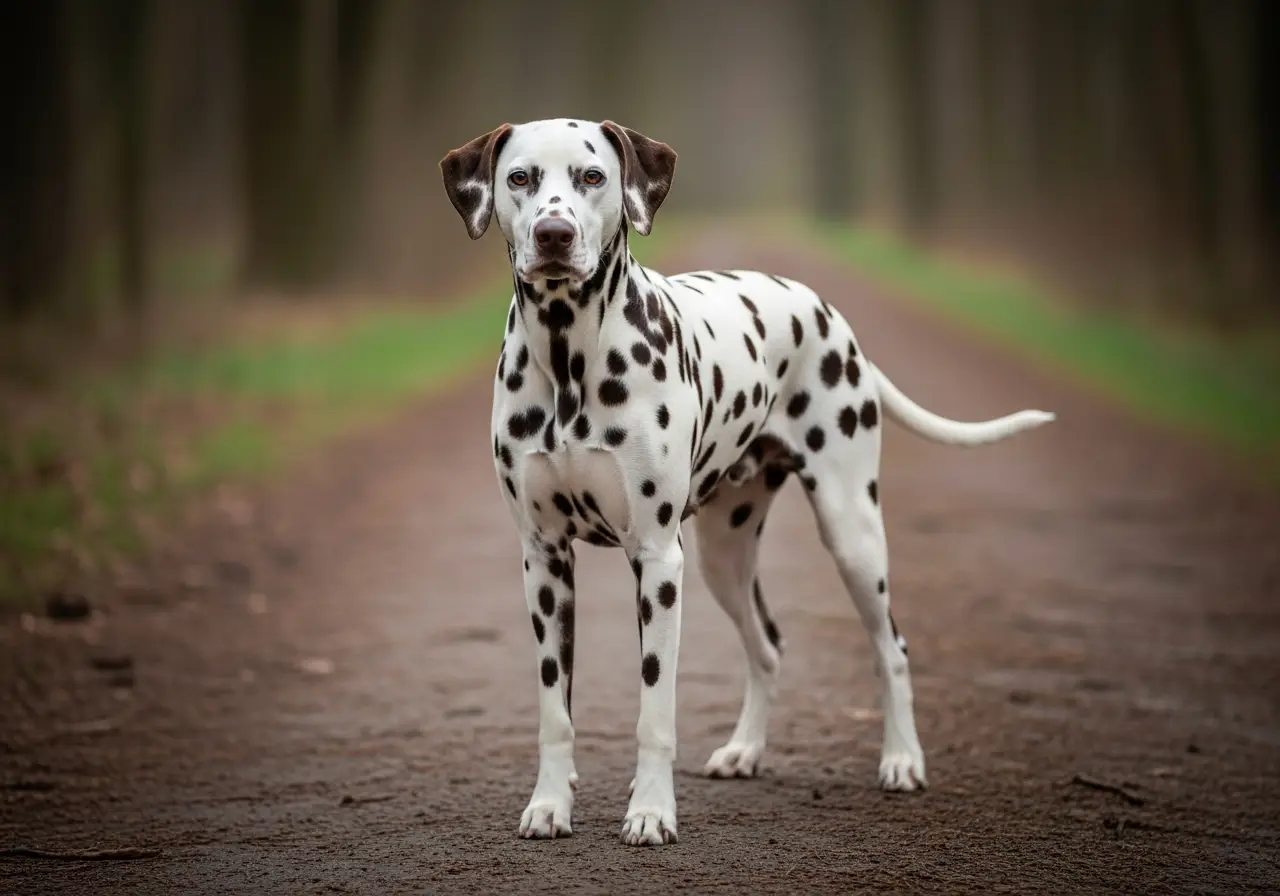
The Dalmatian is a Croatian sighthound with distinctive spotted coat, high exercise needs and strong bond to humans. Anyone who keeps one plans for 90 to 120 minutes of active endurance exercise daily, not as a bonus, but as a basic requirement. In addition, there are breed-specific health risks such as urinary stones and congenital deafness, which require an informed decision before purchase.
02Introduction
What makes the Dalmatian special
The Dalmatian is a Croatian spotted dog, FCI Group 6, enduring and energetic, known through "101 Dalmatians", withers height 54–62 cm.
03Profile
Key facts and suitability
- Origin
- Kroatien
- Original purpose
- Coach companion and guard dog
- FCI
- No. 153 · Group 6 · Sektion 3: Verwandte Rassen
- height at the withers
- 54–62 cm
- Weight
- 23–32 kg
- Life expectancy
- 10–13 Years
- Coat type
- Short-haired
- Minimum exercise
- 120 min/day
- Puppy price
- 1'200–2'000 CHF
- Waiting period
- 9 months
- Sports
- Canicross · Agility · Obedience · Bikejöring
04Temperament
How the Dalmatian shows up in everyday life
When you come home, you can expect a dog that takes the greeting seriously: the Dalmatian registers moods, daily rhythms and changes in the household with remarkable attention. This bond with people is not an accessory; it is a central characteristic of the breed, stemming from its historical role as a carriage companion.
Internally, the Dalmatian requires 90 to 120 minutes of active exercise daily, going beyond just walking. Running alongside a bicycle, jogging, canicross or structured retrieving work correspond to its endurance profile. Mental stimulation through nose work or obedience training complements physical exertion; a Dalmatian that is only physically exhausted but mentally under-stimulated will develop its own coping strategies, which are rarely desirable.
Externally, the Dalmatian behaves openly to slightly reservedly towards strangers. The FCI standard describes it as friendly, not shy and free from aggression; in practice, this means that it usually greets visitors without suspicion, but does not show exuberant friendliness towards unknown people. This reserve is not a lack of socialisation, but breed character.
It gets along well with other dogs given early and consistent socialisation. Its scent hound instinct is present; attention should be paid when on a lead in areas rich in wildlife.
It is important to separate both axes: a high need for social contact with one’s own family does not mean that the Dalmatian treats every person equally. Those who do not understand this difference will experience surprises in both directions.
05Needs
What this breed needs daily
The Dalmatian requires at least 90 to 120 minutes of active endurance exercise daily. What counts is not the total time spent outdoors, but the actual physical exertion. Short walks do not meet this requirement.
Suitable forms of exercise include running, accompanying a bicycle (from the second year of life, when the joints are fully grown), canicross, long hikes or structured retrieving training. The Dalmatian has genetically anchored endurance; it is not a sprinter, but a dog that wants to be exercised evenly over long distances.
Mental stimulation is just as necessary as physical exercise. Nose work, search games, obedience training or dog sports such as agility provide the Dalmatian with the cognitive stimulation it needs. A dog that is physically exercised but mentally under-stimulated will develop restless behaviour, destructiveness or excessive barking.
The need for social contact is high: the Dalmatian requires regular closeness and interaction with its primary caregiver. Being left alone should be built up gradually; more than four hours daily are a strain for most Dalmatians.
Structured daily routines help it to orient itself. Clear, consistent rules and calm, reliable handling are not optional educational measures; they are prerequisites for a balanced coexistence. Inconsistency and frequent rule changes create insecurity in the Dalmatian, which manifests itself in undesirable behaviour.
Exercise
Very high
mental work
A lot
Social needs
High
training
Medium
06Sport & Mental and Physical Stimulation
What sports the Dalmatian is suited for
Realistic in terms of physiology and genetics – not every breed suits every sport.
Structurally and physiologically suitable: CaniCross / bikejoring possible.
07Quick Check
08Suitability
Who this breed is suitable for – and who it isn't
✓Matches
The Dalmatian suits owners who can integrate 90 to 120 minutes of active endurance exercise into their daily routine, not occasionally, but structurally. Joggers, cyclists or people who hike regularly will find an enduring companion in it.
Households with prior experience with high-energy or sensitive dogs are suitable. Anyone who has already kept a dog with high exercise needs and knows what consistent, positive handling looks like in everyday life brings a good starting basis.
Families with children from about eight years of age, where sufficient time for exercise and structure is available, are also suitable, provided that the children have been introduced to handling a lively, medium-sized dog.
People who wish to participate in dog sports (canicross, agility, mantrailing or obedience) will find a willing-to-learn partner in the Dalmatian, one that accepts mental challenges.
It is also important to be willing to engage with breed-specific health issues: low-purine nutrition, BAER testing for puppies and regular veterinary checks of the urinary tract are not optional extras, but an integral part of keeping a Dalmatian.
×Doesn't match
The Dalmatian is not suitable for owners who are away from home for more than four to five hours a day and cannot organise reliable care. Its high need for social contact and sensitivity do not go well with long periods of being left alone.
Households that restrict exercise to two short walks a day fundamentally underestimate the genetically ingrained endurance needs of this breed. A Dalmatian that is not physically sufficiently exercised will develop behavioural problems; this is not a matter of training, but of biology.
First-time owners without experience with sensitive, energetic dogs face a steep learning curve. The Dalmatian reacts to inconsistency and unclear leadership with uncertainty, which manifests as destructiveness or restlessness.
Anyone who chooses a Dalmatian because of its appearance or the Disney effect, without engaging with purine metabolism, the risk of deafness and exercise needs, is making a decision on an incomplete basis. The breed demands informed owners, not just enthusiastic ones.
Households with very young children under four years of age should bear in mind that a lively, medium-sized dog with a high drive for movement presents a demanding combination in everyday life with toddlers.
10Line reality
Show line, working line, breeder market
The Dalmatian is today primarily bred as a companion and show dog. A pronounced working line in the classical sense, comparable to Retriever or herding dog working lines, does not exist. The FCI lists it without a working test.
In practice, differences between breeding lines are nevertheless apparent: some breeders focus on show conformation and coat quality, others on temperament and endurance. These differences are less formalised than in breeds with clearly separated show and working lines, but they are noticeable in everyday life.
Dalmatians from lines with a focus on show success can be calmer in temperament and somewhat more moderate in their drive for movement, although “moderate” in the Dalmatian still means a considerable daily activity requirement. Lines with an emphasis on health and function often show greater endurance and stronger willingness to work.
The question of health breeding is particularly relevant: reputable breeders carry out BAER tests (hearing tests) and select for freedom from urinary stones. These criteria are more important than line affiliation in the narrower sense. A puppy from a line with consistent health selection is preferable to one from breeding focused purely on appearance, regardless of show success.
11Health · Reality
What you need to plan for medically with your Dalmatian
The Dalmatian carries a mutation in the SLC2A9 gene that fundamentally alters its purine metabolism. While other dog breeds break down uric acid into allantoin, the Dalmatian excretes uric acid directly. This significantly increases the risk of urate crystals and urinary stones. Studies show that almost all Dalmatians are homozygous for this mutation (Bannasch et al., 2008, Genome Research). A low-purine diet and sufficient water intake are medically necessary measures, not optional recommendations.
Congenital deafness is the second central health issue. Investigations by the Louisiana State University School of Veterinary Medicine (Strain, 2004) found that around 8% of Dalmatians are bilaterally deaf and a further 22% unilaterally. The BAER test (Brainstem Auditory Evoked Response) is the only reliable proof; behavioural observation is not sufficient. Reputable breeders test all puppies before handover.
Life expectancy is 11 to 13 years. Hip dysplasia (HD) occurs in the breed, but is less prevalent than in larger dog breeds. Regular urine examinations (recommended every six months) help detect stone formation at an early stage.
Recommended preventive examinations: BAER test for puppies, urine analysis every six months, eye examination according to ECVO scheme, HD X-ray before breeding. Overweight increases the risk of urinary stones additionally and should be avoided through regular weight monitoring.
12Structured data
Health by the numbers
Prone to diseases
Deafness (BAER test), uric acid metabolism problems (uraturia), hip dysplasia
Recommended health tests
BAER test (hearing), uric acid test, hip X-ray
13Myths ↔ Reality
What is often said incorrectly about this breed
Five myths, five realities, five sources.
"The Dalmatian is a low-maintenance family dog that suits every active household.
The Dalmatian requires 90 to 120 minutes of structured endurance exercise daily, walking is not enough. Its exercise requirement is genetically anchored and cannot be compensated by occasional outings. Households without a consistent activity routine regularly report destructiveness and restlessness.
"Dalmatians become deaf because they were poorly socialised.
Congenital deafness in Dalmatians has a genetic cause and is related to the merle-like pigmentation pattern as well as the absence of melanocytes in the cochlea. Socialisation has no influence on this risk. Estimates suggest that 8% of Dalmatians are bilaterally deaf, another 22% unilaterally, figures that the BAER test (Brainstem Auditory Evoked Response) reliably detects.
"Dalmatians tolerate a normal protein-rich dry food ration like all dogs.
The Dalmatian carries a breed-typical mutation in the SLC2A9 gene, which fundamentally changes its purine metabolism. It excretes uric acid instead of allantoin, which significantly increases the risk of urate crystals and urinary stones. A low-purine diet and sufficient water intake are not optional recommendations, but medically necessary measures.
"The Dalmatian is also an uncomplicated first dog due to its friendly appearance.
The Dalmatian reacts sensitively to inconsistent handling and under-stimulation. It requires an experienced primary caregiver who sets clear structures and provides sufficient daily mental and physical stimulation. Owners without prior experience with high-energy dogs regularly underestimate its needs, which contributes to the above-average number of surrenders in animal shelters.
“Dalmatians are guard dogs because they used to watch over carriages.
The FCI standard describes the Dalmatian as friendly, not shy or reserved, and free from aggression. A pronounced guarding instinct is not part of the breed profile. The historical guarding function referred to their presence with the carriage, not to territorial protective behaviour in the modern sense.
14animal welfare
The animal welfare perspective
Breeder market, designer versions, animal shelter reality — what no one writes in the puppy ad.
The Dalmatian is a breed with a documented animal welfare problem that is directly linked to media popularity. After the Disney films in 1961 and 1996, puppy numbers rose sharply, with predictable consequences: Many owners were not prepared for the actual needs of the breed, and surrender rates in animal shelters increased significantly. This pattern repeats itself with every surge in media attention.
The backyard breeder market reacts quickly to demand peaks. Puppies without BAER testing, without health screening for urinary stones and without socialisation are offered at low prices, often via classifieds platforms, without studbook entry and without aftercare. The owner bears the consequences: high veterinary costs, behavioural problems due to lack of imprinting, and in the worst case a deaf dog whose impairment only becomes apparent months after purchase.
Breeding-related problems in Dalmatians primarily concern purine metabolism and the prevalence of deafness. Both risks can be reduced through consistent selection, but only if breeders test and select accordingly. Anyone buying a puppy without asking for BAER test results and nutritional advice is funding breeding practices that ignore these risks.
Adopting from an animal shelter or via breed protection organisations is an equally valid option. Adult Dalmatians from rehoming services have the advantage that their character and health status can already be assessed. The German Dalmatian Club 1920 e.V. and the Swiss Dalmatian Club SDC have rehoming contacts for dogs looking for a new home for various reasons. This option deserves the same serious consideration as searching for a puppy from a breeder.
15Costs · Transparency
What this breed realistically costs
A puppy from a reputable breeder with VDH/FCI papers, BAER test and health screening costs between 1,200 and 1,800 euros in Germany and Austria. Offers significantly below this, especially without proof of the BAER test, signal missing health checks.
Annual living costs range from 2,000 to 3,500 euros depending on the region and type of keeping. High-quality, low-purine food for a Dalmatian costs between 60 and 120 euros per month, significantly more than standard dry food, which is unsuitable for this breed. Care (short coat, regular brushing) remains within reasonable cost limits.
Veterinary costs are above average for Dalmatians: semi-annual urine tests (approx. 40–80 euros per examination), BAER test for the puppy (one-off approx. 80–150 euros), basic immunisation and annual booster (approx. 100–200 euros/year). Costs of 1,500 to 4,000 euros can arise for treating urinary stones, depending on severity and necessary intervention.
Dog health insurance with surgical cover costs between 40 and 90 euros per month for a Dalmatian, depending on provider, age and scope of benefits. Given the breed-specific risk of urinary stones, such coverage is a serious option to consider.
16Puppy search
What you need to consider when choosing a breeder
- A reputable breeder provides proof of the BAER test for each individual puppy, not just for the parent animals.
- The test result should be available in writing before a purchase contract is signed.
- Breeders without this proof are not an option, regardless of the price.
- Further criteria for reliability: VDH or FCI studbook entry, proof of health examinations of the parent animals (HD, eyes), nutritional advice on low-purine feeding, puppy handover no earlier than eight weeks of age, possibility to visit the breeder on site.
- Beware of offers on classifieds platforms without a studbook number, puppy mediation without personal contact and prices significantly below 1,000 euros.
- Rehoming an adult Dalmatian through breed rescue organisations or animal shelters is an equally valid alternative.
- The German Dalmatian Club 1920 e.V.
- (ddc-online.de), the Swiss Dalmatian Club SDC (dalmatiner.ch) and the Austrian Dalmatian Club (dalmatinerclub.at) have rehoming contacts.
- Adult dogs from rehoming schemes have the advantage that temperament and health status are already known.
- No named breeder recommendations by rundum.dog; the breed clubs maintain current breeder lists.
FAQ
Frequently asked questions about the Dalmatian
Is Dalmatian suitable for beginners?
Dalmatian is considered suitable for first-time dog owners.
Is Dalmatian a family dog?
Dalmatian is considered suitable for families with good socialisation and species-appropriate care.
How much exercise does Dalmatian need?
At least around 120 minutes of exercise per day. As an active breed, more so — plus mental stimulation.
What is the size and weight of Dalmatian?
Fully grown, Dalmatian reaches about 54–62 cm at the withers and weighs around 23–32 kg.
What is the life expectancy of Dalmatian?
The life expectancy of Dalmatian is approximately 10–13 years.
Which diseases are common in Dalmatian?
Deafness (BAER test), uric acid metabolism problems (uraturia), hip dysplasia
17Breed clubs
Official breed clubs in DACH
19Related
Similar breeds – and their differences
You might also be interested in


Participate
Do you have a good photo of your Dalmatian?
We are looking for expressive images for our breed profiles. Submit yours; the editorial team reviews every submission before publication.
Does this breed suit you?
Enduring, energetic dog. Many Dalmatians are acquired too quickly after the "101 Dalmatians" hype and surrendered.