
Dog with glasses? Vision aid for full clarity
Dog glasses work for specific vision problems but require weeks of getting used to them. Particularly useful for UV-sensitive eyes or after operations.
Content
Does your Border Collie recently run into chairs, door frames, all sorts of things? Or has the vet just diagnosed cataracts in your 8-year-old female dog – and you are wondering whether a pair of dog glasses could help at all? Short answer: sometimes yes, but the conditions for this are quite specific.
Why do so few dogs walk around with glasses anyway?
The simplest reason: most visually impaired dogs manage without them.
Dogs compensate for vision loss much better through their other senses than we humans do. A dog with advanced cataracts often moves surprisingly safely in its familiar home – because nose and ears take over the actual navigation for it. The eyes are simply not its most important tool.
Then there is the price: custom-made corrective glasses cost between 150 and 800 euros. Owners only invest this amount if there is genuine, visible benefit behind it.
And then there is the issue of getting used to it. A dog that has never felt anything on its face before needs weeks – realistically rather months – until it tolerates glasses. Many owners give up beforehand, and that is understandable.
These breeds develop vision problems more often
In some breeds, the cause lies in the genes:
- Boston Terrier: Frequent corneal damage due to their large, protruding eyes
- Cavalier King Charles Spaniel: Hereditary retinal diseases
- Schnauzer (especially Giant and Miniature Schnauzers): Progressive Retinal Atrophy
- Cocker Spaniel: Cataracts sometimes already in middle age
- Border Collie: Collie Eye Anomaly affects 2–15 % of the breed
Do dog glasses with dioptres actually help?
Yes – for certain vision defects, they can actually help.
The principle is the same as with human visual aids: The lenses refract the light so that it lands correctly on the retina. Sounds simple, but it only works if precise measurements were taken beforehand. And by that I don’t mean the routine check-up at the vet – this requires a vet with an ophthalmological specialisation.
In my assessment, based on everything I have read and heard about it: Dogs with moderate vision defects benefit the most. With very severe vision loss, the effort is often not in a sensible proportion to the result.
What types of dog glasses are there?
The range extends from genuine visual aids to pure decorative objects – and the difference is considerable:
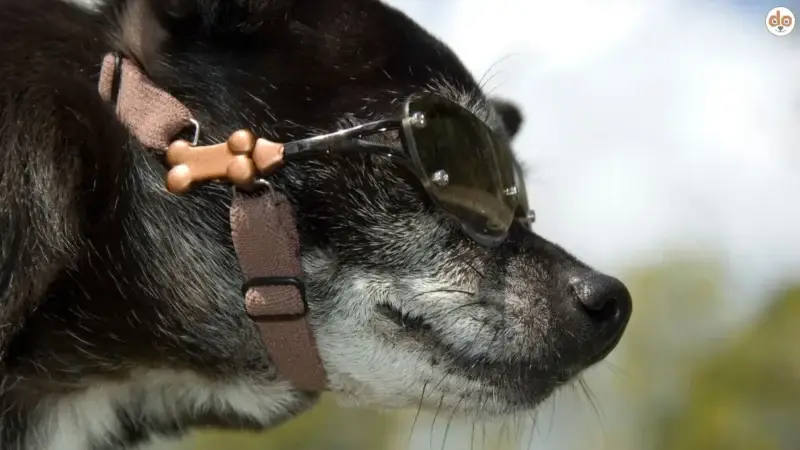
Sun protection glasses: Useful for UV-sensitive dogs or after eye surgery. Protect against strong light and wind – and they can really do that well.
Protective glasses: Robustly built for dogs that are active professionally or in sports and could thereby endanger their eyes. Think of dogs on construction sites, during agility training or on hunts.
Corrective glasses: With individually adjusted dioptres. The most expensive variant – but the only one that actually improves vision.
Fashion glasses: No medical benefit. But they can help to slowly get a dog used to wearing glasses before the real corrective glasses are introduced.
What are dog glasses made of?
Good glasses have lenses made of polycarbonate – it does not break and does not shatter. The frames are usually made of flexible plastic or TPU, which means they adapt somewhat to the snout rather than lying rigidly.
The padding is particularly important: Silicone or medical foam prevents pressure points behind the ears and on the bridge of the nose. Nylon straps with Velcro fasteners allow individual adjustment – and that is needed because dog heads are simply not standardised.
How do I get my dog used to glasses?
Allow for at least 2–3 weeks, more likely longer. There is no shortcut.
Week 1: Establish association
The glasses lie around, the dog is allowed to sniff them. No putting them on, only treats when it approaches. This sounds trivial, but it is the foundation.
Week 2: First short contacts
Put the glasses on for 5–10 seconds, take them off immediately and reward. Several times a day, but never to the point of frustrating the dog.
Week 3 and onwards: Extend wearing time
Gradually increase, always in parallel with something positive – eating, playing, going for a walk. Never just put them on and wait.
A dog that accepts the glasses moves normally and does not constantly try to remove them with its paw. Some dogs never get used to it despite all efforts – this says nothing about the owner, it just is what it is.
What do dog glasses cost and where can you get them?
Simple sunglasses are available from around 20–60 euros. Custom-made corrective glasses start at 150 euros and can cost up to 800 euros, depending on how complex the vision defect is.
Specialised providers such as „Doggles” or „Rex Specs” offer glasses with a medical claim. Important here: The fitting should be in the hands of a vet with ophthalmological experience – not simply ordering online and hoping for the best.