
01Summary
In a paragraph
If you only have 30 seconds.
The Schnauzer is a medium-sized, wire-haired utility dog from southern Germany with pronounced guarding behaviour, high mental workload requirements and strong family bonding. It demands consistent leadership, daily mental stimulation and an owner who understands independence as a character trait, not as a training error. Anyone who meets these conditions receives a robust, long-lived companion with a clear stance.
02Introduction
What makes the Schnauzer special
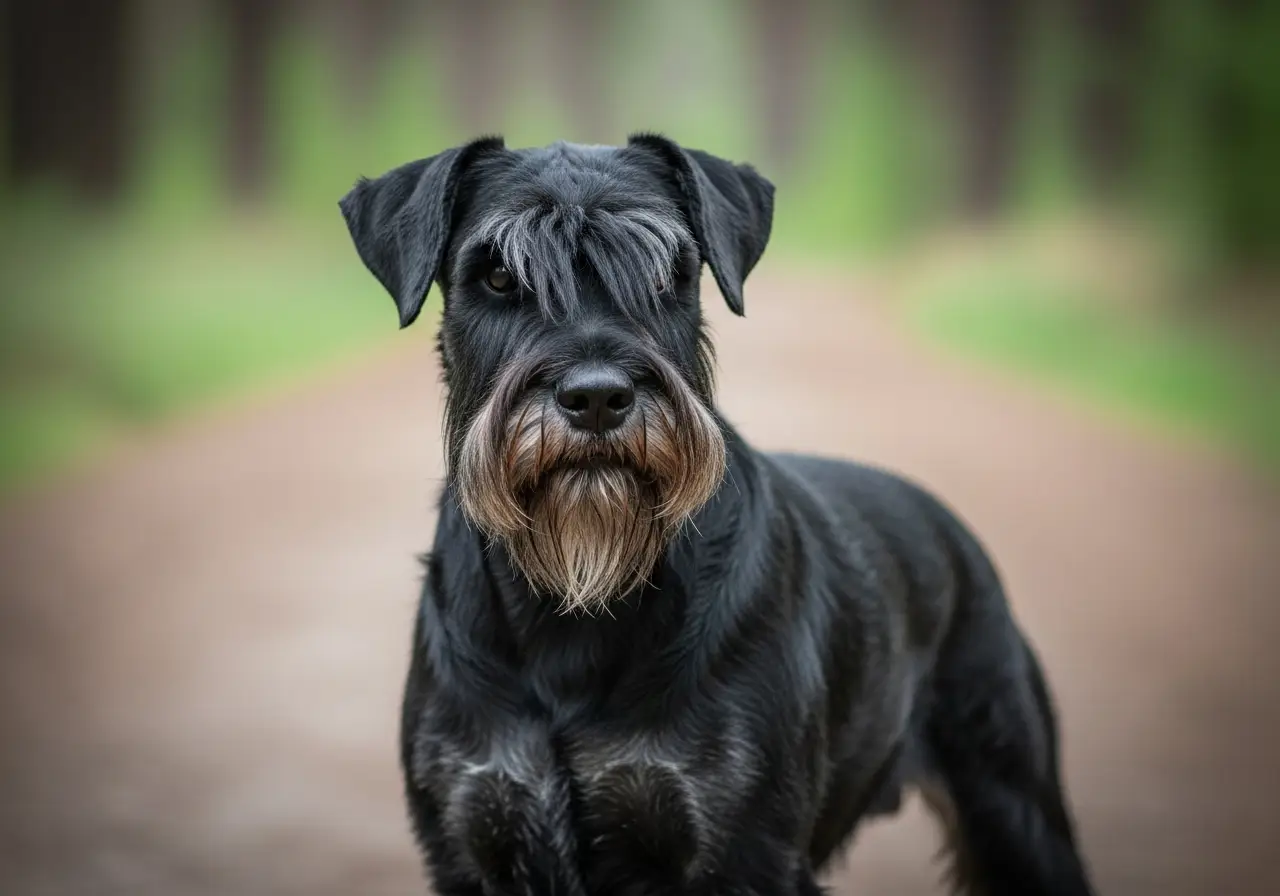
Schnauzer (Standard Schnauzer): original barn dog from Germany, reliably vigilant and a lively family companion
03Profile
Key facts and suitability
- Origin
- Deutschland
- Original purpose
- Ratting and guarding work
- FCI
- No. 182 · Group 2 · Sektion 1: Pinscher und Schnauzer
- height at the withers
- 45–50 cm
- Weight
- 14–20 kg
- Life expectancy
- 13–16 Years
- Coat type
- Wire-haired
- Minimum exercise
- 60 min/day
- Puppy price
- 1'500–2'500 CHF
- Waiting period
- 4 months
- Sports
- Agility Obedience Tricks
04Temperament
How the Schnauzer shows up in everyday life
When you leave the apartment in the morning, the Schnauzer registers that, and when you return, it registers that too. The greeting is warm, but not hysterical. It observes you briefly, assesses the situation, and then returns to its place. This pattern shows itself throughout everyday life: The Schnauzer is present without being intrusive.
Internally (i.e., in terms of what it requires from you), the Schnauzer is demanding. The need for mental work is high: a walk without a mental task is not enough for it. Nose work, search games, structured obedience training or trick work are part of daily basic care. If you neglect this, you will notice it: the dog starts to seek its own enrichment, through barking, scratching, or monitoring every movement in the household.
Externally, i.e., in its reaction to its environment, the Schnauzer presents a different picture. It behaves reservedly towards strangers. When an unknown person visits the apartment for the first time, it keeps its distance, observes, and decides itself when to allow closeness. This is not a mistake, but its guarding instinct. Anyone who confuses this instinct with a lack of sociability underestimates the breed.
Towards its family, it shows loyalty and strong bonding. With children who interact with it calmly and respectfully, it develops a stable relationship. Hectic activity, loud noises, or unpredictable movements cause tension in it; this should be taken into account in everyday family life.
Its guarding instinct is pronounced. It reliably alerts at the property boundary or when the doorbell rings. If you do not actively channel this, you risk the guarding behaviour escalating uncontrollably.
05Needs
What this breed needs daily
The Schnauzer requires 60 to 90 minutes of active exercise daily. It is not just about distance or speed, but quality: a structured walk with search tasks or obedience exercises has a stronger effect than a pure free-run session without a mental component.
The need for mental work is rated at the highest value on the internal axis. This means concretely: the Schnauzer requires some form of thinking task daily. Nose work (e.g., Mantrailing, scent tracking), structured obedience training, trick training, or fetch tasks are suitable formats. Without this component, it develops substitute activities that are rarely desirable.
The need for social contact is moderately pronounced. The Schnauzer is not a dog that demands constant physical closeness, but it requires regular, high-quality contact with its primary caregiver. Long phases of isolation, even with sufficient exercise, lead to restlessness and increased guarding behaviour.
Being left alone is possible for up to five hours with good habituation. This limit should not be regularly exceeded in everyday life. A dog that is left alone longer than this daily often develops barking as a compensation strategy.
The coat requires professional trimming two to three times a year. Daily brushing of the undercoat and regular beard care (removing moisture after eating) are part of the basic routine. Replacing trimming with clipping permanently alters the coat structure.
A secured property significantly facilitates the management of guarding behaviour. In apartment living, clear rules and consistent boundary setting regarding barking at doors and windows are indispensable.
Exercise
Medium
mental work
A lot
Social needs
Medium
training
Medium
07Quick Check
08Suitability
Who this breed is suitable for – and who it isn't
✓Matches
The Schnauzer suits owners who enjoy structured training and are willing to carry it out long-term and consistently. Concretely: at least 60 to 90 minutes of active enrichment daily, supplemented by daily mental work in the form of nose work, obedience training, or similar tasks.
It is suitable for individuals or families with children from about eight years old who can ensure a calm and respectful interaction with the dog. A secured property is not a must, but it significantly eases everyday life.
Owners who already have experience with independent or watchful breeds will find a reliable partner in the Schnauzer. First-time owners are not fundamentally excluded, but they require an accompanying dog training school from the start and realistic expectations regarding the time commitment.
Anyone who frequently receives visitors should be prepared to actively work on socialisation; the Schnauzer does not automatically accept strangers, but does so based on experience and clear guidance by the owner. Anyone who understands and accompanies this process obtains a dog with a stable, reliable temperament.
×Doesn't match
The Schnauzer does not suit owners looking for an uncomplicated, spontaneously friendly dog that immediately accepts strangers. Anyone who expects the dog to integrate into everyday life simply by being present will not be happy with a Schnauzer.
It is not suitable for households where more than five hours of being left alone is unavoidable on a regular basis, without dog care or daily structure. Owners who find guarding behaviour and alert barking disturbing and are not willing to actively channel it should consider another breed.
Families with very young children who have not yet learned calm interaction with the dog should realistically assess the high need for mental work and the independence of the Schnauzer. A dog that is mentally under-stimulated reacts with behaviours that create additional stress in everyday family life with toddlers.
Anyone who views mental work and daily training as an optional addition, rather than a basic requirement, will find that the Schnauzer organises its own enrichment. The result rarely corresponds to the owner's expectations.
10Line reality
Show line, working line, breeder market
The Schnauzer (Standard Schnauzer) is today predominantly bred as a companion dog. A pronounced differentiation between working and show lines, as known for example in the German Shepherd Dog or Labrador Retriever, does not exist for this breed to a comparable degree.
Nevertheless, there are differences within breeding in the weighting of character traits. Breeders oriented towards show success prioritise exterior and type stability. Breeders with a focus on utility dog characteristics place greater emphasis on nerve strength, drive structure and trainability. These differences are not always visible at puppy age, but become apparent in the development of the dog from the first year of life.
Anyone looking for a Schnauzer with stable nerves and pronounced willingness to be trained should specifically ask the breeder about the temperament assessment of the parent dogs and, if possible, observe both parents in everyday life. Show titles alone do not provide information about character quality.
Regionally, there are active breeding clubs in Germany and Switzerland that combine temperament tests and breed shows. The Pinscher-Schnauzer Club (PSK) in Germany and the Swiss Club for Schnauzers and Pinschers (SCSP) are the authoritative organisations for true-to-breed breeding in the DACH region.
11Health · Reality
What you need to plan for medically with your Schnauzer
The Schnauzer is considered a comparatively robust breed with a life expectancy of 13 to 15 years. This range is well documented by breeding association data and veterinary practice, but varies depending on living conditions, nutrition and genetic predisposition.
The following diseases occur frequently in a breed-typical manner:
Hyperlipidaemia (elevated blood lipid levels): The Schnauzer has a genetic tendency towards elevated triglyceride and cholesterol levels. According to a study by the University of Tennessee (2010), the Miniature Schnauzer is one of the most affected breeds, a finding that also holds relevance for the Standard Schnauzer. A low-fat diet and regular blood tests from the fifth year of life are recommended.
Pancreatitis: Directly linked to hyperlipidaemia is the increased risk of pancreatitis. Fatty meals or treats can trigger acute episodes. Owners should be aware of symptoms such as vomiting, abdominal pain and loss of appetite and have them checked by a vet.
Eye diseases: Cataracts and progressive retinal atrophy (PRA) occur in Schnauzers. Breeders who pay attention to eye health have breeding dogs examined ophthalmologically on a regular basis. When buying a puppy, you should ask for the latest eye test results of both parent animals.
Preventive examinations: Annual blood count checks from the fifth year of life, eye examination by the breeder before purchase, weight check every six months. Overweight significantly increases the risk of pancreatitis and should be actively avoided. The Schnauzer tends to gain weight if fed incorrectly.
12Structured data
Health by the numbers
Prone to diseases
Heart problems Eye problems Skin problems
Recommended health tests
Heart examination Eye examination
13Myths ↔ Reality
What is often said incorrectly about this breed
Five myths, five realities, five sources.
"The Schnauzer is a low-maintenance family dog all-round talent that fits into any household by itself.
The Schnauzer has a pronounced guarding instinct and meets strangers with reserve. Without consistent socialisation and clear leadership, it develops territorial behaviour, which becomes a real challenge in everyday life, for example when visitors come or in the city. It does not fit in by itself, but requires active structuring by the owner.
"Schnauzer hardly bark, they are quiet dogs.
The FCI standard explicitly describes the Schnauzer as alert, but not as a yapper. This means: it reliably reports changes in its surroundings, but should not bark continuously. If guarding behaviour is reinforced by lack of leadership or unclear boundaries, excessive barking develops, one of the most common reasons for surrender according to animal welfare organisations.
"The wiry coat of the Schnauzer cares for itself and requires little effort.
The rough topcoat of the Schnauzer requires regular hand-stripping, i.e. manually plucking out dead hair. Clipping permanently alters the coat structure and makes the hair soft and more maintenance-intensive. Professional stripping is required two to three times a year, supplemented by regular brushing of the undercoat.
"Schnauzers are beginner dogs because they are so intelligent and eager to learn.
High intelligence does not automatically make training easier. The Schnauzer actively questions inconsistent leadership and exploits gaps in training. Without clear rules and long-term consistency, it develops its own solutions, which rarely align with the owner's expectations. First-time owners need accompanying dog training school attendance and realistic expectations.
"The Schnauzer is a robust breed without significant health problems.
Although the Schnauzer is considered comparatively robust, certain diseases occur frequently in a breed-specific manner: eye diseases (including cataracts), hyperlipidaemia (elevated blood fat levels) and pancreatitis are documented. Regular preventive examinations and a low-fat diet are not optional measures, but part of responsible ownership.
14animal welfare
The animal welfare perspective
Breeder market, designer versions, animal shelter reality — what no one writes in the puppy ad.
The Schnauzer ends up in animal welfare less often than many other breeds, but when it does, for predictable reasons. The most common reasons for surrender are excessive barking, territorial behaviour towards visitors and a lack of consistency in training. These problems do not arise from a fault of the dog, but from an underestimation of the character profile at the time of purchase.
Backyard breeder market: Schnauzers are regularly advertised on classifieds platforms without pedigree registration, without health tests of the parent animals and at prices well below market level. A puppy without VDH/FCI papers, without litter inspection and without accessible parent animals is a risky purchase, not because of the missing papers themselves, but because health prevention (eyes, blood lipid levels) is carried out systematically in reputable breeding and is missing with backyard breeders.
Designer versions: Crossbreeds such as "Schnoodle" (Schnauzer × Poodle) or other Schnauzer mixes are marketed with the promise of combining the positive traits of both breeds. In fact, the inheritance of character traits in crossbreeds is not predictable. Anyone who buys a Schnauzer mix gets a dog with an unknown character profile; this can work, but it is not a calculable result.
Adoption as an equally valid option: Adult Schnauzers from adoption have a decisive advantage: their character is already visible. Animal welfare organisations and breed rescues know their dogs and can assess whether a dog fits into a household with children, other dogs or frequent visitors. The Swiss Club for Schnauzers and Pinschers (SCSP) and the PSK occasionally facilitate the rehoming of returned dogs from reputable breeding. This is not a stopgap solution, it is an informed decision.
15Costs · Transparency
What this breed realistically costs
Getting a Schnauzer from reputable breeding costs between 1,200 and 1,800 euros in the DACH region. Offers under 800 euros without pedigree registration and health certificates of the parent animals are a warning sign.
The annual keeping costs break down as follows: food (high-quality dry food or fresh meat) is between 600 and 1,000 euros per year, depending on food quality and body weight. Professional trimming costs between 80 and 150 euros per session two to three times a year, i.e. 160 to 450 euros annually. Anyone who trims themselves reduces this item, but needs instruction and suitable tools.
Veterinary costs for basic care (vaccinations, parasite prophylaxis, annual preventive care) are between 300 and 500 euros per year. For breed-typical diseases such as pancreatitis or eye problems, individual treatments can cost between 500 and 2,000 euros. Pet health insurance with surgical cover costs between 30 and 80 euros monthly depending on the provider and scope of benefits and is recommended for this breed.
Dog training school in the first year of life: 200 to 500 euros for basic course and advanced courses. For the Schnauzer, accompanying dog training school is not an optional addition, but a sensible investment in a stable foundation for training.
16Puppy search
What you need to consider when choosing a breeder
- A reputable breeder lets the puppies grow up with the mother dog and allows at least one visit before handover, ideally several.
- Both parent dogs should be documented in current eye examination reports.
- Ask about the blood lipid levels of the parent dogs, as hyperlipidaemia occurs frequently in Schnauzers.
- Litter acceptance by the breeding club, entry in the VDH or SKG stud book, and a minimum age of eight weeks at handover are minimum standards, not extras.
- Breeders who hand over puppies earlier or dispense with papers should be questioned critically.
- The purchase price for a Schnauzer from reputable breeding in the DACH region is between 1,200 and 1,800 euros.
- Offers significantly below this range indicate missing health tests or backyard breeding.
- Adopting an adult Schnauzer through breed rescues or animal welfare organisations is an equally valid alternative.
- Adult dogs already show their character, which considerably facilitates assessing the suitability of the match.
- The SCSP and the PSK provide information on adoption options upon request.
- No specific recommendations for individual breeders are made on this platform; the breeding clubs maintain current breeder lists.
FAQ
Frequently asked questions about the Schnauzer
Is Schnauzer suitable for beginners?
Schnauzer is considered suitable for first-time dog owners.
Is Schnauzer a family dog?
Schnauzer is considered suitable for families with good socialisation and species-appropriate care.
How much exercise does Schnauzer need?
At least around 60 minutes of exercise per day.
Does Schnauzer suit an apartment?
With enough exercise and enrichment, Schnauzer can also be kept in an apartment.
What is the size and weight of Schnauzer?
Fully grown, Schnauzer reaches about 45–50 cm at the withers and weighs around 14–20 kg.
What is the life expectancy of Schnauzer?
The life expectancy of Schnauzer is approximately 13–16 years.
Which diseases are common in Schnauzer?
Heart problems Eye problems Skin problems
17Breed clubs
Official breed clubs in DACH
19Related
Similar breeds – and their differences
You might also be interested in



Participate
Do you have a good photo of your Schnauzer?
We are looking for expressive images for our breed profiles. Submit yours; the editorial team reviews every submission before publication.
Does this breed suit you?
Medium Schnauzer variant – robust, eager to learn and needs regular trimming or shearing