4 sourcesUpdated September 11, 2026Responsible editor: Roger KleinText: Miriam Schäfer
01Summary
In a paragraph
If you only have 30 seconds.
The Boston Terrier is a compact, people-oriented companion dog from the USA with a characteristic tuxedo pattern and alert expression. It requires around 60 minutes of moderate exercise daily and tolerates heat and intensive physical exertion poorly due to its brachycephalic anatomy. Anyone keeping this dog takes responsibility for an animal with increased health risk, and receives in return a dog with exceptionally close bond orientation.
02Introduction
What makes the Boston Terrier special
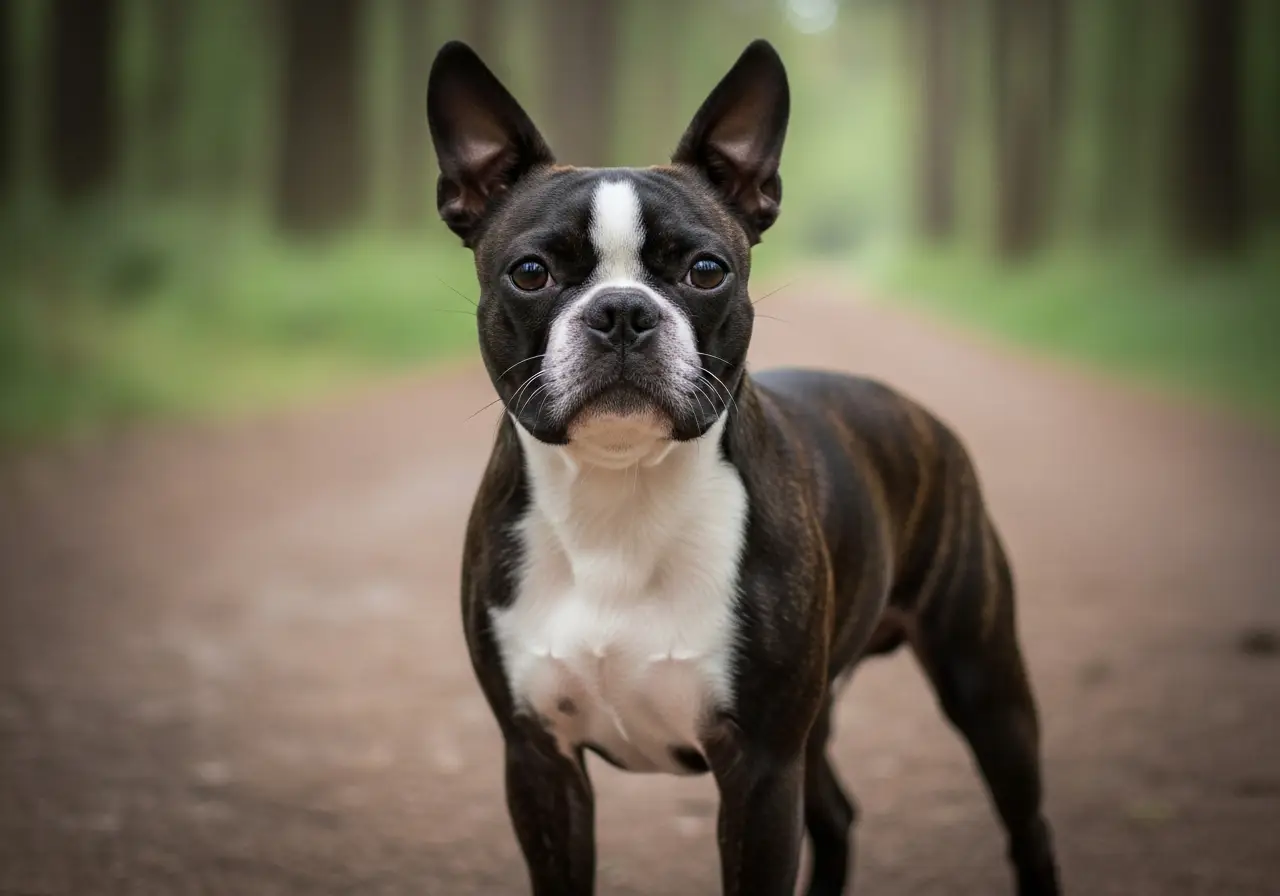
The Boston Terrier is a compact US-American companion dog, FCI Group 9, with a black-and-white tuxedo pattern, brachycephalic, shoulder height 38–43 cm.
03Profile
Key facts and suitability
- Origin
- USA
- Original purpose
- Companion dog (originally ratting)
- FCI
- No. 140 · Group 9 · Section 11
- height at the withers
- 38–43 cm
- Weight
- 4–11 kg
- Life expectancy
- 11–13 Years
- Coat type
- Short-haired
- Minimum exercise
- 30 min/day
- Puppy price
- 1'200–2'500 CHF
- Waiting period
- 6 months
- Sports
- Agility · Obedience
04Temperament
How the Boston Terrier shows up in everyday life
When you come home, the Boston Terrier shows what a high need for social contact means in everyday life: it expects an active greeting, seeks physical contact and clearly signals if it has been left on its own for too long. This is not a whim but a genetically anchored bonding orientation.
At home, the Boston Terrier needs mental enrichment and human closeness daily. Trick training, short search games or nose work meet its need for mental work better than purely physical stimulation. Anyone who only offers walks without engaging its mind will observe a dog in the evening that finds its own entertainment.
Towards strangers, the Boston Terrier is remarkably open. It greets visitors without pronounced reserve, but does not show pushy behaviour. This openness towards strangers must not be confused with the need for social contact: a Boston Terrier that greets strangers friendly still needs a fixed key person as an anchor; it is not a dog to which every human is equal.
In city life, it proves adaptable. Keeping it in an apartment works if sufficient outdoor stimuli and interaction are offered daily. On hot days, its energy level changes noticeably: it seeks shade, breathes audibly and signals exhaustion earlier than dogs without brachycephalic anatomy. Taking this signal seriously is not overreacting but responsible ownership.
It gets along well with children who handle dogs respectfully. Toddlers who crowd it unsupervised pose a real risk of injury due to its prominent eyes.
05Needs
What this breed needs daily
The Boston Terrier requires around 60 minutes of moderate exercise daily, divided into several sessions. Intensive sustained exertion, heat above 22 °C and humid air should be avoided due to its brachycephalic anatomy. Walks in the early morning and late evening hours protect its airways on warm days.
Mental stimulation is not a luxury for this breed, but a basic need. The requirement for mental work is moderate: trick training, nose work, short search tasks or interactive food searches meet this need. Without cognitive challenges, the Boston Terrier tends towards restlessness and overexcited behaviour.
The need for social contact is high and demands daily, active interaction with the primary caregiver. Passive presence (the dog lying in the same room while the owner works) is not sufficient. The dog needs direct attention, joint activities and clear communication.
Being left alone must be built up systematically. The tolerance limit is around four hours daily. Anyone who is regularly absent for longer periods needs a reliable care solution, such as a dog sitter, dog sharing or day care.
Training succeeds with positive reinforcement and clear structure. The Boston Terrier reacts sensitively to inconsistency: anyone who tolerates a behaviour today and corrects it tomorrow creates uncertainty. A supporting dog training school in the first months is recommended, especially for owners without prior experience with strongly bond-forming breeds.
Exercise
Low
mental work
Medium
Social needs
High
training
Easy
06Sport & Mental and Physical Stimulation
What sports the Boston Terrier is suited for
Realistic in terms of physiology and genetics. Not every breed suits every sport.
Structurally and physiologically suitable: not an endurance sport (brachycephaly / BOAS).
07Quick Check
08Suitability
Who this breed suits and who it doesn't
✓Matches
The Boston Terrier suits owners who can plan at least 60 minutes of active time with the dog daily, split between walks, play and training. Keeping it in an apartment in the city is possible if the dog receives sufficient outdoor stimuli daily.
The breed is well suited for individuals or couples with a regular daily routine who are looking for a close companion and are prepared to limit periods of being left alone to a maximum of four hours. Families with children from around six years old, who know how to handle dogs, are also suitable, provided the dog's eyes are protected from injury in everyday life.
Owners keeping a dog for the first time can have good experiences with the Boston Terrier if they use a supporting dog training school and take the breed's health peculiarities seriously from the start. Crucial is the willingness to plan regular vet checks and, if necessary, finance surgical interventions on the airways.
Anyone living in a temperate climate and preferring activities that can be well adapted to the daytime temperature (hikes in the early morning, city strolls in the evening) will find an attentive companion with manageable space requirements in the Boston Terrier.
×Doesn't match
The Boston Terrier does not suit owners who are away from home for more than four hours daily and cannot organise a reliable care solution. Its high need for social contact is not a trait of individual dogs but a breed characteristic.
Anyone looking for a sports dog for intensive activities such as jogging, cycling or extended mountain hikes chooses the wrong breed with the Boston Terrier. The brachycephalic anatomy sets structural limits to physical endurance that cannot be overcome through training.
Owners who equate the Boston Terrier's openness towards strangers with a low need for social contact underestimate the breed. A dog that greets visitors friendly still needs intensive daily attention from its primary caregiver; the two are not the same.
Anyone not prepared to plan for increased vet costs (BOAS assessment, eye checks, possible airway surgeries) should carefully reconsider getting a Boston Terrier. The health risks of the breed are documented and not a rare exception.
Households with very small children under four years old, in which continuous supervision of the dog is not guaranteed, pose an increased risk of injury for the dog because of the Boston Terrier's exposed eyes.
09Related
Similar breeds and how they differ



10Line reality
Show line, working line, breeder market
The Boston Terrier is now bred exclusively as a companion dog; a functional working line does not exist. The FCI standard does not provide for a working test. Differentiation within the breed runs primarily along two lines: weight classes and breeding philosophy.
The FCI standard distinguishes three weight classes: under 6.8 kg, 6.8 to 9.1 kg and 9.1 to 11.3 kg. This classification is relevant for shows, but has little impact on temperament or exercise needs in everyday life.
More relevant for future owners is the distinction between breeding lines with a focus on show standard and those that prioritise health characteristics. Reputable breeders who integrate BOAS grading, eye examinations (CAER) and patella examinations into their breeding programme produce dogs that show significantly fewer breathing problems in everyday life than lines that select exclusively for exterior.
In the USA there is a tendency towards very compact, extremely short-nosed types, which is critically assessed by reputable breeders and associations in Europe. The Swiss Club BTFS and the German 1st Club for Boston Terriers explicitly recommend health tests before breeding. Anyone looking for a puppy should specifically ask for these certificates: they are the decisive difference between a line with an acceptable health risk and one with structurally determined long-term problems.
11Health · Reality
What you need to plan for medically with your Boston Terrier
The Boston Terrier belongs to the brachycephalic breeds with documented health risks. Life expectancy is 11 to 13 years, depending on health status and keeping conditions.
Brachycephalic Obstructive Airway Syndrome (BOAS) affects a significant proportion of the breed. A study by the University of Cambridge (Liu et al., 2017, Veterinary Record) found clinically relevant breathing restrictions in 58% of the Boston Terriers examined. Surgical corrections (widening of the nostrils, shortening of the soft palate) are often necessary for affected dogs and cost between 800 and 2,500 CHF/EUR in the DACH region, depending on the procedure.
Eye problems represent the second most common health issue. The prominent, large eyes are susceptible to corneal injuries, keratoconjunctivitis sicca (dry eye) and hereditary cataracts. Regular eye examinations by a specialist vet are recommended, at least once a year.
Patellar luxation occurs more frequently in Boston Terriers than in the breed average. An examination before purchase and during the first year of life is advisable.
Preventive examinations that reputable breeders should provide evidence of: BOAS grading (breathing function test), CAER eye examination, patella assessment. Owners should request this evidence from the breeder and have the dog fully checked by a vet in its first year of life.
12Structured data
Health by the numbers
Prone to diseases
breathing problems (BOAS), eye problems (cataracts, corneal issues due to exposed eyes), patellar luxation, vertebral malformation
Recommended health tests
BOAS screening, eye examination, patella screening
13Myths ↔ Reality
What is often said incorrectly about this breed
Five myths, five realities, five sources.
“The Boston Terrier is a robust breed without significant health problems.
As a brachycephalic breed, the Boston Terrier carries a structurally determined risk for Brachycephalic Obstructive Airway Syndrome (BOAS). Studies from the University of Cambridge show that over 50% of the examined brachycephalic dogs exhibit clinically relevant breathing restrictions. In addition, there are increased rates of patellar luxation, cataracts and corneal injuries due to their prominent eyes.
“Boston Terriers can do sports without problems and go for long walks.
Intensive physical exertion and heat pose a real risk for brachycephalic dogs. The Boston Terrier requires moderate exercise of around 60 minutes daily, but without peaks in exertion. At temperatures above 22 °C, activities should be moved to the morning and evening hours to avoid heat collapse.
“Boston Terriers are terriers and therefore independent and robust in training.
Despite the name, the Boston Terrier has little in common with classic terrier traits such as stubbornness or a pronounced prey drive. The breed was consistently selected for companion dog characteristics: high need for social contact, close bonding, sensitivity to moods. Pressure and inconsistency in training quickly lead to insecurity and overexcited behaviour.
“The short muzzle is just about looks, it hardly affects the dog in everyday life.
Brachycephalic anatomy affects not only the external shape, but the entire airway structure: narrow nostrils (stenosis), an elongated soft palate and a relatively narrow nasopharynx can permanently restrict oxygen intake. Snoring, snorting under exertion and sleep apnoea are not quirks, but clinical symptoms that should be investigated by a vet.
“Boston Terriers are loners and cope well on their own.
The Boston Terrier has a high need for social contact. It is closely oriented towards its key people and reacts to long periods of being left alone with stress behaviour such as vocalisation, incontinence or destructive behaviour. Being left alone must be built up early and systematically; more than four hours daily represents a limit of tolerance for most representatives of this breed.
14animal welfare
The animal welfare perspective
Breeder market, designer versions, animal shelter reality: what no one writes in the puppy ad.
The Boston Terrier is one of the breeds that regularly appears in animal welfare contexts, and for understandable reasons. Those who know the background make better decisions.
Backyard breeder market and import risks
Demand for Boston Terriers has increased in recent years, activating the backyard breeder market. Puppies from dubious sources are often sold without health tests, without socialisation and with forged papers, often via classifieds portals or as imports from Eastern Europe. These dogs end up disproportionately often in animal welfare organisations when breathing problems become visible in the first year of life and vet costs exceed expectations.
Designer versions and colour trends
"Rare" colours such as blue, lilac or merle are marketed by backyard breeders as premium products and offered at prices of 3,000 EUR and more. These colour variants do not correspond to the FCI standard and are often associated with additional health risks: merle genetics, for example, increase the risk of deafness and eye malformations. A high price is not a quality indicator.
Surrender reasons related to keeping conditions
The most common reasons for surrender in animal welfare are: underestimated breathing problems and associated costs, periods of being left alone that are too long, leading to behavioural problems, and dogs surrendered after a separation or move. Boston Terriers with a history are available in animal welfare organisations and breed rescues; they often already have basic socialisation and are an equivalent alternative to a puppy.
Adoption as an option
The 1. Club für Boston-Terrier in Germany (boston-terrier.de) and the BTFS in Switzerland maintain rehoming contacts. Those who take on an adult dog already know its health status and character, an advantage over a puppy, whose breathing problems often only fully manifest in the first year of life.
15Costs · Transparency
What this breed realistically costs
The purchase price from reputable breeders with health tests (BOAS grading, CAER, patella) is between 1,500 and 2,500 CHF/EUR in the DACH region. Offers significantly below this, under 800 EUR, often come from backyard breeding without health evidence. "Rare" colour variants at 3,000 EUR and more do not correspond to the FCI standard and are not a quality indicator.
Annual living costs for a Boston Terrier are typically between 2,000 and 3,500 CHF/EUR, depending on health status and region. Food (quality dry food or BARF) amounts to 600 to 1,000 CHF/EUR per year. Care is minimal due to the short coat: basic grooming, nail trimming and occasional ear cleaning cost around 100 to 200 CHF/EUR annually.
The decisive cost factor is veterinary care. A BOAS operation costs between 800 and 2,500 CHF/EUR in the DACH region. Eye treatments, patella corrections and routine check-ups add to this. Pet insurance with surgical cover is strongly recommended for this breed; the annual premium is between 400 and 900 CHF/EUR depending on provider and scope of cover. Without insurance, a reserve of at least 3,000 CHF/EUR should be set aside for emergency procedures.
16Puppy search
What you need to consider when choosing a breeder
- A reputable breeder voluntarily provides the following documents: BOAS grading of both parent animals, CAER eye examination (not older than 12 months), patella assessment and proof of membership in a breeding association (VDH, SKG or ÖKV).
- Puppies leave the litter at the earliest with eight weeks, are chipped, vaccinated and dewormed.
- Viewings take place at the breeder's, never at a neutral meeting point.
- The breeder shows the mother of the litter and asks questions about the planned keeping.
- Anyone who does not ask questions and sells immediately is not a reputable contact.
- Caution with offers on general classifieds portals, with puppies without papers, with "rare" colours (blue, merle, lilac) and with prices under 800 EUR.
- These dogs often come from backyard breeding without health tests.
- The rehoming of an adult Boston Terrier via animal welfare organisations or the breed rescue of breeding associations is an equally valid alternative.
- Adult dogs bring a known health status with them, an advantage, as BOAS symptoms often only fully manifest in the first year of life.
- Contacts for rehoming dogs are provided by the 1st Club for Boston Terriers in Germany (boston-terrier.de) and the BTFS in Switzerland (bostonterrier.ch).
FAQ
Frequently asked questions about the Boston Terrier
Is Boston Terrier suitable for beginners?
Boston Terrier is considered suitable for first-time dog owners.
Is Boston Terrier a family dog?
Boston Terrier is considered suitable for families with good socialisation and species-appropriate care.
How much exercise does Boston Terrier need?
At least around 30 minutes of exercise per day.
Does Boston Terrier suit an apartment?
With enough exercise and enrichment, Boston Terrier can also be kept in an apartment.
What is the size and weight of Boston Terrier?
Fully grown, Boston Terrier reaches about 38–43 cm at the withers and weighs around 4–11 kg.
What is the life expectancy of Boston Terrier?
The life expectancy of Boston Terrier is approximately 11–13 years.
Which diseases are common in Boston Terrier?
breathing problems (BOAS), eye problems (cataracts, corneal issues due to exposed eyes), patellar luxation, vertebral malformation
Participate
Do you have a good photo of your Boston Terrier?
We are looking for expressive images for our breed profiles. Submit yours; the editorial team reviews every submission before publication.
Does this breed suit you?
Suitable companion dog for city life. Have the airways checked when buying. No intensive sporting exertion.