
Help, my dog is snapping! 10 scenarios with solutions
Your dog suddenly snaps at your hand, at other dogs, or when being petted – and you do not know what just happened? This behaviour unsettles many dog owners, which is completely understandable. Snapping does not automatically mean that your dog is dangerous or aggressive. Almost always, there are very specific triggers behind it: stress, over-excitement, protective reflexes, or simply a lack of impulse control. We will look at ten typical situations in which dogs snap – and what you can do in each case.
Scenario 1: Dog snaps at other dogs or animals
What is behind it? When your dog snaps when encountering other dogs or animals, quite different things can play a role: It feels threatened or insecure, shows territorial behaviour, or reacts out of frustration – for example because it cannot move aside on the lead.
What helps? Socialisation is the key word here, but please in a controlled manner and in small steps. Plan calm, relaxed encounters with familiar dogs, keep the distance large initially and reward every calm reaction from your dog. Treats that he really loves help enormously with this. If the situation escalates or you cannot make any further progress, an experienced dog trainer is the right point of contact.
Scenario 2: Dog snaps when feeding
What lies behind it? If your dog snaps at your hand when you put down the bowl, this often indicates a lack of frustration tolerance – technical term: impulse control. He is so focused on the food that he can no longer find any brakes.
What helps? Train a short waiting procedure before eating: dog into the sit position, bowl on the floor, wait briefly – only then the signal to eat. Sounds simple, but makes a real difference in the long term. You should initially avoid feeding directly from the hand if your dog tends to snap. With consistent positive reinforcement, the behaviour changes step by step.
Scenario 3: Dog snaps when being petted
What lies behind it? This is one of the cases that makes me personally most thoughtful: many dogs send clear signals – ears back, turning body away, short growling – before they snap. And often these signals are overlooked or ignored. Petting at the wrong moment, in the wrong place or simply too much of it can cause real stress.
What helps? Observe your dog’s body language really closely. Does he withdraw, does he growl softly, does he put his ears back? Then stop petting immediately and give space – no drama, no punishment. With targeted training you can positively charge touches step by step: short gentle touch, treat immediately, increase slowly.
Scenario 4: Dog snaps when playing
What lies behind it? Playing can really get dogs worked up – and then the brakes suddenly fail. Snapping during play is often not malicious intent, but simply over-excitement. Particularly young dogs and certain breeds tend to do this.
What helps? Clear rules help here more than admonishing. If your dog snaps while playing, break off the game immediately – without a big reaction, just a short pause. Then start again. Anyone who sticks to this consistently often notices a clear difference after just a few weeks. Regular short training sessions promote impulse control sustainably.
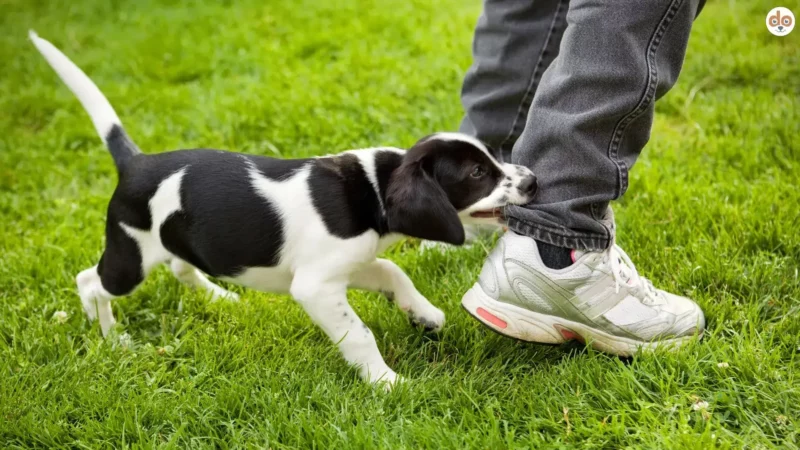
Scenario 5: Dog snaps at trouser leg
What lies behind it? A classic, especially with puppies and young dogs: the trouser leg moves, it’s fun, so you snap at it. Usually playfulness is behind it, sometimes also simply a desire for movement or boredom.
What helps? Do not “fight” with the leg – that only makes it more interesting for the dog. Instead redirect immediately: hold out a toy, direct attention to something permitted, and reward playing with the correct object directly. Simply ignore snapping at the trouser leg, do not dramatise it.
Scenario 6: Dog snaps when approaching bowl or toy
What lies behind it? This is called resource guarding – your dog guards what is important to him and snaps if someone gets too close. This is a deeply rooted behaviour, not malice, but it should be taken seriously.
What helps? Approaching the bowl or favourite toy must be associated positively. Go in small steps: first throw treats from afar, then come closer, always bring something good. Avoid simply taking away food or toys – that only reinforces the guarding. Build up rather than confront.
Scenario 7: Dog snaps at sudden movements or noises
What lies behind it? A loud noise, an unexpected movement – and your dog reacts by snapping. This is often a startle reflex, not an attack. Some dogs are hypersensitive to stimuli, sometimes incomplete socialisation as a puppy also lies behind it.
What helps? Habituation through controlled exposure – but slowly and without pressure. Show your dog various noises and movements in an environment where he feels safe. If he remains calm, there is immediate reward. Regular training reduces overreactions over time.
Scenario 8: Dog snaps when touched while sleeping
What lies behind it? Dogs can also snap out of deep sleep – this is usually a pure reflex, not a conscious behaviour. Sometimes a disturbed sleep pattern or an overreaction if the dog does not feel safe also lies behind it. [Interesting on this: Why you should not wake sleeping dogs]
What helps? The simplest rule: do not touch a sleeping dog. If snapping during sleep happens frequently or your dog seems disoriented afterwards, it is worth talking to the vet – sometimes health causes lie behind it that should be clarified. Also provide a quiet, undisturbed sleeping place.
Scenario 9: Dog snaps at the vet
What lies behind it? Strange smells, unknown people, unpleasant examinations – the vet’s practice is pure stress for many dogs. Snapping is then a protective reaction, often reinforced by previous bad experiences.
What helps? Prepare for the vet visit, do not just drive there and hope. Visit the practice occasionally without treatment – just go in briefly, treats from the staff, come out again. This way the place is slowly positively charged. During the examination, distraction by favourite treats and a calm, patient approach help more than holding on and soothing words.
Scenario 10: Dog snaps during grooming
What lies behind it? Ear cleaning, nail clipping, grooming – all this feels uncomfortable for some dogs, especially if they were not used to it early on. Snapping is then an attempt to end the procedure.
What helps? Approach slowly and in tiny steps. Today, just show the clippers and give a treat; tomorrow, briefly touch a paw; next week, trim one nail. Never force it. With consistent positive reinforcement, your dog will learn that grooming moments are nothing to fear. In cases of extreme reactions, consulting a behaviourist or dog trainer is worthwhile.
When the dog snaps without an apparent reason
Sometimes snapping seems to come out of nowhere – no obvious trigger, no warning. This is the moment when a vet visit really becomes important. Pain, neurological issues, or other health causes can trigger snapping that appears puzzling at first glance.
Observe your animal closely: exactly when does it happen? In which situation? Is there perhaps a pattern you only notice on second thought? Notes help with this. If the vet examination reveals no physical cause, a behaviour therapist or experienced dog trainer is the next sensible step – not as a last resort, but as concrete support.