
Dog Won’t Let You Touch It – 10 Scenarios with Solutions
If your dog pulls away from touch, pain, trauma, or lack of socialisation could be the cause. With the right training, fear of touch can usually be successfully overcome.
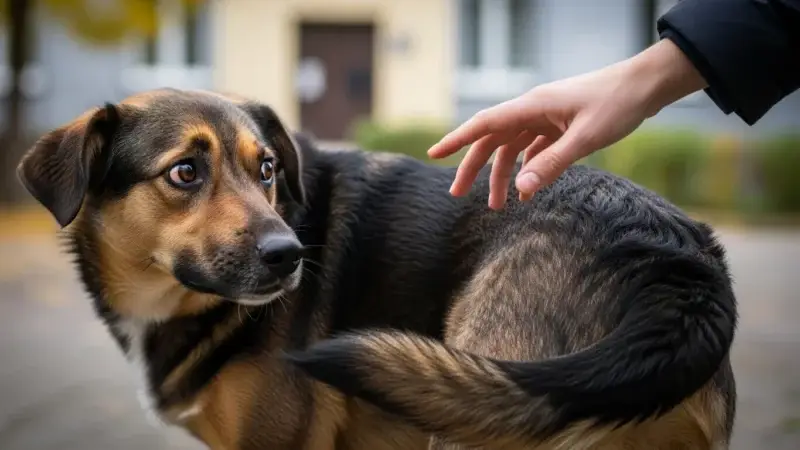 Source: legacy_text
 Content
- Why does my dog flinch when I touch it?
- How do I recognise fear of touch in my dog?
- What should I do if my dog is traumatised?
- How do I know if my dog is poorly socialised?
- Can overstimulation be the cause?
- Are there dogs that simply do not like being touched?
- How do I help an insecure dog?
- When should I seek professional help?
You reach out your hand – and your dog backs away or freezes completely. This is not an uncommon phenomenon. Fear of touch in dogs appears more often than most people suspect, and it almost always has a specific reason. And usually, something can be done about it.
Here are the most common causes – and what you can do step by step.
Why does my dog flinch when I touch it?
To be honest: pain is the most obvious suspect. A dog with joint problems, skin irritation, or anything that twinges somewhere will react defensively to touch instinctively – even if you are as gentle as can be. It cannot explain that it is in pain. It can only move away.
Look closely: Does it flinch only at certain parts of the body? Is it moving more stiffly than usual? If so, a visit to the vet is mandatory – not optional. A medical check usually clarifies physical causes within a few days.
Behavioural training only makes sense once you know there is no physical problem.
How do I recognise fear of touch in my dog?
Fear is rarely loud. Most of the time, it is quiet, almost invisible. Your dog turns its head away, briefly licks its snout, or takes a small step backwards – long before it growls or snaps. If you miss these signs, you will eventually hear the loud signal.
Watch for the following signs when attempting to touch your dog: panting without prior exertion, tucked tail, averted gaze, excessive yawning. All of this means: “Please not now.” And you should take that seriously.
How do you train this away? Stand three metres away. Reach out your hand – and stay still. Just like that. As soon as your dog remains relaxed, it gets a treat. Then reduce the distance by about 30 centimetres each day. Realistically, the whole process takes two to three weeks – sometimes longer.
What should I do if my dog is traumatised?
Mistreatment, rough vet visits, accidents – all of this leaves traces that are invisible but which the dog carries with it every day. It cannot understand that your hand is different from the hand that caused pain back then.
What helps: predictability. Announce every single touch. Say “hand” and then wait three seconds before you move. Sounds pedantic, but it works. This way, your dog learns that it can assess a situation before it happens.
A rough training plan for traumatised dogs:
Week 1–2: Show only the palm of your hand, no movement
Week 3–4: Move your hand slowly towards the dog, stop immediately at the first sign of stress
Week 5–6: First gentle touch on the neck – never on the head, that is too threatening
Week 7+: Gradually extend the duration of contact
How do I know if my dog is poorly socialised?
A poorly socialised dog avoids not only your touch, but that of all people. It has simply never learned that human hands can also mean something good.
What I like to recommend: classical conditioning, quite simple. Every time your hand comes into its field of vision, a treat falls to the floor. You do not touch it during this process. Simply: hand visible, treat falls. After a week – sometimes even earlier – it begins to associate your hand with something positive.
Only then, on this more stable basis, does the actual touch training begin. Not before.
Can overstimulation be the cause?
Absolutely. If your dog has just come back from a walk, children are running through the flat or there was a visitor at the door – then it simply cannot process touch. Its nervous system is fully occupied, leaving no room for petting.
This can actually be solved quite easily: timing. Attempt contact only during calm moments. If it is lying around relaxed or dozing slightly, the chance of success is significantly higher than immediately after playing roughly.
I like to call this a “touch schedule”: in the morning after the first walk, and in the evening just before going to bed. At these times, the nervous system is at its calmest – and the reaction correspondingly more relaxed.
Are there dogs that simply do not like being touched?
Yes. And this is not a defect, it just is what it is. Some dog breeds and some individuals are less contact-needy – no different from certain people who prefer to avoid hugs.
These dogs show affection in their own way: they follow you through the flat, lie down near you, bring you their favourite toy. This is also bonding. Not everything has to end with cuddling.
What works instead? Joint walks, nose work, search games, training sessions. Many dogs that do not like being touched literally blossom when learning new commands. The bond forms – just differently.
How do I help an insecure dog?
Insecure dogs need one thing above all: control. You do not decide when contact takes place – it decides. This sounds counterintuitive, but it is the key. Simply sit on the floor and wait. No pressuring, no luring. Often it takes only a few minutes until it approaches you on its own.
The so-called hand-target trick fits well here: hold out your palm and wait. As soon as it touches it with its nose – reward. Immediately. It thereby learns that it can take the interaction into its own hands, in the truest sense.
After about two weeks, you can carefully start to touch it briefly while it nudges your hand. The transition often works surprisingly smoothly.
When should I seek professional help?
If, after four weeks of consistent training, every touch is still blocked or your dog even reacts aggressively, then a behaviour specialist is no longer an option – but the next thing you do.
Clear warning signs: growling when attempting to touch, snapping at the air or complete freezing. These reactions point to deeper problems that an experienced trainer can assess better than you and I can from a distance.
And even if you are simply unsure whether you are proceeding correctly: a single consultation session is almost always worthwhile. A good trainer sees in ten minutes what you may have overlooked for weeks – not because you are inattentive, but because you are too close to the situation.