
Tail
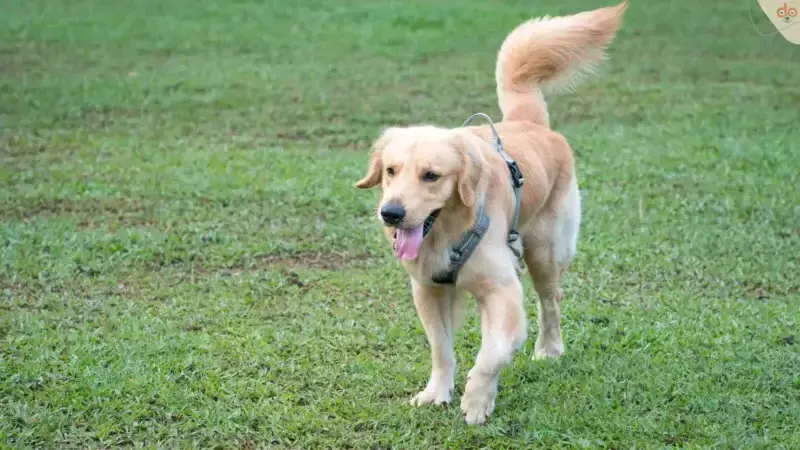
The tail is a muscular extension of the spine, consisting of 6-23 movable vertebrae and serving both balance and inter-canine communication.
Content
The tail is not an appendage – it is a fully-fledged part of the spine, permeated with muscle, built from 6 to 23 movable vertebrae, and simply indispensable for the dog: for balance, for communication with conspecifics, and for everything in between.
If you observe your dog for a while, you notice this quickly. At the vet, the tail hangs down. On the walk, it perks up. And when you come home, it flies like a propeller. Three situations, three completely different messages – no words needed.
How is the dog’s tail anatomically structured?
The caudal vertebrae are significantly smaller and more flexible than the thoracic vertebrae – this makes the tail so expressive. How many there are depends on the breed: between 6 and 23. This explains why a Pug has a compact curly tail and a Golden Retriever a long, bushy one – both are anatomically normal, just very different.
Several muscle groups control the movement: elevators, depressors, lateral flexors and the circular muscles responsible for wagging. The nerve supply is dense – anyone who has experienced how a dog reacts when the tip of its tail is bumped knows what that means. Tail injuries hurt. Seriously.
The coat tells its own story: from the double-coated Retriever tail to the almost naked stubby tail of the Bulldog. In breeds with thin tail skin, frostbite can even be an issue in winter – sounds dramatic, but is not uncommon in dogs susceptible to cold.
What significance do different tail positions have?
Dogs speak with their tails. Not as a metaphor – that is literally true. Other dogs read this code instinctively, and with some practice, humans can decipher it too.
Carried high and held stiffly upright: dominance or alertness. The dog makes itself look big, showing that it is present. Combined with fast, wide wagging, the same tail position instead means joy – context decides. Tucked between the legs is clear-cut: submission, fear, stress. The dog literally makes itself small. A tail carried neutrally at back height shows that everything is fine right now.
Particularly interesting: studies show that dogs wag to the right when they see something positive – such as their owner – and to the left with stimuli perceived more negatively, like a strange dog. This asymmetry is no coincidence; it reflects which half of the brain is currently more active.
Why is the tail so crucial for balance?
During rapid changes of direction, jumps or when running on narrow surfaces, the tail acts like a counterweight – similar to a balancing pole. This is not just theory: dogs with short or missing tails have measurably poorer balance values. They compensate for this through increased trunk musculature and altered movement patterns, but it is not a complete replacement.
When swimming, the tail takes on the function of a rudder. If it is missing, every correction of direction costs more energy. Anyone who has observed a dog without a tail in water sees this clearly.
What legal aspects should be considered regarding tail docking?
In Germany, Austria and Switzerland, tail docking has been banned for years – with the exception of medically necessary interventions.
In Germany, § 6 of the Animal Welfare Act prohibits the complete or partial amputation of body parts. A violation is an administrative offence in Germany and is punished under § 18 of the Animal Welfare Act with a fine of up to €25,000. The import of docked dogs is restrictedly possible if the docking took place abroad before import.
In Austria, § 7 of the Animal Welfare Act prohibits the docking of tails and ears. Docked dogs are also excluded from dog shows.
In Switzerland, Art. 22 para. 1 letter a of the Animal Welfare Ordination prohibits the docking of tails and ears. Art. 76a para. 1 of the Animal Welfare Ordination also prohibits the import of docked dogs, with the exception of dogs whose ears or tails were docked for medical reasons, and imports as household goods.
At EU level, the Convention for the Protection of Pet Animals generally prohibits docking. Medical exceptions are only provided for in cases of severe injuries or tumours.
What are common tail injuries?
Happy Tail Syndrome sounds less serious than it is. Large dogs with heavy tails – Boxers, Great Danes, Weimaraners – bleed the tip of their tail when wagging enthusiastically. The real problem: the wound does not heal because the dog keeps wagging. Chronic cases can drag on for weeks.
Cold water tail (also known as cold water tail) occurs after prolonged swimming in cold water or unaccustomed physical exertion. The tail hangs limply, and the dog shows pain when trying to lift it. Retrievers and pointers are frequently affected. In most cases, dogs recover within 2 to 4 days.
Tail fractures occur due to entrapment or falls and represent a different category: veterinary treatment is always necessary here – this is not a case for waiting and seeing.
In long-haired breeds, burrs, twigs, or ice clumps in winter often collect in the tail fur after outings. If they are not removed, painful matting occurs, which irritates the skin and, in the worst case, becomes inflamed.
How do you care for the tail correctly?
Long-haired breeds require regular brushing – after walks in the woods, a quick check for foreign objects before bringing them home is worthwhile. If you take those two minutes right afterwards, you save significantly more effort later.
After bathing or swimming, dry the base of the tail thoroughly. Moisture easily accumulates there, especially in densely haired breeds such as Newfoundland dogs, and can lead to skin irritation.
If you have a particularly enthusiastic wagger, you should check the tip of the tail regularly. Small cracks, treated early, heal without complications. Chronic happy tail wounds, on the other hand, are a long-drawn-out affair – one that you can usually avoid with a little attention.
More from the Wiki
All wiki entries →Plum
The plum is a stone fruit of the genus Prunus. Its stone contains cyanogenic glycosides; the …
Rhubarb
Rhubarb is a knotweed whose leaves are rich in soluble oxalic acid. For dogs, the leaves …
Why is dog faeces white?
White dog faeces occurs when normal digestion is disrupted or certain substances change the colour of …
Dog licks its anus, what to do?
Anal licking in dogs is a normal grooming behaviour that serves for cleaning and emptying the …