
01Summary
In a paragraph
If you only have 30 seconds.
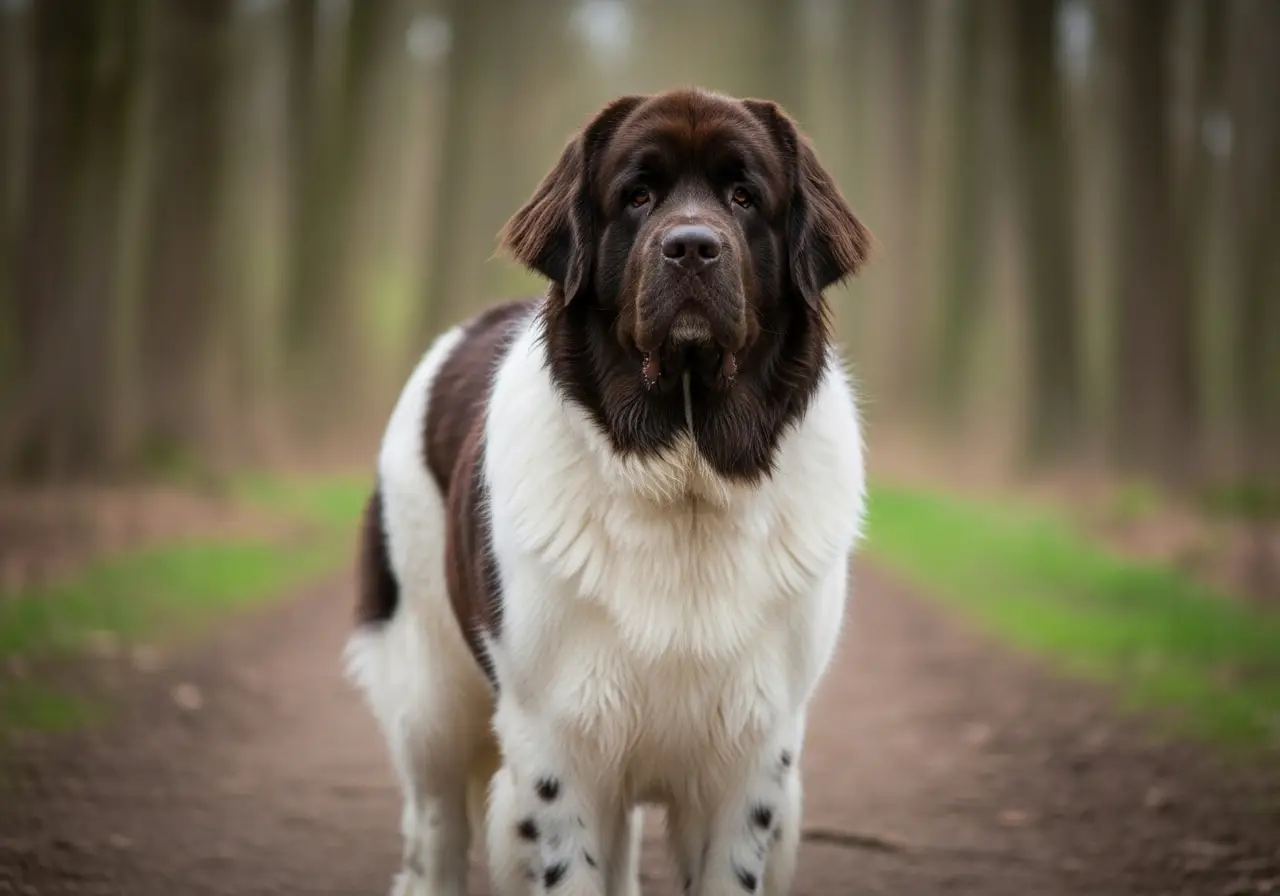
The Newfoundland is a massive, water-loving working dog with a calm temperament and pronounced family bond. Its size is not a backdrop, it places real demands on space, care, finances and the physical resilience of the owner. Anyone who meets these conditions receives a dog with stable social competence and remarkably calm everyday behaviour. Anyone who underestimates them quickly reaches their limits.
02Introduction
What makes the Newfoundland special
Newfoundland: gentle giant from Canada, water-enthusiastic, patient and with a strong rescue instinct in the water
03Profile
Key facts and suitability
- Origin
- Kanada
- Original purpose
- Rescue dog pack carrier in water
- FCI
- No. 50 · Group 2 · Section 2.2
- height at the withers
- 66–71 cm
- Weight
- 45–68 kg
- Life expectancy
- 8–10 Years
- Coat type
- Doppel
- Minimum exercise
- 60 min/day
- Puppy price
- 1'500–2'500 CHF
- Waiting period
- 5 months
- Sports
- Swimming Rescue dog Sled work
04Temperament
How the Newfoundland shows up in everyday life
When you come home, you are not met with a hectic greeting ritual. The Newfoundland rises, trots to the door, and that suffices for it as a welcome. This calmness is not disinterest, but an expression of a stable temperament. The bond with the family is close; it follows its people through the house, lies down within sight and registers changes in mood with remarkable accuracy.
Internally, what the dog needs: The need for social contact is high. A Newfoundland kept permanently alone or without human contact develops stress symptoms. It is not a dog for a kennel in the garden. It requires mental work to a moderate extent; nose work, simple search tasks or water rescue exercises are sufficient to provide it with mental stimulation. Physically, moderate exercise suffices; intensive endurance exertion is contraindicated due to joint strain at this body mass.
Externally, how it reacts to its environment: It behaves predominantly calmly to friendly towards strangers. A pronounced guarding instinct is not typical for the breed; it activates when something unusual happens, but rarely escalates. In everyday life with children, it shows patience, but its body size requires supervision, as it can simply knock over toddlers without intending to.
On a walk, it walks calmly beside you, provided loose-leash walking was trained early on. At bodies of water, the picture changes: It actively seeks out the water, dives in and swims with endurance. This affinity for water is not a trick; it is a basic need that should be given space regularly.
05Needs
What this breed needs daily
The Newfoundland requires 60 to 90 minutes of exercise daily at a moderate pace. Swimming takes priority here, as it spares the joints, corresponds to the working background of the breed and provides both physical and mental stimulation simultaneously. Anyone without regular access to a body of water should factor this in honestly before getting a dog.
Intensive endurance exertion (long jogging, extensive mountain hikes in heat) is unsuitable for this breed. The body weight strains the joints, and sensitivity to heat sets strict limits in summer. Walks in the early morning or evening hours are mandatory on warm days, not a matter of comfort.
Mentally, the Newfoundland does not require highly intensive enrichment. Nose work, simple search tasks or water rescue exercises in a club are sufficient to provide stimulation. A monotonous daily routine without any tasks leads to restlessness and overweight, both of which harm health in the long term.
The need for social contact is high. The dog requires daily, close contact with its key people. Being left alone is possible to a moderate extent (up to four hours, if built up gradually) but should not be the permanent state.
Grooming represents a distinct time commitment: thorough brushing at least three times a week, daily during the main coat change period. Anyone who underestimates this effort risks matting, skin problems and permanently increased veterinary costs. A dog of this size also requires sufficient space to lie down; an orthopaedic bed of at least 1.5 × 1.0 metres is no exaggeration.
Exercise
Medium
mental work
Something
Social needs
High
training
Easy
07Quick Check
08Suitability
Who this breed is suitable for – and who it isn't
✓Matches
The Newfoundland suits owners who have a house with a garden or direct access to green spaces and can plan for at least 90 minutes daily for exercise and care. Access to a body of water (lake, river, dog swimming pool) should be realistically and regularly possible.
Families with children from about six years old are suitable if the parents actively accompany the interaction and the children are trained in handling a large dog. The body mass of the dog requires supervision, not because of aggression, but simply due to its size.
Owners with experience in training large breeds benefit from the cooperative nature of the Newfoundland. First-time owners are not fundamentally excluded, but require a supportive dog training school from the start and a realistic picture of care and cost effort.
Active people aiming for water rescue, sled dog sports or rescue dog work find a suitable partner in this breed, provided physical exertion is dosed appropriately for age.
Financially, an annual budget of at least 3,000 to 4,500 EUR should be planned for food, care and basic veterinary care. Anyone who can realistically cover this framework and is willing to invest time and structure receives a dog with stable social competence and a long memory for reliability.
×Doesn't match
The Newfoundland does not suit owners living in a small apartment without outdoor space. The body mass alone makes permanent apartment keeping without regular, generous exercise an animal welfare problem, regardless of how calm the dog appears in the house.
Anyone who is away from home for more than four hours a day and cannot organise reliable care should not choose this breed. The high need for social contact is not a character flaw, but is genetically ingrained.
Anyone who equates the calmness of the Newfoundland with friendliness towards strangers misunderstands the dual-axis profile: the dog is family-oriented and calm, which does not mean that it automatically copes with every situation without training and socialisation.
Owners in regions with hot summers and no possibility for heat adaptation (air conditioning, access to water bodies, flexible exercise times) expose the dog to a permanent health risk.
Anyone looking for a dog that requires little care, costs little and occupies itself will be permanently overwhelmed by a Newfoundland. This is not a matter of good will, it is a matter of real capacities. Anyone who does not bring these capacities with them is not doing the dog any favours.
10Line reality
Show line, working line, breeder market
A pronounced line differentiation between working and show lines, as exists for example in the Labrador or Golden Retriever, is less pronounced in the Newfoundland. Nevertheless, relevant differences exist that should be known before searching for a puppy.
Breeding lines with a focus on water rescue work, particularly active in Italy and France, place value on endurance, swimming ability and resilience under real operational conditions. These dogs are physically more robust and require a higher degree of active enrichment. Anyone aiming for rescue dog work should specifically seek out breeders who use their dogs in appropriate clubs and have them tested.
Show-oriented lines focus on exterior, gait and type consistency according to the FCI standard. These dogs are no less healthy if breeding is conducted seriously, but the focus on working traits is less systematically documented there.
In the DACH region, lines oriented towards suitability as family and companion dogs dominate. Most reputable breeders in the German Newfoundland Club e.V. (Deutscher Neufundländer-Klub e.V.) and the Swiss Newfoundland Club SNK combine show suitability with health screenings (HD, ED, cardiac examination). The Landseer (ECT) is recognised by the FCI as a separate breed and should not be equated with the classic Newfoundland, even though the relationship is obvious.
11Health · Reality
What you need to plan for medically with your Newfoundland
The Newfoundland belongs to the breeds with a documented increased risk of hip dysplasia (HD) and elbow dysplasia (ED). According to evaluations by the German Newfoundland Club e.V., depending on the breeding line, 20 to 35 % of the dogs examined show HD findings that go beyond grade A. ED findings occur at a similar frequency. Reputable breeders provide X-ray reports of both parent animals, this is not a bonus, but the minimum standard.
Heart problems, in particular subvalvular aortic stenosis (SAS), are typical for the breed and should be ruled out before purchase by a cardiological examination of the parent animals. Subaortic stenosis can run without symptoms and is not always recognised immediately in puppies.
The life expectancy is 8 to 10 years according to breed club information, a realistic framework for a breed of this body mass, which however can be positively influenced by consistent weight control. Overweight is a serious problem in Newfoundlands: already 5 kg above the ideal weight measurably increases joint stress and shortens the active life phase.
Gastric torsion (gastric dilatation-volvulus, GDV) occurs disproportionately frequently in deep-chested large dogs. Meals should be divided into two to three portions daily; intensive exercise immediately after eating is to be avoided.
Preventive examinations that should take place regularly: HD/ED X-rays (parent animals before breeding, follow-up control in adulthood), heart auscultation annually, eye examination, weight control every six months. Heat-related exhaustion is not a rare event, at temperatures above 25 °C active heat management is mandatory.
12Structured data
Health by the numbers
Prone to diseases
Hip dysplasia Heart problems (SAS) Cystinuria
Recommended health tests
Hip X-ray Heart examination Cystinuria test
13Myths ↔ Reality
What is often said incorrectly about this breed
Five myths, five realities, five sources.
"The Newfoundland is so big and calm, it hardly needs exercise.
An adult Newfoundland needs 60 to 90 minutes of moderate exercise daily. Swimming, dog sled work and structured walks correspond to its working background. Too little stimulation leads to restlessness, overweight and joint strain, which is a serious health risk especially with a body mass of up to 68 kg.
"Newfoundlands are so gentle that they do not need consistent training.
The calm nature disguises the body mass. A poorly trained Newfoundland that pulls on the lead or jumps at visitors poses a real risk of injury, not out of aggression but simply due to its size. Clear rules from the first week are not an option but a basic requirement.
"The dense coat protects it, heat does not affect it.
The opposite is true. The double-layered, dense coat is optimised for cold, damp conditions. At temperatures above 25 °C there is an increased risk of overheating. Newfoundlands need shady spots in summer, access to cool water and significantly reduced physical exertion during midday hours.
"As a rescue dog it is naturally safe in the water, you do not need to get it used to water.
The affinity for water is genetically determined but not automatically accessible. Negative experiences during the puppy phase can permanently inhibit the love of water. Positive, gradual introduction to water from puppyhood is crucial so that the predisposition actually develops.
"Newfoundlands are beginner dogs, so calm and good-natured.
The breed forgives training errors less than its temperament suggests. Anyone who does not establish a clear structure in the first months will later face a 60 kg dog with ingrained habits that are difficult to correct. First-time owners need accompanying dog training school and realistic expectations regarding care and time commitment.
14animal welfare
The animal welfare perspective
Breeder market, designer versions, animal shelter reality — what no one writes in the puppy ad.
The Newfoundland is given up more often than many other large breeds. The reasons are well documented: underestimated space requirements, unexpectedly high care and veterinary costs and the short life expectancy, which catches owners emotionally and financially unprepared. Breed club placement offices in the DACH region regularly record surrenders of dogs aged two to four years, exactly when the puppy phase is over and the real requirements become visible.
The backyard breeder market is also active with this breed. Newfoundland puppies from untested breeding are offered without HD/ED certificates of the parent animals, without heart examination and without a socialisation concept, often at prices that appear attractive at first glance, but are far exceeded in the long term by higher veterinary costs and behavioural problems. A puppy without health certificates of the parent animals is not a bargain.
Designer variants and crosses with the name "Newfoundland mix" appear on classifieds platforms. Without clear origin and health documentation, the buyer is in a weak information position, regardless of how sympathetic the photo looks.
The placement of adult Newfoundlands via breed club offices or specialised animal welfare organisations is an equivalent option. Adult dogs have the advantage that character, health status and size are already known. The settling-in phase requires patience, but this applies to puppies as well.
Choosing a Newfoundland is a decision with a time horizon of eight to ten years and a real cost framework that goes far beyond the purchase price. This decision deserves honest preparation, not a romanticised notion of the gentle giant.
15Costs · Transparency
What this breed realistically costs
The purchase price for a Newfoundland puppy from reputable breeding with health certificates for the parent dogs is between 1,800 and 2,800 EUR in the DACH region. Offers significantly below this should be critically examined; missing HD/ED certificates or insufficient socialisation are frequent causes of later additional costs.
The annual food costs for an adult Newfoundland (60–68 kg) on high-quality dry food nutrition are between 1,200 and 1,800 EUR. Raw feeding (BARF) can significantly exceed this range.
Grooming involves either personal effort (brushing, clipping, ear and paw care) or regular costs at the dog groomer, depending on the region 80 to 150 EUR per session, recommended four to six times a year.
Veterinary costs for basic maintenance (vaccinations, parasite prevention, annual check-up) are between 400 and 700 EUR annually. For breed-typical diseases (HD treatment, heart medication, GDV surgery), individual costs of 2,000 to 8,000 EUR can arise. Pet insurance for large dogs costs between 80 and 180 EUR monthly in the DACH region, depending on the scope of benefits and provider.
The realistic annual budget for a healthy Newfoundland is 3,000 to 4,500 EUR, excluding extraordinary veterinary costs. Anyone who cannot sustainably bear this framework should postpone the decision or consider rehoming an adult dog.
16Puppy search
What you need to consider when choosing a breeder
- A reputable breeder provides the hip and elbow dysplasia X-ray reports of both parent animals as well as a current cardiological examination before the sales conversation.
- Anyone who does not show these documents or evades them on request is not a suitable contact, regardless of photos or references.
- Puppies should be handed over at the earliest at eight weeks of age.
- Breeders who offer earlier handover prioritise sales over puppy development.
- Good socialisation in the first weeks of life (contact with people, everyday noises, different surfaces) is particularly relevant for this breed, as the dog is supposed to show calmness in many situations later on.
- Membership of the German Newfoundland Club e.V., the Swiss Newfoundland Club SNK or the Austrian Newfoundland Club is an indication of breeding regulations and control, but no guarantee.
- A personal visit to the breeder, where the mother and puppies can be observed together, is indispensable.
- The placement of adult Newfoundlands via breed club positions is an equivalent alternative.
- Character and health status are easier to assess in adult dogs than in puppies.
- Breed club contacts for the DACH region: dnk-ev.de, neufundlaender.ch, neufundlaender.at.
FAQ
Frequently asked questions about the Newfoundland
Is Newfoundland suitable for beginners?
Newfoundland is considered suitable for first-time dog owners.
Is Newfoundland a family dog?
Newfoundland is considered suitable for families with good socialisation and species-appropriate care.
How much exercise does Newfoundland need?
At least around 60 minutes of exercise per day.
Does Newfoundland suit an apartment?
With enough exercise and enrichment, Newfoundland can also be kept in an apartment.
What is the size and weight of Newfoundland?
Fully grown, Newfoundland reaches about 66–71 cm at the withers and weighs around 45–68 kg.
What is the life expectancy of Newfoundland?
The life expectancy of Newfoundland is approximately 8–10 years.
Which diseases are common in Newfoundland?
Hip dysplasia Heart problems (SAS) Cystinuria
17Breed clubs
Official breed clubs in DACH
19Related
Similar breeds – and their differences
You might also be interested in


Participate
Do you have a good photo of your Newfoundland?
We are looking for expressive images for our breed profiles. Submit yours; the editorial team reviews every submission before publication.
Does this breed suit you?
Very short life expectancy for a large breed – heart examination of parent dogs is important