
When Your Dog Harasses Other Dogs – Causes and Solutions
If your dog harasses other dogs, fear or frustration is usually the underlying cause. With proper distance training and patience, the behaviour can be significantly improved within 3-6 months.
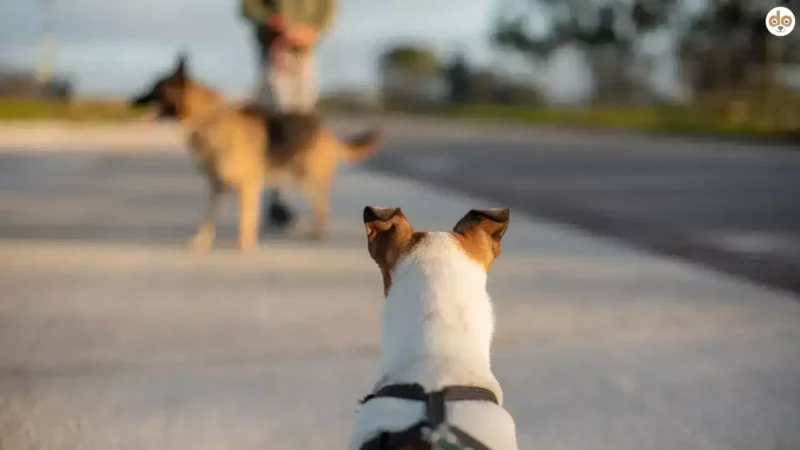
Content
Your stomach knots up when a dog appears at the other end of the street. You know exactly: in ten seconds your dog will start barking, pulling or growling. Leash aggression makes every walk a torment – for you and often for your dog too.
Why does my dog harass other dogs on the leash?
The leash is the main culprit. It takes away your dog’s natural ability to walk away or approach at his own pace.
Fear is the primary factor for many affected dogs. A fearful dog follows a simple logic: “I can’t get away from here – so I must scare the other one off.” Barking becomes a defence strategy.
Frustration follows closely behind. Your dog wants to go to the other dog, but the leash prevents it. The pent-up energy is released in aggressive behaviour.
Inadequate socialisation between the 3rd and 16th week of life can have long-lasting effects. Dogs that had little contact with other dogs during this phase often react insecurely or excessively to conspecifics.
How do I tell if my dog is harassing out of fear or frustration?
Fearful dogs usually show additional stress signals: tucked tail, ears laid back, crouching down. They want to create distance.
Frustrated dogs, on the other hand, pull forward, have erect ears and a high-held tail. They want to go over – but can’t.
This difference determines your training strategy. A fearful dog needs self-confidence, a frustrated one needs impulse control.
What immediate measures help in the acute situation?
Turn around and walk away as soon as you see another dog. Do not fight against your dog’s reaction.
Keep a distance of at least 20 metres from other dogs – more if necessary. Most dogs only react aggressively beyond a certain critical distance.
Reward your dog with high-quality food (cheese, liverwurst) as soon as he notices another dog calmly. Timing is key: reward before the reaction, not after.
How do I train my dog to stop harassing?
Start training with a distance of 30 to 50 metres from a calm dog. Your dog should be able to see the other one, but remain relaxed.
Feed treats continuously as long as the other dog is visible. Stop as soon as he disappears. Your dog learns: Other dogs = good food.
Reduce the distance by only 2 to 3 metres per week. If you go too fast, you will undo weeks of progress.
Train daily for 10 to 15 minutes, but only if your dog stays below his threshold. A single instance of harassing reinforces the unwanted behaviour.
After 4 to 6 weeks, initial improvements should be visible. Allow for 3 to 6 months for stable behaviour.
What am I doing wrong if nothing improves?
You are going too fast. The most common source of error: not enough distance or approaching too quickly.
You are training too rarely or irregularly. Twice a week is not enough – your dog forgets between training sessions.
You are punishing the harassing. Leash jerks or shouting increase fear and worsen the problem.
You only practice with one training partner. Your dog must learn that all dogs are harmless – not just the familiar neighbour’s dog.
When do I need professional help?
Immediately, if your dog has already bitten or seriously attempted to bite. This exceeds the possibilities of self-training.
If there is no improvement after 8 weeks of consistent training. Sometimes medical causes are underlying or the training is fundamentally flawed.
In cases of very strong reactions – for example, if your dog remains agitated for hours after a dog encounter – you need an individual training plan.
How long does it take for my dog to stop barking at other dogs?
3 to 6 months with consistent training. Fearful dogs often need longer than frustrated ones.
Can I still take my dog to a dog training school?
Only in special courses for reactive dogs. Normal puppy groups usually exacerbate the problem.
Do calming aids help with training?
Yes, in severe cases veterinarians can prescribe medication that supports training. On their own, they do not solve the problem.
Will my dog ever interact normally with other dogs?
Most dogs learn to pass others calmly. Friendships with strange dogs develop less frequently.
Can I ignore the problem and just take different routes?
This usually intensifies the reactions. With rare encounters, your dog will react even more intensely.