
When the dog marks: what is behind it and when is it too much?
Marking is canine communication – but not everywhere is it welcome. With clear training, you decide where your dog is allowed to leave its messages.
Content
Your own dog lifts its leg at every second tree, and the question quickly arises as to whether this is still normal or already too much. Marking behaviour is part of a dog’s nature, but not every spot is suitable for it. The line between natural communication and disruptive behaviour is sometimes thin.
Why do dogs mark in the first place?
Marking is dog language. Every drop of urine carries information: sex, age, health status, and even whether a female dog is in heat. Other dogs read these “messages” and leave their own responses.
This has little to do with dominance, a myth that persists stubbornly. Instead, marking works like a noticeboard in the dog park. Who was here? When? How are they doing?
You know the typical marking spots: trees, lampposts, corners and edges. That is where the messages accumulate because the scent lingers longer.
How do I recognise normal marking behaviour?
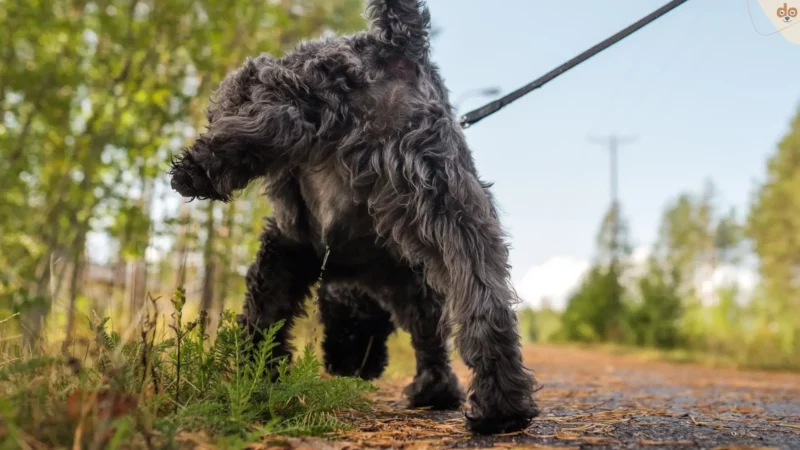
Normal is this: your dog sniffs thoroughly first, then lifts its leg and deposits only a few drops. The body posture is tense and focused. It deliberately selects prominent spots, not just any random patch.
Unlike normal urination, where it squats down relaxed or bends the leg only slightly: when relieving itself, it empties the bladder completely; when marking, it doses carefully.
A healthy male dog marks 3–6 times on a walk. Castrated male dogs and female dogs mark less frequently, but they do so as well.
When does marking become a problem?
It becomes problematic when your dog stops every few metres. Or when it marks in inappropriate places: house walls, other people’s cars, children’s playgrounds. Some dogs even start marking inside the house.
If there are more than 15 attempts to mark per walk, something is going wrong. This points to stress, insecurity or bad habits.
Urine damages facades and metal. The sharp smell disturbs neighbours. As the owner, you are responsible for this.
How do I train controlled marking?
Training works through clear rules: you decide where marking is allowed. You proceed as follows:
Step 1: Determine 2–3 permitted marking spots on your standard route. Park, dog run, specific trees.
Step 2: At all other spots, you keep walking without stopping. If your dog makes a move to mark, you give the command “On” and move briskly forward. No pulling, no scolding, just keep going.
Step 3: At the permitted spots, you say “Go ahead” and consciously give it time to sniff and mark. Praise it for doing so.
Step 4: Introduce the command “Enough” if it overdoes it. After 30 seconds of sniffing, you move on.
This training requires 2–4 weeks of consistency. But it is worth it: your dog can continue to communicate without you getting into conflicts.
What do I do about marking inside the house?
Marking inside the house is almost never normal. This points to stress, illness or territorial behaviour.
Immediate measures: clean thoroughly with an enzymatic cleaner, not with normal cleaning agents. Interrupt the dog when it marks, take it outside and reward it there if it relieves itself.
Investigate causes: Was a strange dog visiting? Were there changes in the household? If marking inside the house recurs, you should consult a dog trainer.
Which mistakes should I avoid?
Scolding achieves nothing; your dog does not understand the connection. Punishing afterwards is also pointless.
Do not let it sniff everywhere where other dogs have marked. This leads to endless stops.
Avoid preventing it from marking when you are at a permitted spot. Communication with conspecifics is a basic need.