
The Dog and Its Super Nose: How the Sense of Smell Works
Dogs smell many times more intensely than humans and can sniff out diseases, moods and time levels. Practical tips on how to properly use your dog’s sense of smell.
Content
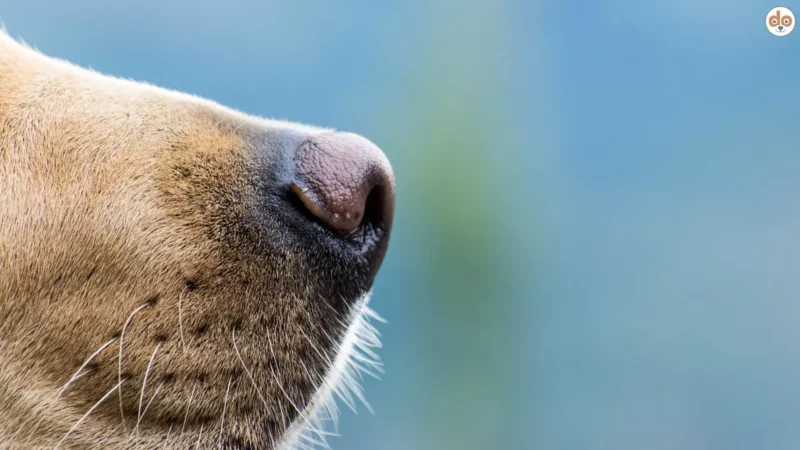
Your dog sniffs at the lamppost and stands there for minutes on end. For him, this is not a waste of time; he is reading a complete news page. The sense of smell is his most important connection to the world and works completely differently from ours.
Why do dogs smell millions of times better than humans?
A dog has 300 million olfactory cells, whereas humans have only 6 million. However, this alone does not yet explain the difference of 1:10,000 in odour intensity.
The olfactory mucosa of your dog covers 130 to 200 cm², whereas yours manages a mere 5 cm². The decisive factor, however, is the olfactory bulb in the brain: in dogs, it accounts for 10% of the brain volume, whereas in humans it is 1%. Your dog can sniff out a teaspoon of sugar in two Olympic swimming pools.
The nasal turbinates, folded bone structures in the nose, direct the air into two streams: one for smelling and one for breathing. Your dog can sniff and breathe normally at the same time. In humans, both mix together.
What does my dog see with his nose that I cannot see?
Your dog smells in layers and time dimensions. He recognises not only that another dog was here, but also when (10 minutes ago or 3 hours ago), what sex, what health status and what mood.
An example from our everyday life: you walk with your dog through the park. He sniffs at a spot and knows immediately: two hours ago, a stressed male dog that had diarrhoea and was not neutered was here. You see only grass.
Humans smell tomato soup. Dogs smell separately: tomatoes, onions, salt, pepper, the metal of the pot and that the tomatoes were harvested three days ago. For them, smelling is like HD television for us.
Can dogs really sniff out diseases?
Yes, and more precisely than some laboratory devices. Diabetic alert dogs recognise hyper- or hypoglycaemia 15–20 minutes before measuring devices register it. They smell the ketone bodies in the breath that arise during blood sugar fluctuations.
Dogs can sniff out cancer; they react to volatile organic compounds (VOCs) released by tumour cells. However, how well this succeeds varies considerably: individual small studies reported hit rates of over 90 percent, others barely exceeded the level of chance, and the most spectacular values could not be replicated later. Research has progressed furthest with lung cancer. At the Penn Vet Working Dog Center in Pennsylvania, work is also being done on ovarian cancer, but so far without a reliable hit rate from blood samples. A diagnostic procedure based on the cancer-sniffing nose therefore does not exist to this day.
COVID-19 detection dogs at Helsinki Airport achieved 98% accuracy with asymptomatic individuals. They smell the metabolic changes triggered by the virus, not the virus itself.
How do I use my dog’s sense of smell in everyday life?
Sniffing games mentally exhaust your dog more than an hour of running. Hide treats in the flat or let him sniff out his food instead of eating it from the bowl.
On walks: let your dog sniff at least every 50 metres. These “sniffing breaks” are like reading the newspaper for you. A 20-minute walk with sniffing stops is equivalent to an hour of continuous walking.
Warning: never hold his muzzle or say “no” when your dog is sniffing (unless he is eating something dangerous). You would thereby deprive him of his most important source of information.
Why does my dog constantly sniff other dogs?
The anal area of other dogs is their business card. Scent glands are located there, transmitting individual information. Your dog learns more about the other dog in 3 seconds than you do in a 10-minute conversation with the owner.
This “greeting sniffing” is normal and important. Interrupt it only if one of the dogs appears visibly stressed. Most dog conflicts arise because owners intervene too early and disrupt natural communication.
Can all dog breeds smell equally well?
No. Bloodhounds have the best nose; their olfactory mucosa is twice as large as that of a German Shepherd. Pugs and other short-muzzled breeds smell worse because their nasal cavity is shortened.
Does my dog lose his sense of smell with age?
To some extent. From the age of 8, olfactory performance declines, but never completely. Older dogs compensate for this through experience; they already know where the interesting smells are.
Why does my dog sniff at my breath?
He checks your health and mood. Dogs smell stress hormones, what you have eaten and whether you are becoming ill. Some owners report that their dog became restless before they themselves noticed that they had caught a cold.
Can I train my dog’s nose?
Yes, through nose work. Start with simple search games: hide treats under cups. Gradually increase the difficulty. Professional mantrailing or target object search are ideal dog sports for dogs with an intense sense of smell.
Why does my dog smell more intensely after rain?
Moisture intensifies smells. The scent molecules dissolve better and reach the olfactory mucosa more effectively. This is why detection dogs are more successful in damp weather than in dry conditions.