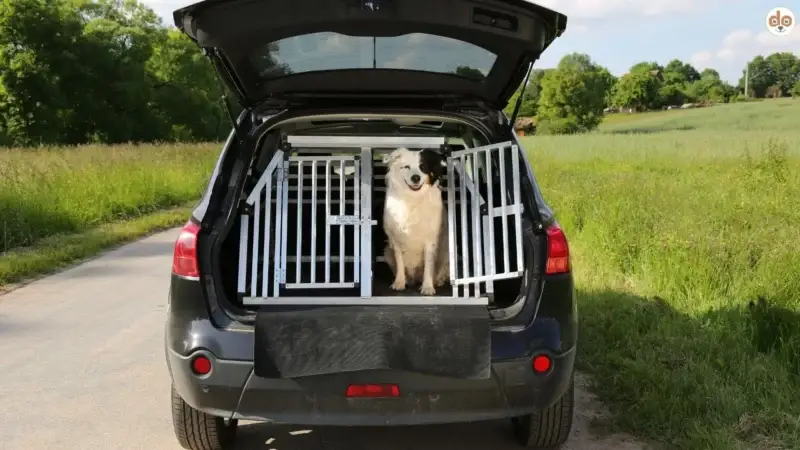
Crossing borders with a dog: All entry requirements for the most popular travel destinations

In short
France generally prohibits entry for Pitbull types of Category 1, even for mere transit through the country.
Content
- Crossing borders with a dog: Country overview of regulations
- Entry requirements when crossing the border into France
- Entry requirements when crossing the border into Italy
- Entry requirements when crossing the border into the Netherlands
- Entry requirements when crossing the border into Spain
- Entry requirements when crossing the border into Portugal
- Tapeworm treatment: four destinations with an additional deadline
Reviewed on August 17, 2025Responsible editor: Roger Klein
A missing stamp in the pet passport or a rabies vaccination not carried out in time can prevent entry. This article lists the most important regulations for crossing borders with a dog to popular EU travel countries: required documents, vaccinations, microchip requirement, breed bans, entry bans for cropped dogs, as well as leash and muzzle requirements.
Crossing borders with a dog: Country overview of regulations
| Country | Required documents & vaccinations | Microchip | Breed/type bans | Leash/muzzle requirement | Cropped dogs |
|---|---|---|---|---|---|
| France | EU pet passport, rabies vaccination no earlier than 12 weeks and at least 21 days before entry, entry therefore possible no earlier than 15 weeks of age | Mandatory | Category 1 (Pitbull types, Tosa, Mastiff without pedigree) banned; Category 2 only with restrictions | No general requirement; possible in municipalities/public transport; mandatory at all times for Category 1/2 | No entry ban; cropping banned within the country |
| Italy | EU pet passport, rabies vaccination no earlier than 12 weeks and at least 21 days before entry, entry therefore possible no earlier than 15 weeks of age | Mandatory | No breed lists; individual registers for aggressive dogs, licence required for special cases | Leash requirement everywhere; carry a muzzle, required on public transport or in crowds | No entry ban; cropping banned within the country |
| Netherlands | EU pet passport, rabies vaccination no earlier than 12 weeks and at least 21 days before entry, entry therefore possible no earlier than 15 weeks of age | Mandatory | No import bans or breed lists | No nationwide requirement; possible regionally | No entry ban; cropping banned within the country |
| Spain | EU pet passport, rabies vaccination no earlier than 12 weeks and at least 21 days before entry, entry therefore possible no earlier than 15 weeks of age | Mandatory | All breeds allowed to enter; potentially dangerous dogs require a licence and registration | Leash requirement in public; muzzle requirement for dangerous dogs and on public transport | No entry ban; cropping partially banned within the country |
| Portugal | EU pet passport, rabies vaccination no earlier than 12 weeks and at least 21 days before entry, entry therefore possible no earlier than 15 weeks of age | Mandatory | All breeds allowed to enter; potentially dangerous dogs require a licence and registration | Leash requirement in public; muzzle requirement for dangerous dogs and on public transport | No entry ban; cropping partially banned within the country |
Puppy exception: Individual EU states may allow the entry of younger dogs that are not yet immunised. This never applies automatically; the destination country must have actively opened up the exception, and its conditions must be met. Anyone wishing to travel with a dog under 15 weeks old should clarify this with the destination country beforehand.
Entry requirements when crossing the border into France
Documents and vaccinations
- EU/CH pet passport (issued by an authorised vet)
- Microchip (alternatively a clearly legible tattoo, but only if applied before 3 July 2011)
- Proof of valid rabies vaccination
Breed and type bans
- Category 1 (“chiens d’attaque”), entry generally prohibited, even for mere transit through France. (This category includes e.g. Pitbull and Mastiff types)
- Category 2 (“chiens de garde et de défense”): Require an owner permit and a temperament test for border crossing. Since the permit is only issued by the municipality of residence within France, this is not feasible for travellers without a French address.
Muzzle/leash requirement
- No general requirement for “normal” dogs
- Mandatory leash and muzzle in public for dogs of Categories 1 & 2 (see above)
- Public transport: Large dogs on a lead and muzzled, smaller dogs in a transport box or carrier
Special features
- Max. 5 pets per person (non-commercial)
- No entry ban for cropped dogs, although ear cropping is banned within France
Entry requirements when crossing the border into Italy
Documents and vaccinations
- EU pet passport
- Microchip (alternatively a clearly legible tattoo, but only if applied before 3 July 2011)
- Proof of valid rabies vaccination
Breed and type bans
Italy had a “breed list” until 2009. Since it was abolished, entry is permitted for all dog breeds.
Muzzle/leash requirement
- General leash requirement (i.e. everywhere, regardless of whether in the city or in the forest)
- Leash may be a maximum of 1.5 metres long
- A muzzle must generally be carried, even if it does not need to be fitted
Special features
- Max. 5 pets per person (non-commercial)
- Docked dogs are not banned from entering, although docking itself is partly prohibited within Italy
Entry requirements when crossing the border into the Netherlands
Papers and vaccinations
- EU pet passport
- Microchip (alternatively a clearly legible tattoo, but only if applied before 3 July 2011)
- Proof of valid rabies vaccination
Breed and type bans
The Netherlands has neither breed lists nor entry bans for specific dog breeds.
Muzzle/leash requirement
There are no nationwide leash or muzzle requirements. Such rules vary locally, e.g. in parks, within cities or on camp sites.
Special features
- Max. 5 pets per person (non-commercial)
- Docking is generally prohibited in the Netherlands, but this only applies to the procedure within the country and not to entry.
Entry requirements when crossing the border into Spain
Papers and vaccinations
- EU pet passport
- Microchip, ISO-compliant, 15-digit (alternatively a clearly legible tattoo, but only if applied before 3 July 2011)
- Proof of valid rabies vaccination
Breed and type bans
No import bans or breed lists in Spain. Every dog breed may enter.
Muzzle/leash requirement
- Leash requirement in public areas, particularly in cities and on public transport
- Muzzle requirement for dogs classified as dangerous, as well as on certain public transport
Special features
- Max. 5 pets per person (non-commercial)
- Additional requirements apply for travel with more than 5 animals, including a health certificate and a written declaration that you are not entering the country with the animals for commercial purposes.
Entry requirements when crossing the border into Portugal
Papers and vaccinations
- EU pet passport
- Microchip, ISO-compliant, 15-digit (alternatively a clearly legible tattoo, but only if applied before 3 July 2011)
- Proof of valid rabies vaccination
Breed and type bans
No import bans or breed lists in Portugal. Every dog breed may enter.
Muzzle/leash requirement
- Leash requirement in public areas, particularly in cities and on public transport
- Muzzle requirement for dogs classified as dangerous, as well as on certain public transport
Special features
- Max. 5 pets per person (non-commercial)
- Additional requirements apply for travel with more than 5 animals, including a health certificate and a written declaration that you are not entering the country with the animals for commercial purposes.
Tapeworm treatment: four destinations with an additional deadline
France, Italy, the Netherlands, Spain and Portugal do not require treatment against the fox tapeworm. Four other destinations do: Malta, Ireland, Finland and Northern Ireland are considered free of Echinococcus multilocularis. Anyone travelling there must have their dog treated by a vet, no earlier than 120 hours and no later than 24 hours before entry. The vet records the treatment in the pet passport. Only approved products containing praziquantel or an equally effective substance are effective. The basis is Art. 8 lit. b of Delegated Regulation (EU) 2026/131, and for travel from Switzerland Art. 14 lit. d. The Norwegian Food Safety Authority Mattilsynet requires the same treatment within the same time window.
If your dog comes directly from one of these four areas, the treatment is not required. And anyone who crosses the border regularly can switch to a continuous schedule: twice at an interval of 24 hours to 28 days, then every 28 days. The destination country must however have made this option available and publicly announced it.
If you arrive over several days, a treatment at home is not sufficient; you then need an appointment with a vet while on the road.