Airlines that allow dogs: Your dog can fly in the passenger cabin with these airlines
In short
Small dogs up to 8 kg can travel in the cabin with airlines such as Lufthansa, Air France and Eurowings for €40-175 in soft IATA-compliant transport crates measuring up to 55x40x23cm.
Content
- Why dogs should travel in the cabin rather than in the cargo hold
- Overview: Airlines allowing dogs in the cabin, conditions and costs
- Further requirements for dogs in the cabin
- Frequently asked questions
- Which airlines allow dogs in the cabin?
- Can my large dog fly in the cabin?
- What do I need to bring for flying with a dog?
- Why is the cabin better than the cargo hold for small dogs?
10 sourcesReviewed on April 22, 2025Responsible editor: Roger Klein
In short: Small dogs weighing up to approx. 8 kg (including transport crate) are allowed to travel in the cabin with several airlines such as Lufthansa, Air France, Austrian Airlines, Eurowings and Condor. Larger dogs are not permitted in the cabin, unless they are certified assistance dogs.
The most important points in brief
- The weight limit is 8 kg including the transport crate for most airlines.
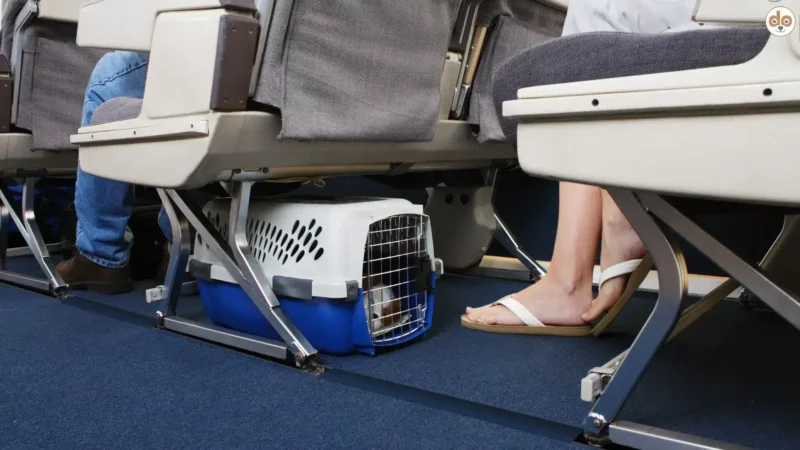
- The transport crate must fit under the front seat, be IATA-compliant, waterproof and bite-proof.
- Dogs usually need to be registered 48 to 72 hours before departure.
- Brachycephalic breeds such as Pugs or French Bulldogs are banned by Condor, while Lufthansa only permits them in the cabin.
- Countries such as the USA or the UK have additional entry requirements that go beyond airline rules.
If you want to go further afield for your holiday and still want to have your dog with you, the question arises: Which airlines allow dogs in the cabin? We show you a selection of the best-known airlines where the dog is allowed to travel in the passenger area and does not have to go into the cargo hold.
Why dogs should travel in the cabin rather than in the cargo hold
Travelling with your dog in the cabin has clear advantages over the cargo hold. While airlines promote transport in the cargo hold as “safe” and “comfortable”, reality often looks different. For small dogs, the cabin is the better choice.
Less noise and environmental stress: The cargo hold is noisy. Engine noises, vibrations and the drone of the aircraft are extremely stressful for dogs with sensitive hearing. In addition, there are noises from luggage or other animals. In the cabin, the noise level is more constant and less threatening, as your dog is in a familiar transport box and close to you.
Temperature concerns in the cargo hold: The temperature control in the cargo hold is not always reliable. Especially during loading and unloading or in the event of delays on the tarmac, extreme temperatures can occur. Dogs that are sensitive to temperature fluctuations, short-nosed breeds, older animals – are particularly at risk here. In the cabin, the same air-conditioned conditions prevail as for passengers.
Lower risk of injury or loss: In the cargo hold, there is a higher risk that transport boxes will be handled roughly, for example during loading or in turbulence. There are isolated reports of damaged boxes or even escaped animals. In the cabin, the transport box remains under your supervision, which minimises the risk.
Better control and safety: In the cabin, you can respond directly to your dog’s needs. Whether it is a calming word, a quick check of the transport box or offering water, you have the opportunity to observe your dog and intervene if they feel unwell. This is not possible in the cargo hold. The staff has no access to the cargo hold during the flight. Problems such as technical faults or insufficient ventilation can go unnoticed. Reports from dog owners suggest that animals sometimes arrive dehydrated or highly stressed after cargo transport.
Overview: Airlines allowing dogs in the cabin, conditions and costs
Here are the main airlines that allow dogs in the cabin, along with their conditions for transport and ticket prices (as of 2025).
Lufthansa
Your dog may weigh a maximum of 8 kg, including the carrier. The carrier itself must not exceed 55 x 40 x 23 cm, must be soft-sided and IATA-compliant. Costs range from €50–80 for European flights and €80–110 for long-haul flights. You must register your dog at least 72 hours before departure.
A special feature: brachycephalic breeds such as Pugs, French Bulldogs or English Bulldogs may not be transported in the cargo hold due to their physical characteristics; they travel exclusively in the cabin. Assistance dogs fly free of charge.
Link: Lufthansa – Transport of animals on aircraft
Air Europa
Here, the weight limit is 8 kg for the dog and 10 kg including the carrier. The transport carrier may measure a maximum of 40 x 30 x 30 cm, must be soft-sided and certified. Costs vary between €35 and €175 depending on the route. Early registration is required.
Air Europa allows up to 3 dogs per carrier if they belong to the same species and are under 6 months old. Pets are not permitted on flights to Great Britain.
Link: AirEuropa – Travelling with pets
Air France
The weight limit is a maximum of 8 kg including the carrier. The transport carrier may be at most 46 x 28 x 24 cm, must be soft-sided and IATA-compliant. Prices are tiered: €40 within France, €55 for European flights, €125 on long-haul routes. You must register your dog at least 48 hours before departure.
Dogs must be at least 3 months old. Pets are not allowed in Business Class on long-haul flights.
Austrian Airlines
Here too, the rule applies: a maximum of 8 kg including the transport carrier, which must not exceed 55 x 40 x 23 cm. The carrier must be soft-sided. Costs are €50 within Austria, €60 for Europe, and €80–110 for long-haul flights. You can register online or via the service centre.
As seats are limited, you should book early.
Discover Airlines
The weight limit is 8 kg including the carrier, which may measure a maximum of 55 x 40 x 23 cm. Costs are €60 for European flights and €100 for transatlantic routes. Registration takes place via the service centre; a checklist is reviewed during check-in.
Link: discover airlines – Carrying dogs and cats
Eurowings
A maximum of 8 kg including the carrier, which must be at most 55 x 40 x 23 cm and soft-sided. Costs start at €60, depending on the route. You can register during booking or via the call centre.
Eurowings only operates short- and medium-haul routes. Pets are not permitted on flights to Great Britain or Dubai.
Link: Eurowings – Travelling with animals
Condor
Here you may take up to 8 kg including the transport carrier, which must not exceed 55 x 40 x 20 cm. Costs start at €59.99, depending on the route. Registration is required at the time of booking.
Note: brachycephalic breeds are prohibited by Condor.
Link: condor – Animal transport
Further requirements for dogs in the cabin
In addition to the conditions mentioned for each airline, you must meet the following requirements:
- Documents: EU pet passport, microchip, rabies vaccination (min. 21 days old). Additional health certificates are often required for non-EU countries.
- Transport crate: Must fit under the front seat, be waterproof, bite-proof and IATA-compliant.
- Age: Dogs must be at least 8–15 weeks old (depending on the airline).
- Destination country regulations: Countries such as the USA (strict CDC rules since August 2024) or the UK have special entry requirements.
- Behaviour: Dogs are not allowed out of the crate during the flight so as not to disturb other passengers.
Are there also airlines that allow larger dogs in the passenger cabin?
The answer is disheartening: there are currently no commercial airlines that allow larger dogs (over 8–10 kg) outside of a transport carrier in the passenger cabin, with the exception of assistance dogs such as guide dogs or companion dogs.
Airlines have strict safety regulations stipulating that pets must be secured during the flight to ensure both passenger and animal safety. A transport carrier that fits under the seat (typically max. 55 x 40 x 23 cm) is the standard solution for small dogs up to 8–10 kg. Larger dogs would require more space, which is problematic in the confined cabin. Loose dogs could also cause issues during turbulence, stress reactions, or conflicts with other passengers.
The International Air Transport Association (IATA) sets standards for animal transport adopted by most airlines. These standards require a closed transport carrier for dogs in the cabin to minimise risks such as biting, soiling or disturbances.
Special services or charter flights as an alternative for large dogs
Since commercial airlines do not allow larger dogs without a transport carrier in the cabin (except assistance dogs), here are some alternatives that may enable a less stressful journey for larger dogs.
A few providers, such as Woof Airlines, a specialised pet transport service, collaborate with selected airlines like Lufthansa, Air France or United Airlines and offer accompanied transports. In this case, dogs travel either in the cabin (if they meet the weight limit) or in the cargo hold, but always with a handler on the same flight. The handler service does not refer to access to the dog during the flight, but to care before, after and between flights.
Private charter flights can be a solution, as they have more flexible rules. With private jets, you can often make individual arrangements, so that larger dogs are allowed to travel without a crate, provided they are leashed and controllable. However, this is very expensive, costing thousands to tens of thousands per flight, and impractical for most dog owners. Companies such as NetJets or VistaJet offer pet transport services.
Frequently asked questions
Which airlines allow dogs in the cabin?
Among others, Lufthansa, Air Europa, Air France, Austrian Airlines, Discover Airlines, Eurowings and Condor allow dogs in the cabin, each with a weight limit of approx. 8 kg including the crate.
Can my large dog fly in the cabin?
No. There are no commercial airlines that allow larger dogs over 8 to 10 kg outside a transport crate in the passenger cabin. Exceptions only apply for certified assistance dogs such as guide dogs or companion dogs.
What do I need to bring for flying with a dog?
You need an EU pet passport, proof of microchipping and a rabies vaccination that is at least 21 days old. Additional health certificates are often required for non-EU countries.
Why is the cabin better than the cargo hold for small dogs?
In the cabin, the noise level is lower, the temperature is reliably air-conditioned and you can react directly to your dog. In the cargo hold, the risk due to temperature extremes, rough handling and lack of supervision is significantly higher.