
Small and Large Blood Tests in Dogs: Understanding the Values
Small vs. large blood test in dogs: Which values are measured, what do they mean and when is which examination sensible?
Content
Your vet suggests a blood test – and you look at them and think: okay, and what exactly is that supposed to show? I know that feeling. A blood test is basically a look under the bonnet of your dog. The values reveal how well the organs are currently doing their job – and where something is brewing that does not yet have visible symptoms. The problem: there is often quite a gap between the numbers on the printout and what they really mean.
What does a small blood test show in dogs?
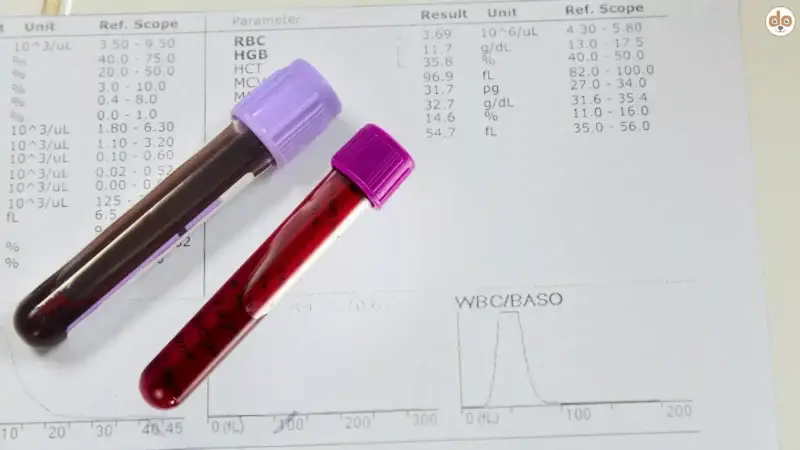
The small blood test focuses exclusively on blood cells. How many red and white ones are swimming around right now – and what condition are they in? Sounds simple. But it is not always.
The most important parameters:
| Parameter | Meaning | Value too low | Value too high |
|---|---|---|---|
| Erythrocytes (RBC) | Red blood cells – transport oxygen | Anaemia, blood loss | Dehydration, stress |
| Hemoglobin (Hb) | Red blood pigment – binds oxygen | Anaemia, iron deficiency | Fluid loss |
| Hematocrit (Hct) | Proportion of solid blood components | Anaemia, severe blood loss | Dehydration |
| Leukocytes (WBC) | White blood cells – immune defence | Viral infections | Bacterial infections, inflammation |
| Thrombocytes (PLT) | Platelets – blood clotting | Clotting disorder | Inflammatory reaction |
Imagine this: the dog comes home from summer looking exhausted, had a tick bite two weeks ago, and is now just dragging itself through the living room. A basic blood count shows red blood cells at rock bottom – this could indicate a tick-borne disease. The basic blood count provides initial clues. It doesn’t tell the whole story yet.
When does my dog need a comprehensive blood test?
The comprehensive blood test goes one step further – out of the cellular world and into the serum. Enzymes, metabolic products, electrolytes. Everything that shows how the liver, kidneys, and others really function in everyday life.
Additional parameters in the comprehensive blood test:
| Parameter | Meaning | Value too low | Value too high |
|---|---|---|---|
| ALT (GPT) | Liver enzyme – indicates liver cell damage | Rarely relevant | Liver damage, medications |
| Creatinine | Kidney function value | Muscle breakdown | Kidney failure |
| Urea (BUN) | Breakdown product – indicates kidney function | Liver disorder | Kidney problems, dehydration |
| Glucose | Blood sugar | Hypoglycaemia | Diabetes, stress |
| Potassium (K) | Heart and muscle function | Vomiting, diarrhoea | Kidney problems |
As soon as your dog shows non-specific signs – drinking more than usual, barely eating, losing weight without an apparent reason – a comprehensive blood test makes sense. Likewise before operations: the liver and kidneys must be able to withstand anaesthesia. Knowing how they are beforehand is not excessive caution.
How do I interpret blood values correctly?
Here is a sentence you should really remember: A single outlier is rarely dramatic. What matters is the overall picture – and what else is going on at the moment.
Let’s take liver values. ALT can be elevated due to medications, stress, or actual liver damage. It only becomes serious when several values go out of control simultaneously – ALT plus AST plus bilirubin. An experienced vet also looks at behaviour here: Is the dog eating? Is it alert? These are not secondary questions.
With kidney values, it is similar, but with one important particularity: creatinine only rises when around 75% of kidney function has already been lost. Urea reacts earlier, but can also be elevated due to stress or dehydration – without the kidney being the problem. The newer SDMA value detects kidney problems significantly earlier, but it is not included in every standard blood test. It is worth asking specifically for it.
My advice: Have the values explained to you by your vet and resist the urge afterwards to double-check everything with Dr Google. Blood values fluctuate depending on time of day, stress, and breed. Your vet knows these factors – and can put the numbers into a context that no search result provides.
How much does a blood test cost in Germany, Austria, and Switzerland?
The costs vary depending on the country, practice, and scope of the examination. As a rough guide:
Germany (GOT schedules):
- Basic blood count: 25–45 Euro
- Comprehensive blood test: 60–120 Euro
- Blood draw: 8–15 Euro
Austria:
- Basic blood count: 30–50 Euro
- Comprehensive blood test: 70–130 Euro
- Blood draw: 10–18 Euro
Switzerland:
- Basic blood count: 45–75 CHF
- Comprehensive blood test: 90–150 CHF
- Blood draw: 20–35 CHF
Consultation fees usually apply in addition. Feel free to ask for a cost estimate beforehand – especially if special parameters such as SDMA or thyroid values are to be included. No reputable vet will hold it against you.
Should I have blood tests done regularly?
For a healthy dog under seven years old, an annual blood test is usually not necessary. However, this changes – and more significantly than many think:
- Dogs over eight years: semi-annual or annual checks are sensible
- Chronic diseases: every 3–6 months depending on the condition
- Long-term medication: some active ingredients place a permanent strain on the liver or kidneys
- Before operations: practically mandatory, especially for older dogs
There is another argument for occasional checks that is often overlooked: blood values are very individual. Those who know what their dog’s normal values look like will notice earlier if something deviates from the pattern. A creatinine value of 1.2 can be completely unremarkable in one dog – in another, it is already at the limit.
When should I have a blood test done immediately?
Some symptoms allow no delay – not even until the next available appointment:
- Sudden weakness or collapse
- Significantly increased drinking and urination over several days
- Yellowing of gums or whites of the eyes
- Persistent loss of appetite – more than two days
- Vomiting with blood
Can I monitor my dog’s blood values myself?
Short answer: No. Blood draws and laboratory analysis belong in professional hands; there is no way around that. What you can observe yourself – and which says surprisingly much – is drinking behaviour, appetite, urine colour, and volume. These everyday parameters are often more informative than a single blood value.
Guideline: A healthy dog drinks approximately 50–100 ml per kilogram of body weight per day. If your 20-kilo dog suddenly guzzles three litres, something is wrong – even if all blood values still look normal on paper.
Are the reference values the same for all dogs?
No – and this is a point that is often underestimated. Puppies have different normal values than adult dogs. Sighthounds have genetically lower platelet counts. And different laboratories partly work with different reference ranges.
That is why you should always have the values interpreted by someone who knows the laboratory and can assess your dog breed. A value outside the reference range does not automatically mean illness – but it is also no reason to ignore it.